





LiPo Battery Voltage Tester Guide
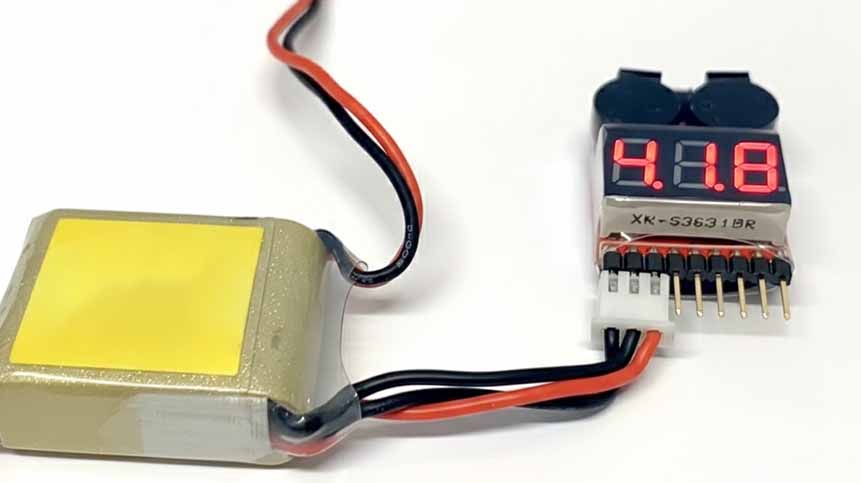
LiPo Battery Voltage Tester – What It Is, Why It Matters, and How to Use It Correctly
As a lithium battery engineer working closely with lithium polymer (LiPo) cells for consumer electronics, medical devices, RC applications, and industrial equipment, I can say this clearly:
Incorrect voltage monitoring is one of the most common causes of:
-
Premature LiPo battery failure
-
Swelling and internal gas generation
-
Over-discharge damage
-
Fire and thermal runaway risks
Incorrect voltage monitoring is one of the most common causes of premature battery failure, swelling, over-discharge damage, and even thermal runaway. In this guide, I explain how LiPo battery voltage testers work, why voltage accuracy matters, and how to select the right tester for your application.
What Is a LiPo Battery Voltage Tester?
A LiPo battery voltage tester is a device used to measure:
-
Total pack voltage
-
Individual cell voltage
-
Cell balance consistency
-
State of charge (SoC)
Unlike simple multimeters, LiPo voltage testers are specifically designed to read multi-cell lithium polymer battery packs through balance connectors (JST-XH, EH, etc.).
Why LiPo Batteries Require Dedicated Voltage Testers
- Operate within narrow voltage windows
- Are extremely sensitive to overcharge and over-discharge
- Can become unsafe if a single cell drifts out of balance
A standard multimeter cannot easily detect individual cell imbalance, which is where most failures begin.
Standard Voltage Ranges of LiPo Batteries
Understanding correct voltage ranges is critical before using any tester.
| Battery State | Voltage per Cell (V) | Risk Level |
|---|---|---|
| Fully Charged | 4.20 | Normal |
| Storage Voltage | 3.80 – 3.85 | Optimal |
| Nominal Voltage | 3.70 | Normal |
| Low Voltage Warning | 3.30 – 3.40 | Caution |
| Over-Discharge | < 3.00 | Damage Risk |
Industry Reference: IEC 62133, UL 1642, UN38.3 testing data.
How a LiPo Battery Voltage Tester Works
Measurement Principles
A LiPo voltage tester works by:
-
Connecting to the balance port
-
Measuring each cell’s voltage individually
-
Calculating:
-
Total voltage
-
Cell deviation (ΔV)
-
Voltage stability
-
Why Cell-Level Measurement Matters
A 3S LiPo pack may show 11.1V total, yet one cell could already be:
-
At 3.0V (damaged)
-
While others remain at 4.0V
This imbalance cannot be detected without a cell voltage tester.
Types of LiPo Battery Voltage Testers
Basic LED / LCD Voltage Checkers
Best for: RC hobbyists, drone users |
Smart Digital LiPo Voltage Testers
Best for: Professional maintenance, battery labs |
Integrated BMS-Based Voltage Monitoring
Best for: Medical devices, industrial batteries |
Why Voltage Testing Is Critical for LiPo Battery Safety
Preventing Over-Discharge DamageOver-discharging below 3.0V per cell causes:
Once this occurs, no charger can recover the battery safely. |
Early Detection of Swelling and FailureVoltage imbalance is often the first measurable symptom before:
This is why we always test voltage before physical inspection. |
Voltage Imbalance – Real Data Example
Cell Imbalance Thresholds
| Cell Deviation | Condition |
|---|---|
| ≤ 0.03V | Excellent |
| 0.04–0.07V | Acceptable |
| 0.08–0.10V | Warning |
| > 0.10V | Replace Battery |
Professional battery manufacturers generally reject packs exceeding 0.1V imbalance during aging tests.
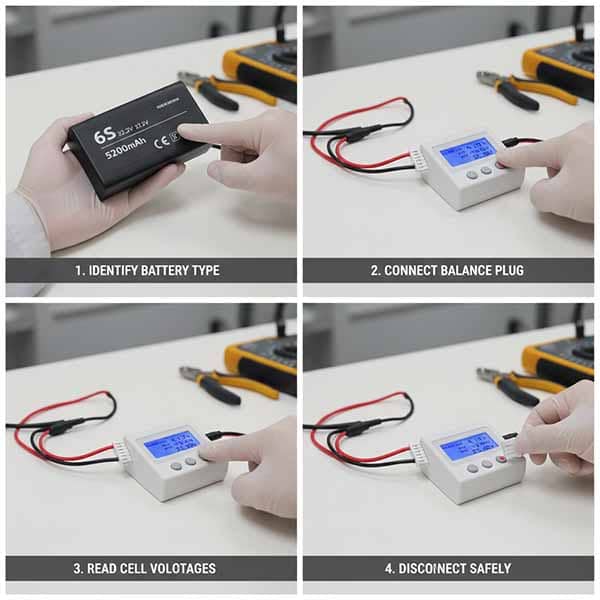
How to Use a LiPo Battery Voltage Tester (Step-by-Step)
Step 1 – Identify Battery ConfigurationExamples:
|
Step 2 – Connect to Balance Port CorrectlyAlways:
|
Step 3 – Interpret Results ProfessionallyDo not only look at: Instead evaluate: |
LiPo Voltage Tester vs Multimeter
| Feature | LiPo Voltage Tester | Multimeter |
|---|---|---|
| Cell-level reading | Yes | No |
| Balance analysis | Yes | No |
| Alarm function | Yes | No |
| Ease of use | High | Medium |
| Safety | High | Low |
Selecting the Right LiPo Battery Voltage Tester
Key Selection Criteria
-
Voltage accuracy (≤ ±0.02V)
-
Cell count compatibility
-
Alarm customization
-
Connector compatibility
-
Build quality
For B2B or industrial use, I always recommend calibrated digital testers over hobby-grade devices.
Applications of LiPo Battery Voltage Testers
-
RC cars & drones
-
Medical equipment batteries
-
Wearable electronics
-
Backup power systems
-
Custom lithium battery packs
LiPo Battery Voltage Testing in Manufacturing (Professional Insight)
In our production lines, voltage testing is performed at:
-
Post-assembly
-
Aging test
-
Final inspection
-
Pre-shipment QA
Voltage testers here are calibrated instruments, not consumer devices.
Common Mistakes When Testing LiPo Voltage
-
Ignoring cell imbalance
-
Measuring immediately after heavy load
-
Testing without temperature stabilization
-
Using damaged balance connectors
FAQ – LiPo Battery Voltage Tester
What is the safe voltage range for a LiPo battery?
Safe operation is between 3.0V and 4.2V per cell. Storage voltage should be around 3.8V.
Can I use a multimeter instead?
A multimeter cannot detect individual cell imbalance, which is critical for safety.
How often should I test LiPo battery voltage?
Before use, after heavy discharge, and before long-term storage.
References
Final Professional Takeaway
From an engineering and safety standpoint, a LiPo battery voltage tester is one of the most cost-effective tools to prevent battery failure and safety incidents.
Whether you are:
-
An RC user
-
A device manufacturer
-
Or sourcing custom LiPo battery packs
Accurate voltage monitoring is non-negotiable.
If you need custom lithium polymer batteries with integrated voltage protection and testing, feel free to explore our solutions or contact our engineering team.
-

 May.2026.09.17Meet A&S Power at KES 2026 in Seoul – Custom Lithium Battery SolutionsLearn More
 -
 May.2026.09.16How to Choose a Custom Lithium Battery Manufacturer in China: A Buyer's GuideLearn More
 -
 May.2026.09.15Can VHR-4N Connectors Work With 14 AWG Battery Wires?Learn More
 -
 May.2026.09.14Who Pays UL Battery Certification Maintenance Fees?Learn More
 -
 May.2026.09.11PTC vs PCM: Why Use Both in Lithium Battery Protection?Learn More