




Lithium-Ion Batteries: The Six Constraints Blocking the Path to Perfection
Introduction: Why “Perfect” Batteries Don’t Exist
As a lithium battery manufacturer working with medical devices, drones, EV systems, and industrial electronics, I’m often asked:
“Why can’t we have a battery that is ultra-light, ultra-safe, ultra-fast charging, extremely long-lasting, low cost, and works in all temperatures?”
The short answer: physics and electrochemistry don’t allow it.
Lithium-ion batteries are not single-parameter products. They are multi-variable constrained systems governed by material science, thermodynamics, ion transport kinetics, and cost economics.
In this article, I will explain:
-
The six fundamental constraints
-
Why trade-offs are unavoidable
-
What data says about real performance ceilings
-
How engineers can make optimal compromises
This guide is written for engineers, sourcing managers, and OEM decision makers.
I. Application Scenarios Driven by Extreme Performance
Many industries push one performance metric to the extreme—while ignoring the consequences.
1. Ultra-Long Endurance: Energy Density Ceiling
The Vision
-
Smartphone lasting one week
-
Electric aircraft matching fuel planes
-
EV range exceeding 1000 km
The Reality: Energy Density Has a Material Limit
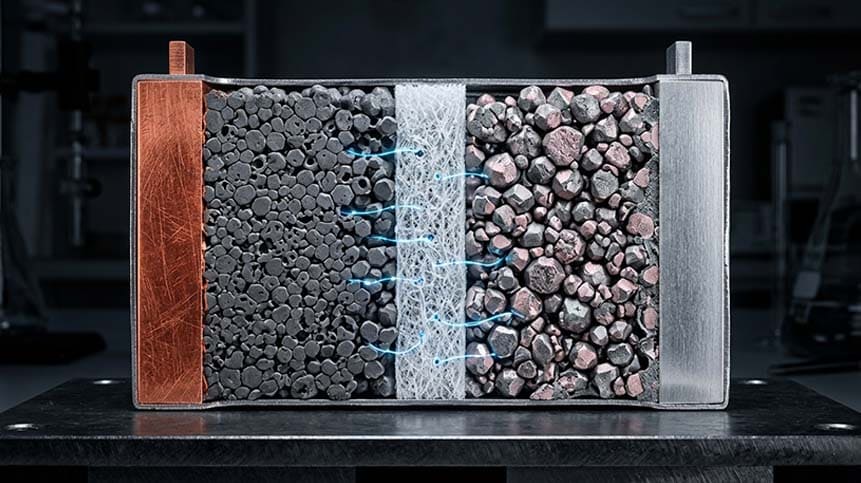
Current commercial lithium-ion batteries:
|
Chemistry
|
Gravimetric Energy Density (Wh/kg)
|
Notes
|
|---|---|---|
|
LFP
|
150–190
|
High safety, lower energy
|
|
NMC 622
|
200–250
|
Balanced
|
|
NMC 811
|
250–300
|
Higher nickel, higher risk
|
|
Lab-level Li-metal
|
350–450 (prototype)
|
Not mass commercialized
|
Key Fact:
Commercial cells today typically top out at ~300 Wh/kg.
Why?
Because:
-
Cathode potential window is limited
-
Graphite anode theoretical capacity ≈ 372 mAh/g
-
Electrochemical stability window of liquid electrolyte ≈ 4.3V
Pushing beyond this requires:
-
Lithium metal anodes
-
Solid-state electrolytes
But both suffer from:
-
Lithium dendrite formation
-
Interface instability
-
Manufacturing scalability challenges
The Energy Density vs Safety Paradox
High-nickel NMC increases capacity.
However:
-
Higher nickel lowers thermal stability
-
Decomposition temperature drops
-
Oxygen release risk increases
When thermal runaway occurs in 300+ Wh/kg cells, heat release is significantly higher than lower-density systems.
Conclusion:
Maximum energy density inherently reduces safety margin.
2. Ultra-Fast Charging: The Lithium Plating Problem
The Vision
3–5 minute charging for EVs.
The Electrochemical Constraint
During charging:
Lithium ions move from cathode → anode (graphite).
If current is too high:
-
Ions cannot intercalate fast enough
-
Metallic lithium deposits on surface
-
This is called lithium plating
Lithium plating causes:
-
Capacity loss
-
Internal short circuits
-
Dendrite growth
-
Thermal runaway risk
Thermal Management Trade-Off
Fast charging generates significant heat.
To manage this:
-
Liquid cooling plates
-
Thermal interface materials
-
Structural reinforcements
But cooling systems:
-
Add weight
-
Add volume
-
Reduce overall pack energy density
So the equation becomes:
Fast charging + Lightweight pack = physically conflicting goals
3. All-Climate Operation: Temperature Window Limits
Most lithium-ion systems operate optimally between:
0°C to 45°C
Low Temperature (-40°C)
-
Electrolyte viscosity increases
-
Ionic conductivity drops sharply
-
Lithium plating risk increases
-
Power output decreases 30–60%
High Temperature (60°C+)
-
Electrolyte decomposition accelerates
-
SEI layer breaks down
-
Side reactions increase
-
Thermal runaway threshold decreases
Additive Dilemma
Additives improving low-temp performance:
-
Often degrade at high temperature
High-temp stabilizers:
-
Reduce low-temp ionic mobility
There is no perfect electrolyte yet.
II. Conflicting Device Parameter Requirements
Now we move from scenario-driven extremes to engineering conflicts.
4. High Energy Density AND Intrinsic Safety
Let’s compare:
|
Parameter
|
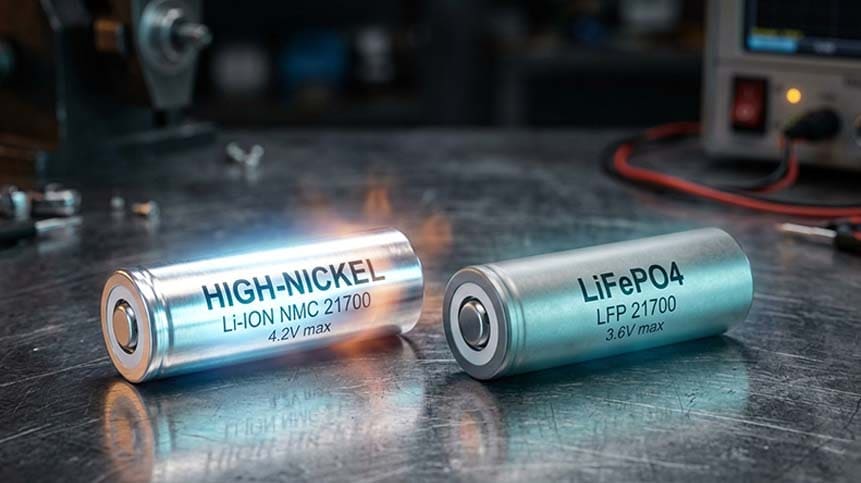
High-Nickel NMC
|
LFP
|
|---|---|---|
|
Energy Density
|
High
|
Medium
|
|
Thermal Stability
|
Lower
|
High
|
|
Cycle Life
|
Medium
|
High
|
|
Cost
|
Higher
|
Lower
|
Increasing nickel:
-
Increases capacity
-
Reduces thermal stability
-
Increases oxygen release risk
External safety structures (armor casing, shutdown separators):
-
Delay failure
-
Do not eliminate material instability
So intrinsic safety declines as energy density rises.
5. Long Cycle Life AND Ultra-High Discharge Rate

Rate-Optimized Design
-
High porosity electrodes
-
More conductive carbon
-
Lower compaction density
Life-Optimized Design
-
Dense electrode structure
-
Stable particle morphology
-
Mild current density
Conflict example:
|
Application
|
Discharge Rate
|
Typical Cycle Life
|
|---|---|---|
|
Drone battery
|
50C–100C
|
100–300 cycles
|
|
Energy storage
|
0.5C
|
3000–6000 cycles
|
High C-rate:
-
Causes mechanical stress
-
Active material cracking
-
SEI thickening
-
Lithium inventory loss
They are fundamentally opposite design philosophies.
6. Low Cost AND High Performance
Raw Material Economics
-
Cobalt stabilizes structure but is expensive
-
Nickel increases energy but increases risk
-
LFP uses iron and phosphate (low cost)
Market desire:
Cheaper than LFP + Higher energy than NMC + Longer life than LTO
Science answer:
Impossible under current chemistry.
Cost reduction usually means:
-
Lower nickel purity
-
Simpler BMS
-
Fewer additives
-
Reduced thermal management
Performance declines accordingly.
III. The Six-Stave Barrel Model
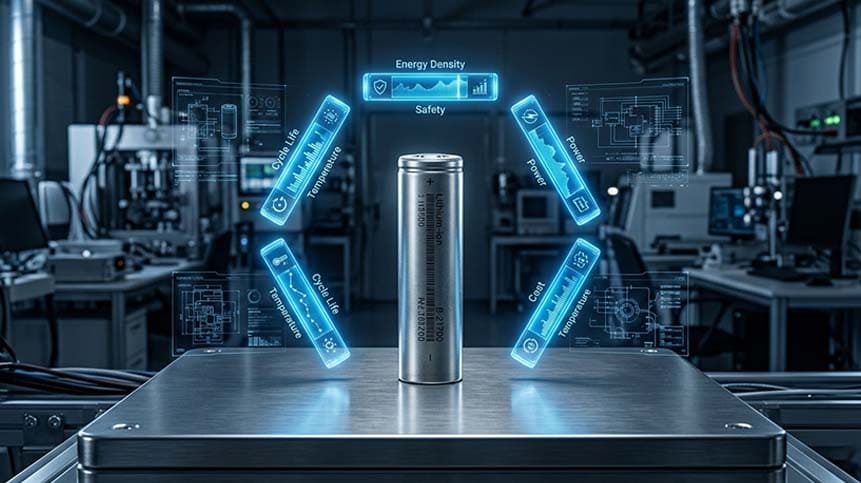
I often explain lithium battery limitations using a “barrel principle.”
A battery has six staves:
-
Energy Density
-
Power Density
-
Cycle Life
-
Safety
-
Cost
-
Operating Temperature Range
If one stave increases (energy density), others shorten (safety, life).
You cannot extend all six simultaneously.
IV. Why This Matters for OEM Buyers
If your application demands:
-
High energy
-
High safety
-
Fast charging
-
Wide temperature range
-
Long life
-
Low cost
You must prioritize.
The correct engineering approach is:
-
Define primary KPI
-
Define acceptable trade-offs
-
Customize chemistry + structure
-
Validate with thermal and lifecycle testing
V. Data Summary: Realistic Performance Windows
|
Target
|
Realistic Commercial Range
|
|---|---|
|
Energy Density
|
150–300 Wh/kg
|
|
Fast Charging
|
2C–4C typical
|
|
Cycle Life
|
500–5000 cycles
|
|
Operating Temp
|
-20°C to 60°C (managed)
|
|
Safety
|
Design dependent
|
|
Cost
|
Chemistry dependent
|
VI. How We Approach Optimization
From our experience working with:
-
Medical devices
-
UAV systems
-
Portable electronics
-
Industrial packs
We never design for “maximum everything.”
Instead, we:
-
Optimize cathode chemistry
-
Adjust compaction density
-
Tune electrolyte additives
-
Customize BMS logic
-
Validate abuse testing (nail, crush, overcharge)
This is how real-world battery engineering works.
References
U.S. Department of Energy Battery Research
Battery University Technical Guides
FAQ Section
Q1: Why can’t lithium-ion batteries achieve both high energy density and high safety?
Because higher energy density typically requires high-nickel cathodes, which reduce thermal stability and increase heat release during failure.
Q2: What limits ultra-fast charging?
Lithium plating on graphite anodes and thermal buildup are the main physical constraints.
Q3: Can solid-state batteries solve all these problems?
Not entirely. They may improve safety and energy density but still face interface resistance, dendrite growth, and manufacturing scalability challenges.
Q4: Is LFP safer than NMC?
Yes, LFP has higher thermal stability and lower oxygen release risk, but lower energy density.
Q5: How should OEMs select battery chemistry?
Define your primary constraint first—energy, life, safety, or cost—then optimize around it.
-

 May.2026.09.17Meet A&S Power at KES 2026 in Seoul – Custom Lithium Battery SolutionsLearn More
 -
 May.2026.09.16How to Choose a Custom Lithium Battery Manufacturer in China: A Buyer's GuideLearn More
 -
 May.2026.09.15Can VHR-4N Connectors Work With 14 AWG Battery Wires?Learn More
 -
 May.2026.09.14Who Pays UL Battery Certification Maintenance Fees?Learn More
 -
 May.2026.09.11PTC vs PCM: Why Use Both in Lithium Battery Protection?Learn More