




Breakthrough Technologies Improving Lithium-Ion Battery Performance
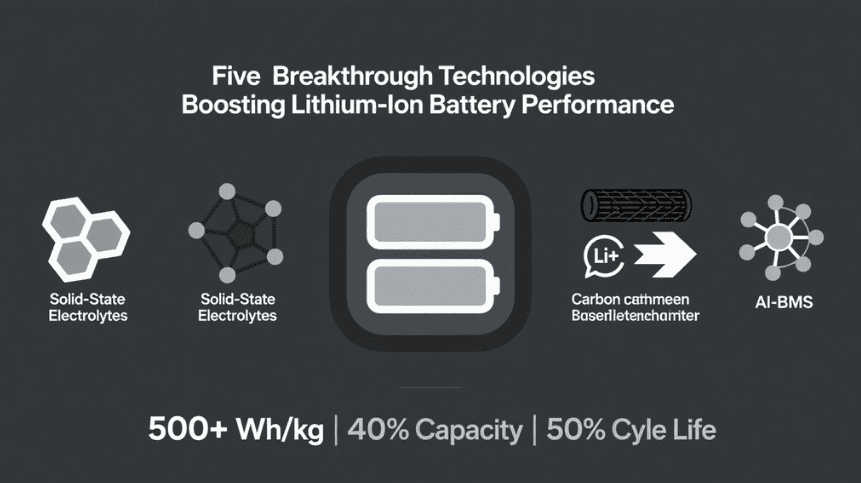
Lithium-ion batteries power much of our modern world—from smartphones and laptops to electric vehicles. With the rising demand for higher capacity, faster charging, and safer operation, researchers are exploring transformative solutions. Below are five breakthrough technologies reshaping today’s lithium-ion batteries.
1. Solid-State Electrolytes
Solid-state batteries replace flammable liquid electrolytes with solid ceramics or polymers, greatly improving energy density and safety.
-
Potential energy density: 500 Wh/kg or higher
-
Benefits: Improved thermal and mechanical stability
-
Example: All-solid-state batteries in China demonstrate enhanced safety and durability
2. Silicon-Based Anodes
Silicon stores 10x more lithium compared to graphite, offering massive improvements in capacity.
-
Panasonic & Sila collaboration: 40% boost in EV driving range
-
Faster recharge times compared to graphite anodes
-
Research from Stanford: Silicon nanowire anodes prevent early structural failure
3. Carbon Nanotube-Enhanced Silicon Anodes
By merging silicon with multi-walled carbon nanotubes, researchers create a conductive network that:
-
Buffers silicon’s expansion during charge/discharge
-
Improves electrical conductivity
-
Extends cycle life by over 50%
4. Pre-Lithiation Techniques
Pre-lithiation involves adding lithium before initial use, solving the issue of irreversible lithium loss.
-
Improves Coulombic efficiency in early cycles
-
Boosts overall energy density and cycle life
-
Ensures more stable performance over time
5. AI-Powered Battery Management Systems (BMS)
Next-generation BMS integrate machine learning with physics-based models to:
-
Optimize charging strategies
-
Predict battery health and lifespan
-
Enhance safety by detecting risks early
-
Dynamically adjust usage parameters for best performance
Why These Innovations Matter
-
Enhanced Energy & Capacity: Solid-state and silicon-based designs allow more storage in smaller sizes.
-
Greater Safety: Solid electrolytes and pre-lithiation reduce risks of overheating and failure.
-
Extended Lifespan: Carbon nanotube reinforcement and AI-driven systems lengthen battery cycle life.
-
Faster Charging & Efficiency: Silicon-based anodes and intelligent BMS make recharging quicker and smarter.
Conclusion
These five breakthroughs are not just incremental upgrades—they represent a paradigm shift in lithium-ion battery technology.
-
Solid-state platforms bring higher density and safety.
-
Silicon-based and nanotechnology-enhanced anodes enable longer range and faster charging.
-
AI-powered BMS ensures smarter, safer, and more reliable use.
Together, they pave the way for:
-
Electric vehicles with longer ranges
-
More reliable consumer electronics and wearables
-
A cleaner, electrified future
FAQ
1: What are the five breakthrough technologies for enhancing lithium-ion battery performance?
Answer: They are: solid-state electrolytes, silicon-based anodes, carbon nanotube-enhanced silicon anodes, pre-lithiation technology, and AI-driven Battery Management Systems (BMS). These technologies are comprehensively reshaping the performance of modern lithium batteries from two key dimensions: materials science and intelligent control.
2: Why are silicon-based anodes considered a disruptive alternative to traditional graphite anodes?
Answer: The energy storage capacity of traditional graphite anodes has already approached its physical limits. In contrast, the theoretical lithium storage capacity of silicon is 10 times that of graphite. Adopting silicon-based anodes can significantly boost a battery's energy density—for instance, in electric vehicle applications, this can extend driving range by approximately 40% and significantly reduce charging times.
3: Silicon-based anodes are prone to expansion during charging and discharging; how is the industry addressing this challenge?
Answer: This challenge is primarily addressed through nanotechnology and composite materials. The article highlights two cutting-edge solutions: first, silicon nanowire anodes—researched at Stanford University—which effectively prevent premature structural failure; and second, carbon nanotube enhancement technology, which integrates multi-walled carbon nanotubes with silicon to create an elastic conductive network that absorbs expansion stress, thereby extending the battery's cycle life by over 50%.
4: What is pre-lithiation technology, and how does it help improve battery efficiency?
Answer: During the initial charge of a traditional lithium battery, a portion of the lithium ions is irreversibly consumed to form a protective surface film (known as the SEI layer), resulting in a permanent loss of capacity. Pre-lithiation technology involves adding extra lithium to the battery before it is put into service; this effectively compensates for that initial loss, thereby significantly boosting the battery's initial Coulombic efficiency, overall energy density, and long-term cycle stability.
5: What absolute advantages do solid-state batteries (featuring solid-state electrolytes) hold over traditional liquid lithium-ion batteries?
Answer: Solid-state electrolytes completely replace flammable liquid electrolytes with solid-state materials. This offers two major core advantages: First, exceptionally high safety, virtually eliminating the risks of thermal runaway and fire caused by overheating, short circuits, or puncture; second, a higher energy density, which allows for compatibility with higher-voltage cathodes and enables a thinner form factor—making it ideally suited for medical devices and high-end electronics with extremely stringent requirements for both safety and space efficiency.
6: How does an AI-driven BMS (Battery Management System) extend battery lifespan?
Answer: Next-generation BMS technology deeply integrates machine learning with physical models. It not only monitors current and voltage in real time but also predicts the battery's State of Health (SOH) and remaining lifespan, providing early warnings before any safety risks arise. By dynamically adjusting charging and discharging parameters and optimizing charging strategies, an AI-driven BMS effectively prevents excessive degradation, thereby significantly extending the battery's actual service life.
-

 May.2026.09.24Optimal Li-Polymer Battery Charge Voltage ExplainedLearn More
 -
 May.2026.09.24Optimal LiFePO4 Charge Voltage Explained: 12V, 24V and 48VLearn More
 -
 May.2026.09.22Can All Lithium Batteries Be Recharged?Learn More
 -
 May.2026.09.21UN3480 vs UN3481: Lithium-Ion Battery Shipping GuideLearn More
 -
 May.2026.09.2121700 Battery Specifications: Capacity, Size, Voltage, and UsesLearn More