




UL1642 Approved Lithium Polymer Battery Manufacturer Guide 2026
Quick Answer:
A UL1642 approved lithium polymer battery manufacturer is a lithium battery producer whose cells are designed, tested, and validated in accordance with the UL1642 safety standard issued by Underwriters Laboratories. UL1642 focuses on cell-level safety performance, evaluating whether lithium polymer cells can withstand electrical, mechanical, and thermal abuse conditions—such as short circuits, overcharge, crush, impact, and high-temperature exposure—without causing fire or explosion.
For OEM buyers and device manufacturers, working with a UL1642-aligned supplier means the lithium polymer cells used in their products have passed recognized safety validation procedures under controlled laboratory conditions, improving regulatory acceptance in markets like the United States and reducing product liability risks in applications such as medical devices, consumer electronics, and industrial systems.
Introduction
From an engineering standpoint, UL1642 is not a marketing certification—it is a destructive safety validation framework applied at the cell level of lithium-based electrochemical systems.
As a lithium polymer battery manufacturer, I treat UL1642 not as a document requirement, but as a design constraint that directly influences material selection, electrode architecture, separator engineering, and failure mode mitigation strategy.
This article explains UL1642 from a manufacturing + compliance engineering + failure analysis perspective, not a simplified marketing interpretation.
UL1642 Standard – Technical Definition and Regulatory Position
UL Standards Official Documentation
UL1642 is published by Underwriters Laboratories (UL) and defines safety requirements for lithium primary and secondary cells.
Engineering Scope of UL1642
UL1642 evaluates:
- Cell internal short-circuit behavior
- External short circuit thermal response
- Mechanical abuse tolerance
- Overcharge stability limits
- Thermal exposure behavior
- Electrolyte leakage containment
Importantly:
UL1642 does NOT evaluate battery pack-level electronics or system integration safety.
It is strictly a cell-level electrochemical safety certification.
UL1642 Safety Philosophy – Failure Mode Based Design Validation
Unlike performance standards, UL1642 is structured around abuse condition simulation (ACS).
The core engineering logic is:
“If a cell is forced into abnormal conditions, it must fail safely without fire or explosion.”
This aligns with three major failure modes:
1. Thermal Runaway Prevention
Lithium polymer systems are vulnerable to:
- Separator collapse
- Internal short circuit propagation
- Exothermic reaction chain
UL1642 tests ensure thermal escalation is controlled or contained.
2. Mechanical Integrity Failure Control
Mechanical stress can induce:
- Electrode delamination
- Internal dendrite formation
- Pouch rupture
UL tests simulate these conditions via crush and impact testing.
3. Electrical Abuse Tolerance
Electrical misuse includes:
- Overcharge beyond recommended voltage
- External short circuits
- Reverse polarity stress
UL1642 defines threshold-based acceptance criteria.
UL1642 Test Methodology
UL testing is destructive and statistically evaluated across sample batches.
Standard Test Matrix
| Test Category | Engineering Purpose | Failure Threshold Logic |
|---|---|---|
| External Short Circuit | Current surge stability | No fire / no explosion |
| Crush Test | Structural collapse behavior | No thermal runaway |
| Impact Test | Shock-induced internal short risk | No ignition |
| Heating Test | Thermal decomposition stability | Controlled venting only |
| Overcharge Test | Electrochemical stability margin | No violent rupture |
| Abnormal Charging | Fault tolerance validation | Safe termination |
Key Engineering Insight
UL1642 is not pass/fail in a simple sense—it is:
A statistical safety validation model across controlled destructive sampling
Manufacturers must demonstrate process consistency, not just sample success.
Lithium Polymer Cell Design Requirements for UL1642 Compliance
From a manufacturing perspective, UL compliance begins at cell design stage, not testing stage.
1. Separator Engineering
We typically use:
- Multi-layer microporous polyethylene (PE) / polypropylene (PP) separators
- Thermal shutdown functionality at 130°C–160°C
- High puncture resistance index (PRI)
2. Electrolyte Stability Control
Key parameters include:
- Flash point optimization
- Additive-controlled SEI layer formation
- Gas generation suppression chemistry
3. Pouch Structural Design
Lithium polymer pouch cells must ensure:
- Aluminum-plastic laminate integrity
- Edge sealing reinforcement
- Controlled expansion tolerance zone
UL1642 vs UL2054 vs IEC62133
| Standard | Level | Focus | Engineering Domain |
|---|---|---|---|
| UL1642 | Cell | Electrochemical safety | Cell chemistry + structure |
| UL2054 | Pack | System safety | BMS + assembly |
| IEC62133 | Global | Consumer safety | Combined cell + pack |
| UN38.3 | Transport | Logistics safety | Mechanical + thermal transport stress |
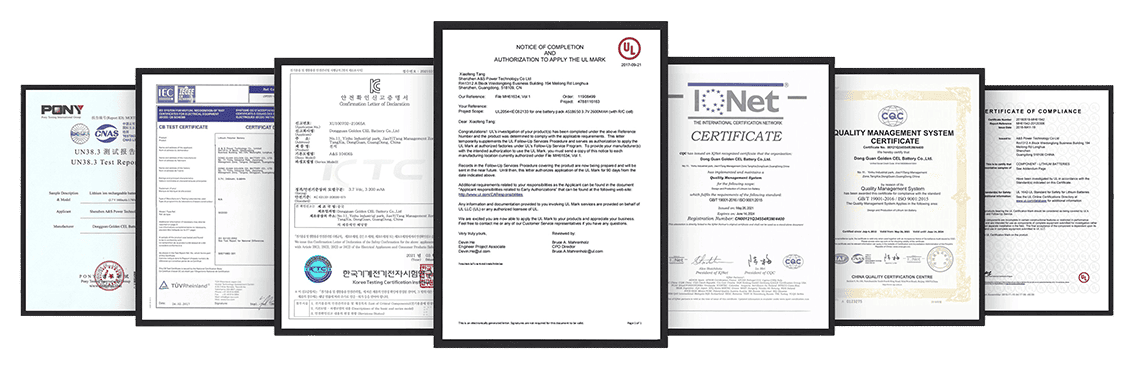
Key Insight:
UL1642 is the foundation safety gate.
UL2054 builds system-level protection on top of it.
Manufacturing Control System Required for UL1642 Lithium Polymer Cells
A UL1642-capable manufacturer must implement process-controlled safety engineering (PCSE).
1. Dry Room Manufacturing Environment
Required humidity control:
- ≤1% RH for electrode assembly
- Prevents lithium reaction with moisture
2. Coating Uniformity Control
Deviation control:
- ±2% electrode coating density tolerance
- Ensures consistent ion diffusion behavior
3. Formation Process Engineering
Formation cycling is used to:
- Stabilize SEI (Solid Electrolyte Interphase)
- Reduce initial impedance variation
- Identify early defect cells
4. Statistical Quality Control (SQC)
Key metrics:
- Internal resistance distribution curve
- Voltage plateau consistency
- Self-discharge rate threshold
Industry Data – UL1642 Compliance Impact on Product Success
| Metric | Non-UL Cells | UL1642 Cells |
|---|---|---|
| OEM acceptance rate | Low | High |
| Regulatory approval time | Longer | Faster |
| Warranty return rate | Higher variability | Stable |
| Insurance approval | Difficult | Easier |
| Product liability exposure | High | Reduced |
Application Engineering Requirements
Medical Devices
Requires:
- Predictable discharge curve
- UL1642 + IEC62133 dual compliance
- Fail-safe shutdown behavior
Industrial IoT
Requires:
- Wide temperature stability
- Low self-discharge design
- Long-cycle reliability validation
Consumer Electronics
Requires:
- High energy density balance
- Miniaturization under UL constraints
- Drop-impact resilience
UL1642 Manufacturer Qualification Checklist
A legitimate UL1642 lithium polymer manufacturer must demonstrate:
- UL file number traceability
- Cell-level test reports (not pack-level only)
- Production lot consistency data
- Controlled raw material sourcing
- Failure analysis capability (root cause engineering)
Common Engineering Challenges in UL1642 Manufacturing
1. Internal Micro-Short Risk
Caused by:
- Particle contamination
- Separator defects
- Lithium dendrite growth
2. Gas Generation in Pouch Cells
Triggered by:
- Electrolyte decomposition
- Overvoltage stress
- High temperature aging
3. Scaling From Lab to Mass Production
Key issue:
Laboratory UL pass ≠ mass production UL stability
Requires process locking and SPC control.
Future Direction of UL1642 and Lithium Polymer Safety
Industry evolution trends:
- Solid-state electrolyte integration
- Lower flammability electrolyte chemistry
- AI-driven battery fault prediction systems
- Higher UL scrutiny on energy density thresholds
- Mandatory traceability digitalization (battery passport systems)
Conclusion
UL1642 should be understood as a cell-level safety engineering validation framework rather than a marketing certification label.
From a manufacturing standpoint, compliance requires:
- Material-level stability engineering
- Structural safety design at pouch level
- Statistical production control systems
- Destructive test validation across multiple abuse scenarios
As a lithium polymer battery manufacturer, our role is not only to “pass UL tests”, but to design electrochemical systems that inherently reduce failure probability under real-world abuse conditions.
FAQ
What does UL1642 mean for lithium batteries?
UL1642 is a safety standard that ensures lithium cells can operate safely under stress conditions such as short circuits, overheating, and mechanical abuse.
Is UL1642 required for exporting lithium batteries to the US?
While not always legally required, it is widely expected by OEM buyers and regulatory bodies for product approval and risk reduction.
Does UL1642 cover battery packs?
No, UL1642 focuses on cells. Battery packs are typically covered under UL2054.
How long does UL certification take?
It depends on design complexity, but typically several weeks to months including testing and documentation.
Can lithium polymer batteries be custom-made and still UL compliant?
Yes. Custom LiPo batteries can still meet UL1642 requirements if materials, structure, and design pass safety testing.
What industries need UL1642 batteries most?
Medical, consumer electronics, industrial IoT, and energy storage systems are the most common users.
-

 May.2026.09.24Optimal Li-Polymer Battery Charge Voltage ExplainedLearn More
 -
 May.2026.09.24Optimal LiFePO4 Charge Voltage Explained: 12V, 24V and 48VLearn More
 -
 May.2026.09.22Can All Lithium Batteries Be Recharged?Learn More
 -
 May.2026.09.21UN3480 vs UN3481: Lithium-Ion Battery Shipping GuideLearn More
 -
 May.2026.09.2121700 Battery Specifications: Capacity, Size, Voltage, and UsesLearn More