




Mastering 3S LiPo Voltage: Your Ultimate 3S Charging Guide
Quick Answer:
What Voltage Should a 3S LiPo Battery Be?
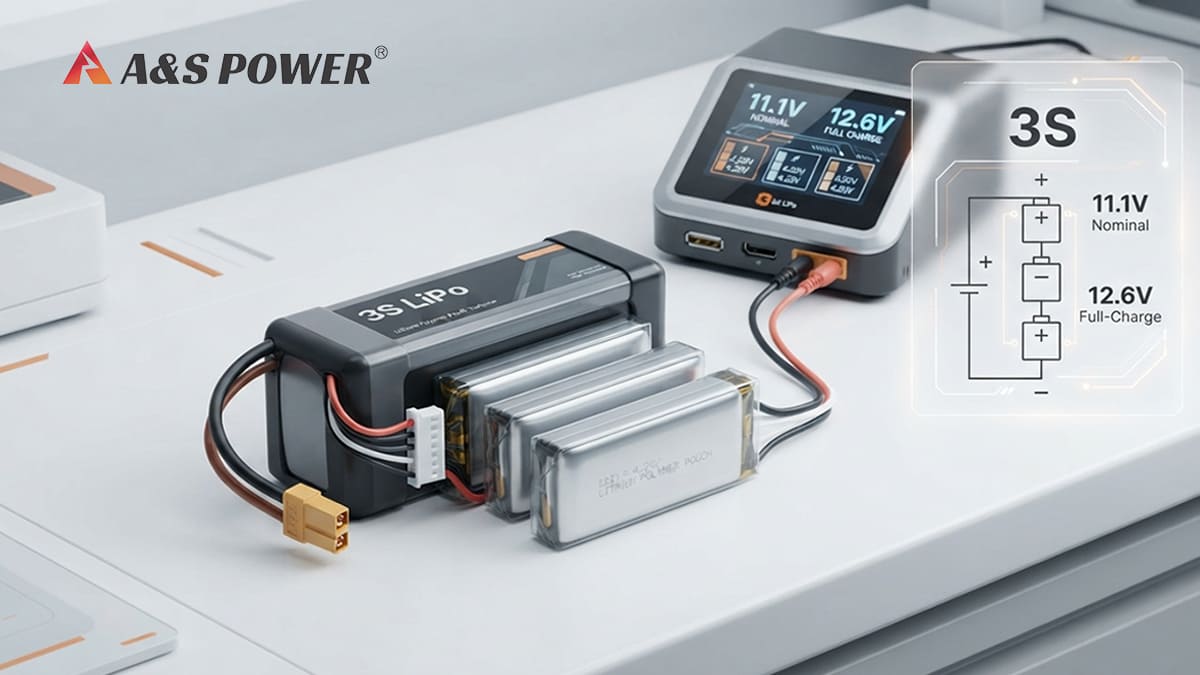
A standard 3S LiPo battery has a nominal voltage of 11.1V and a full-charge voltage of 12.6V. This is because three 3.7V cells are connected in series, while each cell can reach 4.2V when fully charged.
For safe charging, I recommend using a charger specifically designed for LiPo batteries and selecting the correct 3S balance-charge mode when the battery has a balance connector. The charger should limit the total pack voltage to 12.6V and monitor the individual cell voltages.
The important distinction is simple: 11.1V is the nominal rating, not the maximum voltage. A standard 3S LiPo can normally measure approximately 12.6V immediately after a full charge.
Introduction
If you work with drones, RC vehicles, robotics, portable electronics, or custom battery packs, you have probably seen the term 3S LiPo used to describe an 11.1V battery. But one question often causes confusion: if the battery is rated at 11.1V, why does a fully charged 3S LiPo reach 12.6V?
The answer comes down to how lithium polymer cells are connected and how their voltage changes during charging and discharging. A standard 3S LiPo battery contains three cells connected in series, with a nominal voltage of 3.7V per cell and a maximum charge voltage of 4.2V per cell.
In this guide, I will explain the key 3S LiPo voltage levels, how to charge a 3S battery correctly, why balance charging matters, what voltage is appropriate for storage, and which charging mistakes should be avoided. I will also cover the points I consider important when selecting or designing a 3S LiPo battery for an OEM application.
Understanding 3S LiPo Voltage
When I explain 3S LiPo batteries to engineers or product developers, I start with the cell configuration.
The "3S" designation means three cells connected in series. In a series connection, the voltage of each cell is added together, while the nominal capacity in Ah or mAh remains essentially that of the individual parallel group.
For a conventional LiPo cell:
- Nominal voltage: 3.7V
- Full-charge voltage: 4.2V
- Three cells in series: 3 × 3.7V = 11.1V nominal
- Fully charged: 3 × 4.2V = 12.6V
Therefore, an 11.1V 3S LiPo battery should normally reach approximately 12.6V when fully charged.
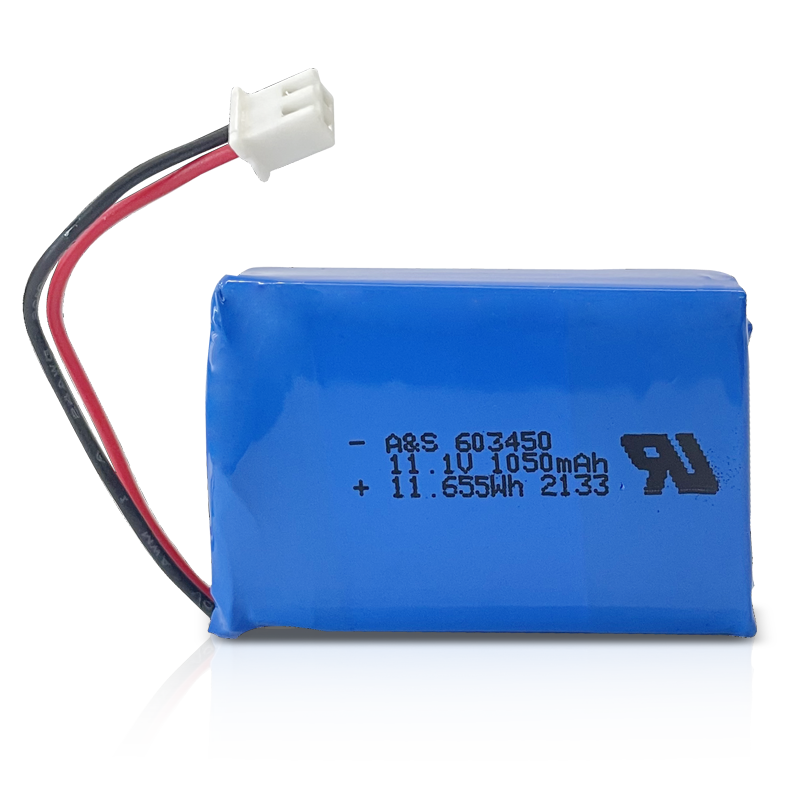
The key point is that battery voltage changes with state of charge. A LiPo battery does not continuously output exactly 11.1V. The 11.1V value is a nominal reference used for battery classification and system design.
3S LiPo Voltage Chart
| Battery State | Voltage per Cell | 3S Pack Voltage | Meaning |
|---|---|---|---|
| Fully charged | 4.20V | 12.60V | Standard full-charge voltage |
| Nominal | 3.70V | 11.10V | Rated/nominal voltage |
| Storage range | About 3.8–3.85V | About 11.4–11.55V | Common long-term storage target |
| Low operating range | Around 3.5V | Around 10.5V | Recharge should be considered |
| Low-voltage region | 3.2V | 9.6V | Avoid continued discharge |
| Critical region | Around 3.0V | Around 9.0V | Potentially damaging if exceeded |
The exact minimum discharge voltage depends on the specific cell chemistry, manufacturer specification, battery protection design, and application. I therefore do not recommend treating one universal cutoff number as appropriate for every LiPo pack.
For example, published safety guidance from the U.S. Naval Postgraduate School specifies a 3S LiPo range of approximately 9.6–12.6V and recommends not charging packs when individual unloaded cells are below 3.2V.
Why Is a 3S LiPo Rated at 11.1V but Charged to 12.6V?
This is probably the most important question to answer.
A standard LiPo cell has a nominal voltage of approximately 3.7V, but its voltage varies during operation. When fully charged, the cell reaches 4.2V.
Therefore:
3.7V × 3 = 11.1V nominal
while:
4.2V × 3 = 12.6V full charge
There is no contradiction between these two numbers.
I often compare this with other rechargeable battery specifications: the nominal voltage is a convenient reference for equipment designers, while the actual terminal voltage changes according to the battery's state of charge, load, temperature, and internal resistance.
This is also why a device designed for an 11.1V LiPo pack may need to tolerate a voltage significantly higher than 11.1V immediately after charging.
How to Charge a 3S LiPo Battery Correctly
The safest approach is to use a charger designed specifically for LiPo batteries and configured for a 3S pack.
A typical charging process uses a constant-current/constant-voltage (CC-CV) approach. During the main charging stage, current is regulated while the pack voltage rises. As the battery approaches its final voltage, the charger transitions toward constant-voltage operation and the charging current decreases.
For a standard 3S LiPo, the final voltage is 12.6V.
Step 1 — Confirm the Battery Configuration
Before connecting the charger, verify that the battery is actually a standard 3S LiPo.
Look for:
- 3S marking
- 11.1V nominal rating
- Battery manufacturer's charging specification
- Correct balance connector, if provided
- Appropriate capacity and charge-current rating
Do not assume that every lithium battery using a similar physical connector has the same charging requirements.
Step 2 — Select 3S LiPo Mode
Set the charger to the correct battery chemistry and cell count.
For a standard 3S LiPo, the charger should recognize:
LiPo → 3S → 12.6V final voltage
I would never select a higher-voltage LiHV profile simply because the battery is physically similar. Standard LiPo and LiHV cells can have different maximum charge voltages.
Step 3 — Use the Balance Function
For a conventional 3S pack with a balance connector, balance charging is strongly preferred.
A balance charger monitors the voltage of the individual cells rather than looking only at the total pack voltage. This matters because three cells connected in series may not have exactly the same state of charge.
For example, a pack could theoretically show an acceptable total voltage while one cell is significantly higher than another. If the charger only monitors total voltage, it may not detect the individual-cell imbalance.
That is why balance charging is an important part of maintaining a multi-cell LiPo pack. Published LiPo safety guidance specifically recommends balancing multi-cell LiPo batteries during charging according to manufacturer specifications.
What Charging Current Should You Use for a 3S LiPo?
Charging voltage and charging current are two different specifications.
The voltage determines the charging limit, while the current determines how quickly energy is transferred into the battery.
For example, if I have a 3S 2200mAh battery and the manufacturer specifies a 1C standard charge rate:
2200mAh × 1C = 2.2A
A 1C charging rate is commonly used as a conservative reference when the manufacturer's maximum charge rate is not otherwise specified. The U.S. Naval Postgraduate School guidance similarly identifies 1C as a general normal charge rate and advises not exceeding the manufacturer's rating.
However, I would always follow the battery manufacturer's datasheet first. Some cells and packs are designed for different charge rates, while a higher charge current can increase heat and accelerate degradation.
3S LiPo Storage Voltage
If I am not going to use a 3S LiPo battery for an extended period, I would not leave it sitting at 12.6V indefinitely.
A commonly used LiPo storage range is approximately 3.8–3.85V per cell, equivalent to about 11.4–11.55V for a 3S pack.
The purpose of storage charging is to avoid keeping the cells continuously at either an extremely high or extremely low state of charge.
For OEM battery applications, however, storage requirements should always be established from the cell manufacturer's specifications, expected storage duration, temperature, and battery management strategy rather than relying on a generic number.
Common 3S LiPo Charging Mistakes I See
Mistake 1 — Treating 11.1V as the Maximum Voltage
An 11.1V rating is nominal, not the full-charge limit. A standard 3S LiPo reaches approximately 12.6V when fully charged.
Mistake 2 — Charging Without Checking Cell Balance
A 12.6V total reading does not automatically prove that all three cells are balanced.
For a multi-cell pack, I recommend checking individual cell voltages whenever the battery and charger provide that capability.
Mistake 3 — Using the Wrong Chemistry Setting
A standard LiPo should not automatically be charged using a LiHV setting. Standard LiPo and high-voltage lithium polymer batteries have different charge-voltage limits.
Mistake 4 — Charging a Damaged or Swollen Battery
If a LiPo pack is visibly swollen, physically damaged, leaking, or becoming abnormally hot, I would stop using it rather than attempting another charge cycle.
Battery manufacturers also emphasize avoiding overcharging, excessive temperature, and physical damage because these conditions can contribute to swelling and safety problems.
3S LiPo Voltage for OEM Battery Design
From an engineering perspective, 3S LiPo voltage is more than a simple charging specification.
When I design or evaluate a custom lithium polymer battery for an OEM product, I look at the entire operating voltage window.
A system designed around an 11.1V nominal pack may experience:
- Approximately 12.6V immediately after a full charge
- Around 11.1V at nominal conditions
- Lower voltage as the battery discharges
- Additional voltage drop under high load because of internal resistance
This affects DC-DC converter selection, motor controllers, protection circuits, charging ICs, BMS configuration, wiring, connectors, and low-voltage cutoff settings.
For custom battery packs, I therefore recommend defining the maximum voltage, nominal voltage, minimum operating voltage, charge current, discharge current, temperature range, and protection strategy together rather than selecting the battery only by its 11.1V label.
For applications that require a custom lithium polymer battery, A&S Power provides OEM/ODM battery customization covering dimensions, capacity, voltage, connectors, protection circuits, and application-specific requirements.
3S LiPo Charging Safety Checklist
Before charging, I recommend checking the following:
| Check | Recommended Practice |
| Battery chemistry | Confirm standard LiPo or manufacturer-specified chemistry |
| Cell count | Confirm 3S |
| Nominal voltage | 11.1V |
| Full-charge voltage | 12.6V |
| Charger | Use a compatible LiPo charger |
| Balance charging | Recommended for conventional 3S packs with balance leads |
| Charge current | Follow the manufacturer's specified C-rate |
| Battery condition | Do not charge visibly damaged or swollen packs |
| Temperature | Avoid charging in excessive heat |
| Supervision | Do not leave charging batteries unattended |
| Storage | Use an appropriate partial-charge/storage voltage |
These practices are especially important because lithium polymer batteries store substantial energy in a compact package. Correct charger selection and battery monitoring are part of the overall safety design, not optional accessories.
3S LiPo Voltage: What Engineers and Buyers Should Remember
If I had to reduce the entire topic to five numbers, I would remember these:
3S = 3 cells in series
11.1V = nominal voltage
12.6V = standard full-charge voltage
3.8–3.85V/cell = commonly used storage range
Charge current = determined by the battery manufacturer's specification
The most important lesson is that voltage should always be considered on a per-cell basis. A 3S pack is not simply a "12V battery." Its cells must remain within the voltage limits defined by the cell and battery manufacturer.
For professional applications, I also recommend looking beyond voltage. Capacity, continuous and peak discharge current, internal resistance, thermal performance, cycle requirements, mechanical dimensions, protection circuitry, certifications, and charging architecture all affect whether a battery is actually suitable for the final product.
Conclusion
Understanding 3S LiPo voltage is essential for choosing the right charger, protecting the battery, and designing reliable electronic equipment. The most important figures to remember are 11.1V nominal voltage and 12.6V full-charge voltage for a standard 3S LiPo battery.
From my perspective, safe LiPo charging should never be based on voltage alone. Cell balance, charging current, battery condition, temperature, storage voltage, and the manufacturer's specifications all need to be considered together.
For OEM and custom battery applications, defining the complete voltage and power requirements before selecting the battery can help improve system reliability, charging performance, and overall battery life.
FAQ: About 3S LiPo Voltage
Is a 3S LiPo battery 11.1V or 12.6V?
Both numbers are correct, but they describe different conditions. A standard 3S LiPo is rated at 11.1V nominal and reaches approximately 12.6V when fully charged.
Can I charge a 3S LiPo to 12.6V?
Yes. For a standard LiPo cell rated at 4.2V maximum charge voltage, three cells in series produce a 12.6V full-charge voltage. Always verify the manufacturer's specifications before charging.
What voltage should a 3S LiPo have in storage?
A commonly used storage range is about 3.8–3.85V per cell, or approximately 11.4–11.55V for a 3S pack. The manufacturer's storage recommendation should take priority.
Do I need to balance charge a 3S LiPo?
For a conventional multi-cell 3S LiPo with a balance connector, balance charging is the preferred approach because it monitors individual cell voltages and helps prevent cell imbalance during charging.
What happens if a 3S LiPo is overcharged?
Charging a standard LiPo cell above its specified maximum voltage can damage the cell and create serious safety risks. A standard LiPo should not be charged beyond its manufacturer's specified voltage limit.
How many volts is a 3S LiPo at full charge?
A standard 3S LiPo is approximately 12.6V at full charge, because each cell reaches approximately 4.2V.
-

 May.2026.09.24Optimal Li-Polymer Battery Charge Voltage ExplainedLearn More
 -
 May.2026.09.24Optimal LiFePO4 Charge Voltage Explained: 12V, 24V and 48VLearn More
 -
 May.2026.09.22Can All Lithium Batteries Be Recharged?Learn More
 -
 May.2026.09.21UN3480 vs UN3481: Lithium-Ion Battery Shipping GuideLearn More
 -
 May.2026.09.2121700 Battery Specifications: Capacity, Size, Voltage, and UsesLearn More