



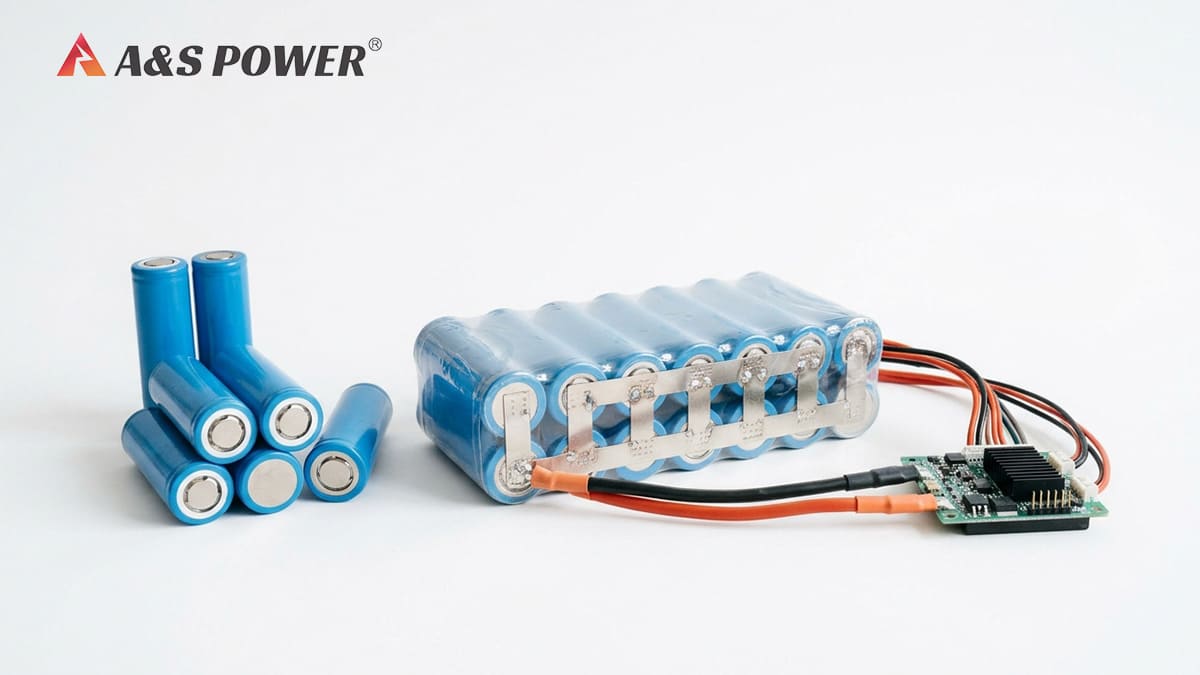
Introduction
When designing a battery for equipment that requires high electrical current, selecting cells based only on voltage and capacity is not enough. The cells must also be able to deliver the required current without excessive temperature rise, unacceptable voltage drop, or premature performance degradation.
This is why high-current battery applications often require high-rate cells rather than standard energy-oriented cells.
In practical battery engineering, the distinction is important. A cell with a large capacity rating does not automatically support a large discharge current. Its actual capability depends on its design, chemistry, internal resistance, thermal characteristics, and manufacturer-specified operating limits.
For battery-powered tools, motor-driven equipment, robotics, industrial electronics, and other high-power devices, choosing the correct discharge-rate capability is essential to reliable operation.
This guide explains why high-current batteries need high-rate cells, how discharge rates affect performance, and what OEM engineers should consider when selecting cells for a custom battery pack.
Quick Answer: Why Do High-Current Batteries Need High-Rate Cells?
High-current batteries need high-rate cells because ordinary cells have limited continuous discharge capabilities. When the load demands more current than a cell is designed to provide, internal heat generation and voltage drop can increase, potentially reducing usable capacity, triggering protection circuits, accelerating cell degradation, or causing unsafe operating conditions.
High-rate cells are designed to support greater discharge currents under specified operating conditions. Selecting an appropriate high-rate cell helps a battery pack meet its continuous and peak power requirements while maintaining acceptable temperature, voltage, and service life.
However, a high-rate cell is not unlimited in its current capability. Its discharge ratings, operating temperature, duty cycle, and cooling requirements must still be respected.
1. What Is a High-Rate Battery Cell?
A high-rate battery cell is designed to deliver or accept electrical current at a relatively high rate compared with its capacity. In battery specifications, this capability is commonly expressed using the C-rate.
The C-rate relates current to rated capacity and helps engineers compare discharge requirements across cells of different sizes. For a useful introduction to this measurement, see Battery University's explanation of battery C-rate.
For example, a 2,000 mAh cell has a nominal capacity of 2 Ah. At a discharge rate of 1C, the corresponding current is 2 A. At 5C, it is 10 A.
The following examples illustrate the relationship:
| Rated Capacity | Discharge Rate | Corresponding Current |
|---|---|---|
| 2 Ah | 1C | 2 A |
| 2 Ah | 5C | 10 A |
| 3 Ah | 1C | 3 A |
| 3 Ah | 5C | 15 A |
| 5 Ah | 2C | 10 A |
These calculations describe the current corresponding to a specified C-rate; they do not establish that every cell can safely operate at that rate. The manufacturer's discharge specification must confirm the allowable current.
A key distinction is that capacity and discharge capability are different characteristics. Capacity indicates how much charge a cell can store under defined test conditions, while discharge capability indicates how quickly it can deliver that charge.
A high-capacity cell may be optimized for energy storage and longer operating time. A high-rate cell may use a different electrode design or other cell-level optimizations to support higher current. The best choice depends on whether the application prioritizes runtime, power output, or a balance between the two.
2. What Happens When a Standard Cell Supplies Too Much Current?
A standard cell may work well in a low-power device but struggle when connected to a demanding load. Three technical effects are especially important.
2.1 Increased Heat Generation
When current flows through a cell, electrical resistance contributes to heat generation. A simplified expression for resistive heating is:
Where:
- P is the heat-generation power associated with resistance, measured in watts.
- I is the current, measured in amperes.
- R is the relevant electrical resistance, measured in ohms.
This relationship shows why current matters so much. If resistance remains constant and current doubles, the resistive heating component increases fourfold.
Actual battery heat generation is more complex because electrochemical polarization, temperature, state of charge, and other operating conditions also influence the result. Nevertheless, the equation provides a useful explanation of why excessive discharge current can create a thermal problem.
If the heat generated inside a cell exceeds what can be dissipated under the operating conditions, its temperature will rise. Sustained elevated temperatures can accelerate degradation and shorten battery service life. Under severe conditions, excessive heating may also create a safety hazard.
Research from the National Renewable Energy Laboratory on lithium-ion battery thermal characterization examines how C-rate, temperature, cell design, and interconnections affect heat generation and battery-pack thermal behavior.
High-rate cells are designed for more demanding current requirements, but they still need to operate within their specified temperature and discharge limits.
2.2 Greater Voltage Drop Under Load
A battery's terminal voltage usually decreases when it supplies current. One simplified way to understand this behavior is:
Where:
- V is the terminal voltage under load.
- OCV is the open-circuit voltage.
- I is the discharge current.
- R represents the effective resistance in this simplified model.
As current increases, the voltage drop associated with resistance increases. Real cells also exhibit electrochemical polarization, so this equation is an approximation rather than a complete battery model.
If the terminal voltage falls below the equipment's minimum operating voltage, the device may reduce its output, reset, stop working, or trigger a low-voltage protection function.
This can be especially problematic for motor-driven equipment, which may demand a large current during startup or acceleration.
Selecting a suitable high-rate cell can help control voltage sag under heavy loads, provided the cell's actual electrical characteristics meet the application's requirements.
2.3 Reduced Usable Capacity Under Heavy Loads
A cell's rated capacity is measured under specified test conditions. The capacity available in an actual application can differ depending on discharge current, temperature, cutoff voltage, and cell characteristics.
At high discharge rates, polarization and voltage drop can cause a cell to reach its discharge cutoff voltage earlier. As a result, the equipment may not be able to use all the capacity that would be available under a lower-current discharge.
This does not mean that every high-rate cell has a larger nominal capacity than a standard cell. Rather, the appropriate cell design can help the battery deliver the required power while providing more suitable performance under the intended load.
For applications that operate at high current for extended periods, engineers should evaluate discharge curves and usable capacity at the actual operating current instead of relying exclusively on the capacity printed on the cell label.
The Battery University guide to lithium-ion discharge characteristics provides additional background on how discharge conditions influence voltage behavior and available capacity.
3. Why High-Rate Cells Are Better for High-Current Applications
The primary reason to choose high-rate cells is to match the cell's electrical and thermal capabilities to the application's power demands.
3.1 Higher Supported Continuous Discharge Current
Continuous discharge current is the current a cell is permitted to supply continuously under the manufacturer's specified conditions.
This rating is critical for equipment that draws substantial current throughout normal operation. Examples include certain industrial devices, motor-driven systems, and high-power portable equipment.
If the application requires 15 A continuously, a cell rated for only 5 A continuous discharge is not an appropriate choice for supplying that current individually.
The design must instead use cells and a configuration capable of meeting the requirement. Depending on the design, this may involve selecting higher-rate cells, connecting cells in parallel, or combining both approaches.
Parallel cells can share the load, but current sharing is affected by cell matching, interconnections, resistance, temperature, and the overall pack design. The number of parallel cells alone does not guarantee safe operation.
3.2 Better Suitability for Short Peak-Current Demands
Some devices draw a relatively modest current during normal operation but require a much higher current for a short period.
Examples include motor startup, acceleration, actuator movement, and brief power surges.
For these applications, the peak discharge rating is as important as the continuous discharge rating.
However, peak current is not a universal rating. It may be specified for a particular pulse duration, temperature, state of charge, and recovery interval. A cell that supports a high current for a few seconds cannot necessarily sustain the same current continuously.
Engineers should compare the application's actual load profile with both the continuous and pulse discharge specifications.
3.3 More Appropriate Thermal Performance Under Heavy Loads
High-rate cells are intended for applications that require greater current output. Their suitability must be assessed using the manufacturer's electrical and thermal data rather than assuming that every high-rate cell generates less heat in every situation.
The heat produced by a battery depends on current, resistance, electrochemical behavior, and operating conditions. A well-selected high-rate cell can provide a more appropriate operating margin for a high-current application, but thermal management remains necessary when the design requires it.
For a battery pack, engineers should also consider heat transfer between cells, enclosure ventilation, available cooling paths, ambient temperature, and the duration of high-current operation.
3.4 More Reliable Power Delivery
High-current equipment needs a battery that can maintain suitable voltage while delivering the required power.
A cell that experiences excessive voltage sag may cause a device to shut down even when substantial charge remains. A cell that overheats under sustained load may require the equipment to reduce power or stop operating.
Matching the cell's discharge capability to the actual load helps reduce these problems and supports more consistent system performance.
The benefit comes from appropriate cell selection and system design, not from the high-rate label alone.
4. High-Rate Cells vs. Standard Cells
The practical difference between standard and high-rate cells is their suitability for different electrical loads. The exact ratings depend on the specific cell model, not simply its chemistry or physical size.
| Comparison Factor | Standard Cell | High-Rate Cell |
|---|---|---|
| Primary design priority | Often emphasizes energy capacity or runtime | Designed to support higher current demands |
| Continuous discharge | Limited to its specified rating | May support a higher specified continuous current |
| Peak discharge | Depends on its individual specification | May support higher short-duration current |
| Performance under heavy loads | May experience greater voltage sag if underspecified | Can be better suited to high-power operation |
| Thermal requirements | Depends on current and operating conditions | Still requires thermal evaluation at high current |
| Typical selection priority | Lower-power or energy-focused applications | High-power or current-intensive applications |
This comparison is general, not a universal specification. Some standard cells can support substantial current, and some high-rate cells have trade-offs in energy density, cycle life, cost, or other characteristics. Actual datasheets should determine the choice.
5. How to Calculate Whether a Battery Needs High-Rate Cells
The selection process should start with the application's current requirement rather than the battery's nominal capacity alone.
Step 1: Determine the Required Current
If the equipment's power demand and operating voltage are known, a first-order current estimate is:
For example, a hypothetical 120 W load operating at 12 V draws approximately 10 A under idealized steady-state assumptions.
Actual battery current can be higher when voltage falls, and conversion losses or motor startup can increase the demand. Engineers should use the equipment's real operating profile whenever possible.
Step 2: Calculate the Required C-Rate
The required C-rate can be estimated by dividing the current by the cell's rated capacity in ampere-hours:
For example, if a 2 Ah cell must deliver 10 A, the required discharge rate is 5C.
The next step is to confirm that the selected cell is explicitly rated to support that current under the intended operating conditions. A calculated 5C requirement does not mean an arbitrary 2 Ah cell can safely discharge at 5C.
Step 3: Separate Continuous Current from Peak Current
Document the normal operating current, maximum continuous current, peak current, and duration of each peak.
A battery that briefly draws 20 A during startup may need a different design from one that continuously draws 20 A for an extended period.
This distinction helps engineers avoid selecting a cell based on a short-duration rating when the real application requires sustained high-current output.
Step 4: Evaluate Voltage, Temperature, and Runtime
Review the cell's discharge curves at the expected current and temperature. Check whether the terminal voltage remains above the equipment's minimum input voltage and whether the available capacity meets the required runtime.
Also assess the expected temperature rise, cooling conditions, and operating environment.
A design that meets its current rating but overheats inside a compact enclosure may still be unsuitable.
6. What Else Matters When Designing a High-Current Battery Pack?
Selecting a high-rate cell is only one part of a reliable high-current battery system.
Battery Management System (BMS) and Protection Circuit
The protection system must be compatible with the selected cells and the load profile. Its current limits should account for continuous operation and permitted short-duration peaks.
The BMS, protection MOSFETs, fuse, wiring, connectors, and other components must be able to handle the expected current. A high-rate cell cannot compensate for an undersized protection circuit or poor electrical connections.
Protection thresholds should be coordinated with the cell manufacturer's voltage, current, and temperature limits. For more background, see Battery University's guide to battery protection circuits.
Series and Parallel Configuration
Series-connected cells increase pack voltage, while parallel-connected cells increase total capacity and can allow the load to be shared across cells.
However, the current rating of a finished battery pack cannot be determined from cell count alone. Cell matching, current distribution, interconnection resistance, thermal conditions, and protection design all matter.
The complete pack must be evaluated as a system.
Operating Temperature and Thermal Management
Ambient temperature and cooling conditions affect both electrical performance and service life. High-current operation in a sealed enclosure may require additional thermal design.
Engineers should verify performance across the intended operating temperature range and assess whether the pack can dissipate heat during the longest expected high-load period.
The 2024 peer-reviewed study on lithium-ion battery thermal characterization and thermal-management design discusses heat generation at both the cell and module levels, including the effects of electrical interconnections and cooling arrangements.
Cell Quality, Matching, and Verification
Cells used together in a pack should be suitable for the same application and appropriately matched according to the manufacturer's requirements. Differences in capacity, resistance, and temperature can affect current sharing and pack behavior.
Prototype testing should reproduce realistic continuous loads, peak-current events, ambient conditions, and end-of-discharge behavior before a design is finalized.
7. Which Applications Benefit from High-Rate Cells?
High-rate cells may be appropriate for applications in which power demand is a major design constraint.
- Power tools and portable equipment with demanding motor loads.
- Robotics and automated systems that require rapid movement or acceleration.
- Industrial equipment with high continuous or intermittent current demand.
- Motor-driven devices that experience startup surges.
- Specialized portable electronics requiring high output power in a compact package.
Not every device in these categories requires high-rate cells. The actual current profile, runtime target, temperature range, and product specifications determine the correct selection.
For OEM manufacturers, the goal is to find a cell and battery configuration that satisfies electrical performance requirements without compromising safety, reliability, packaging constraints, or cost.
8. How A&S Power Supports High-Current Battery Requirements
A&S Power provides OEM/ODM battery solutions for applications that require customized voltage, capacity, dimensions, wiring, connectors, and protection arrangements.
When developing a battery for a high-current application, the most useful starting point is a clear set of electrical and mechanical requirements. These should include:
- Nominal voltage and required capacity.
- Normal continuous discharge current.
- Maximum peak current and pulse duration.
- Expected operating temperature and cooling conditions.
- Available installation space and connector requirements.
- Required runtime and equipment cutoff voltage.
These details help determine whether a high-rate cell is needed, whether a parallel configuration should be evaluated, and what protection and thermal considerations must be addressed.
A&S Power's battery certification resources can also help customers identify relevant product compliance information. Specific certifications and test reports should be verified for the selected battery model and intended application.
For a customized battery project, cell selection should be based on the complete load profile and verified component specifications rather than capacity alone.
Need a Battery for a High-Current Application?
Share your required voltage, capacity, continuous discharge current, peak current, operating temperature, and available installation space with the A&S Power team. These details help establish the requirements for evaluating a suitable custom battery solution.
Visit A&S Power to discuss your OEM/ODM battery requirements.
Conclusion
High-current batteries need appropriately rated high-rate cells because ordinary cells have limits on the current they can deliver continuously and for short periods. Exceeding those limits can increase heat generation, cause voltage drop, reduce usable capacity under load, accelerate degradation, or trigger protection functions.
High-rate cells provide a more suitable foundation for applications with demanding power requirements, but they are not a substitute for correct battery-pack engineering. Continuous and peak current ratings, thermal management, BMS protection, wiring, connectors, and real-world testing must all be considered.
For OEM battery development, the right approach is straightforward: define the actual current profile, calculate the required C-rate, verify the cell specifications, and validate the complete pack under realistic operating conditions.
Frequently Asked Questions
1. Why can't a standard battery cell always be used in a high-current application?
A standard cell may have a continuous discharge rating below the application's current demand. Operating beyond its specified limits can cause excessive heating, voltage sag, accelerated degradation, or protection shutdown. The correct choice depends on the cell's verified discharge ratings.
2. Does a higher battery capacity mean a higher discharge current?
No. Capacity and discharge current are different specifications. A larger-capacity cell does not automatically support a higher C-rate or greater current. Both the rated capacity and the manufacturer's continuous and peak discharge limits must be checked.
3. What is the difference between continuous and peak discharge current?
Continuous discharge current is the current a cell can supply continuously under specified conditions. Peak discharge current is a higher current that may be permitted for a limited duration. The allowed pulse length and operating conditions must be confirmed in the cell datasheet.
4. Do high-rate battery cells generate less heat?
Not necessarily in every operating condition. Heat depends on current, resistance, electrochemical behavior, and temperature. A high-rate cell may be better suited to a demanding load, but engineers must evaluate its actual thermal characteristics and operating limits.
5. How do I calculate the C-rate required for my battery?
Divide the required discharge current in amperes by the cell's rated capacity in ampere-hours. For example, a 10 A load on a 2 Ah cell corresponds to 5C. This is a calculation of the required rate, not proof that the cell is rated for that current.
6. Can connecting cells in parallel eliminate the need for high-rate cells?
Not automatically. Parallel-connected cells can share the load, potentially reducing the current supplied by each cell. However, current sharing, cell matching, wiring resistance, temperature, and protection limits must be evaluated. Each cell must remain within its permitted operating limits.
7. Does a high-rate cell guarantee a longer battery life?
No. Service life depends on operating temperature, current profile, depth of discharge, charging conditions, cell design, and other factors. Selecting an appropriately rated cell can help avoid operation beyond its limits, but it does not guarantee a particular cycle life.
8. What information should I provide when requesting a custom high-current battery?
Provide the required voltage and capacity, continuous discharge current, peak current and duration, expected operating temperature, target runtime, available dimensions, connectors, and protection requirements. These details help the battery manufacturer assess a suitable cell and pack configuration.