



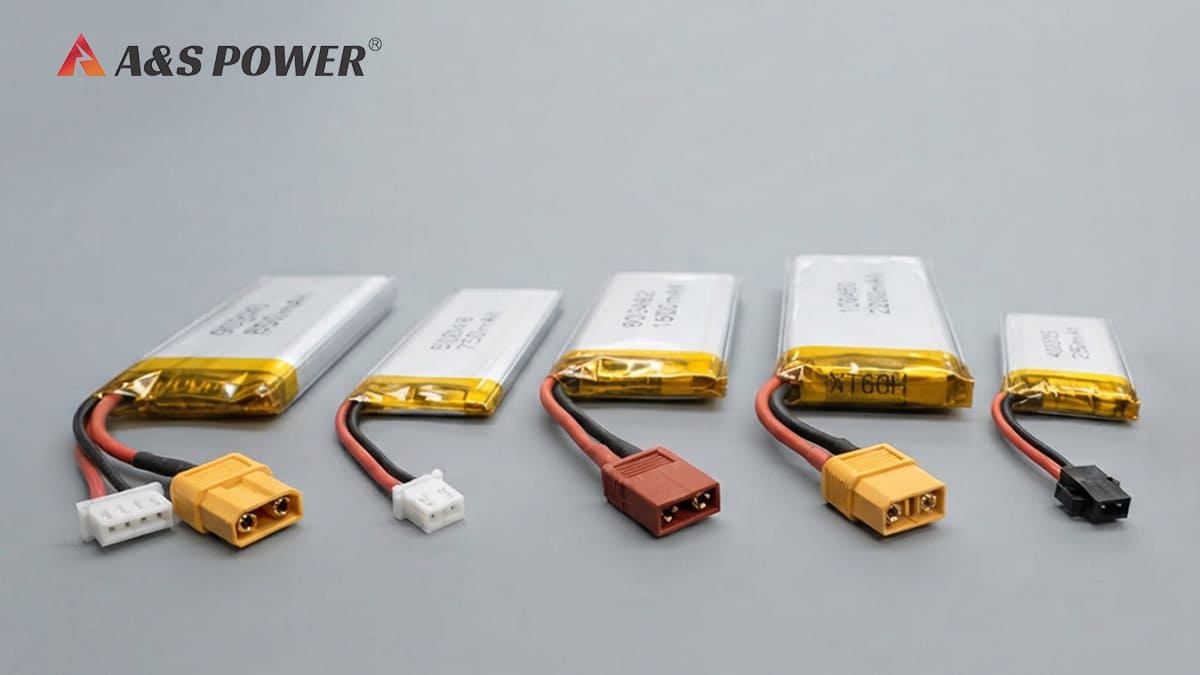
Introduction
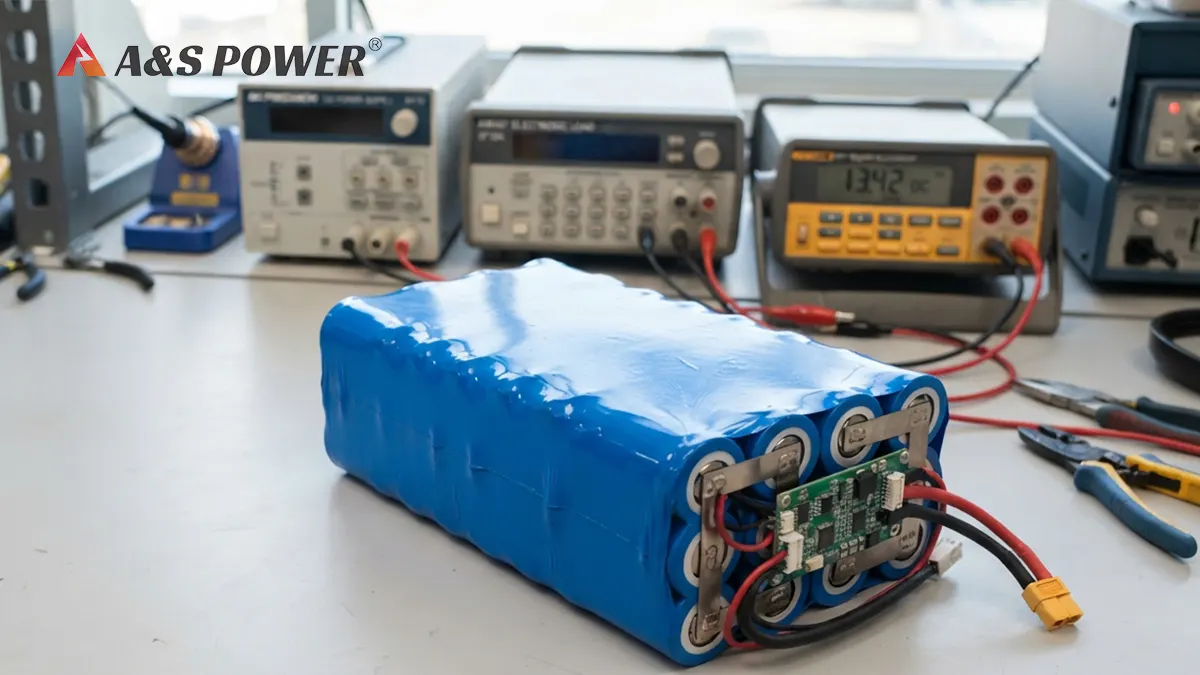
Choosing the right LiPo battery plug type is a small but important part of battery design. The connector must match the device interface, current requirements, wire size, available space, and mechanical conditions. For a custom LiPo battery, the connector also needs to work with the battery's protection circuit, cable assembly, charging system, and final product enclosure.
The challenge is that there is no universal "best" LiPo connector. XT30, XT60, XT90, Deans-style connectors, and different JST connector series are designed for different applications. A connector that works well in an RC application may be too large for a compact medical device, while a small JST connector may not be appropriate for a higher-current power path.
Another important distinction is between the main power connector and the balance connector. Multi-cell LiPo batteries commonly use a separate balance connection, and the connector series, number of positions, pitch, and wiring arrangement must match the charging or monitoring system.
In this guide, I will explain how I evaluate LiPo battery plug types for OEM and ODM battery projects. We will compare common connector families, explain the difference between power and balance connections, and show how current, wire gauge, dimensions, mating compatibility, and application requirements should influence the final selection.
Quick Answer: How Do You Choose a LiPo Battery Plug?
To choose the right LiPo battery plug, first determine the battery's continuous and peak current requirements, then match the connector to the device's mating interface, wire gauge, available installation space, and operating environment.
For high-current LiPo applications, connectors such as XT30, XT60, XT90, EC-series, or Deans-style connectors may be suitable depending on the system requirements. For compact, lower-current electronics, smaller JST-family connectors may be more appropriate.
For multi-cell LiPo batteries, the main power connector and balance connector should be evaluated separately. The main connector carries the primary battery current, while the balance connector provides access to individual cell connections for monitoring and balancing.
For an OEM LiPo battery, I recommend confirming the connector's exact part number, mating connector, wire gauge, cable length, current requirement, dimensions, and pinout before the battery enters mass production.
Key Takeaways
- Choose the LiPo connector based on the application, not battery capacity alone. A battery's mAh rating does not determine which connector should be used. Continuous current, peak current, charging current, wire size, and operating conditions are more relevant.
- The main power connector and balance connector serve different purposes. The main connector carries the primary battery current, while the balance connector provides access to individual cell junctions in a multi-cell pack.
- XT30, XT60, and XT90 are not interchangeable choices based simply on size. Their suitability depends on the application's current requirements, physical space, cable configuration, and the connector manufacturer's specifications.
- "JST connector" is not a specific connector type. JST manufactures multiple connector families, including XH, PH, and SH, with different pitches and electrical and mechanical characteristics.
- Connector ratings must be interpreted in their specified test conditions. For example, JST's official XH documentation specifies a 3 A AC/DC rating under its stated AWG #22 condition. This should not be interpreted as a universal 3 A operating limit for every XH-based battery assembly.
- Wire and connector selection should be considered together. A connector with an appropriate rating cannot compensate for an undersized wire, excessive cable length, poor crimping, or unsuitable thermal conditions.
- For OEM LiPo batteries, connector selection should be finalized before mass production. The connector, mating interface, cable length, wire gauge, protection circuit, and battery dimensions should be verified during the sample-development stage.
- Providing the exact connector part number is the safest way to avoid compatibility problems. If the connector is unknown, provide the battery manufacturer with photographs, dimensions, pitch, wire information, mating connector, and application requirements for verification.
Why Does the LiPo Battery Connector Matter?
A LiPo battery connector is part of the electrical path between the battery pack and the application. Although the connector is physically small compared with the battery itself, its electrical and mechanical performance can affect the complete system.
A poorly matched connector can introduce excessive contact resistance, voltage drop, heat generation, mechanical instability, or compatibility problems.
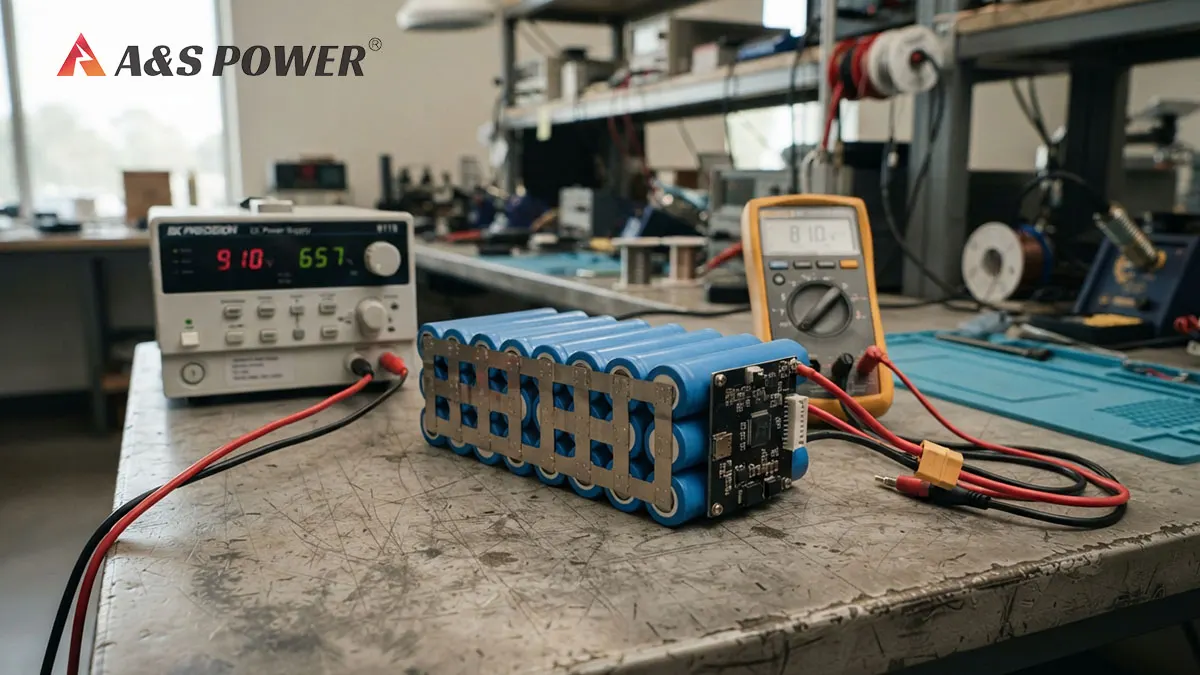
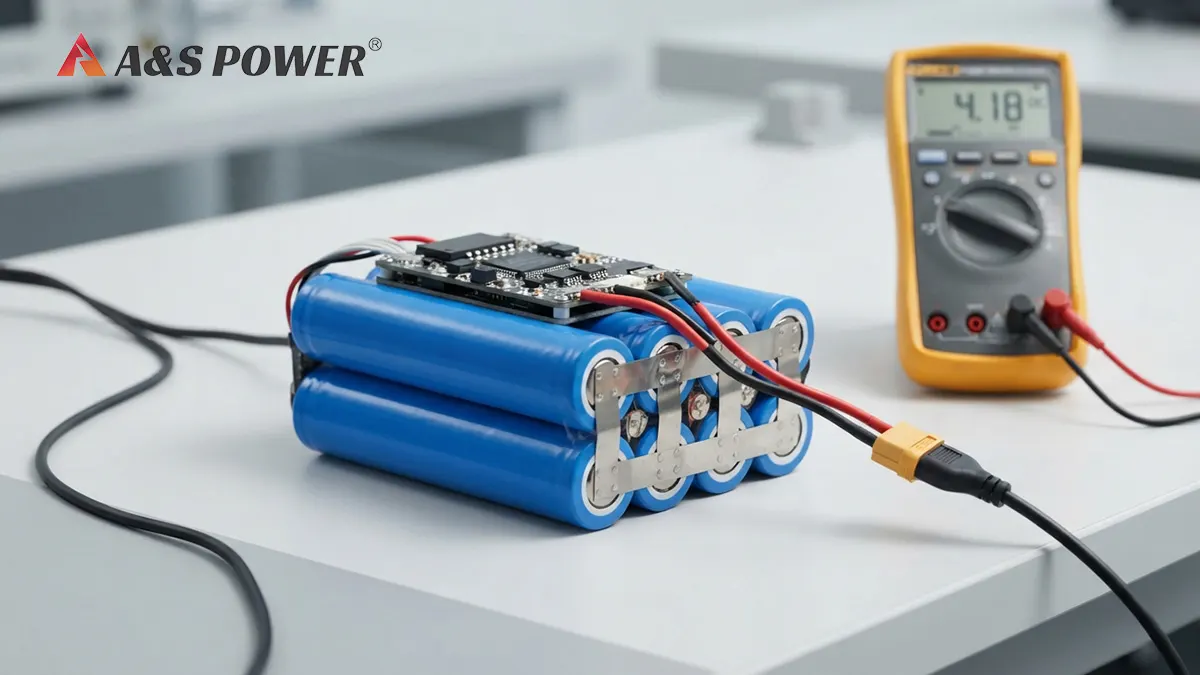
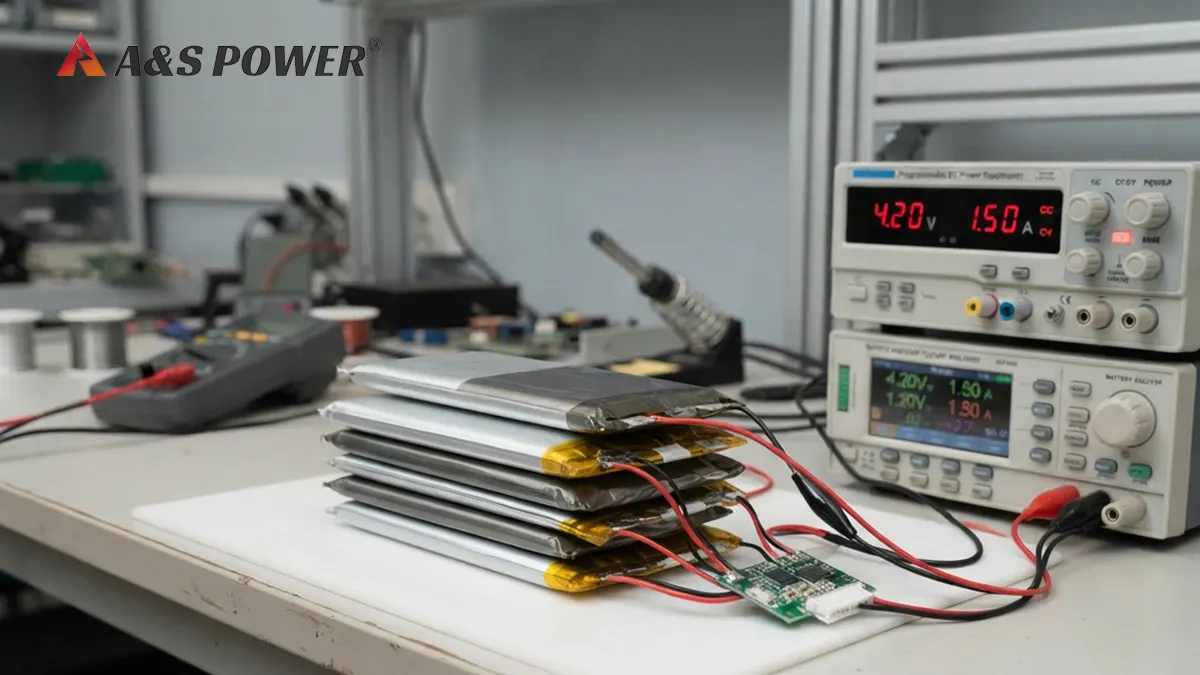
The connector should therefore be considered together with the battery cell, protection circuit, cable, and application load.
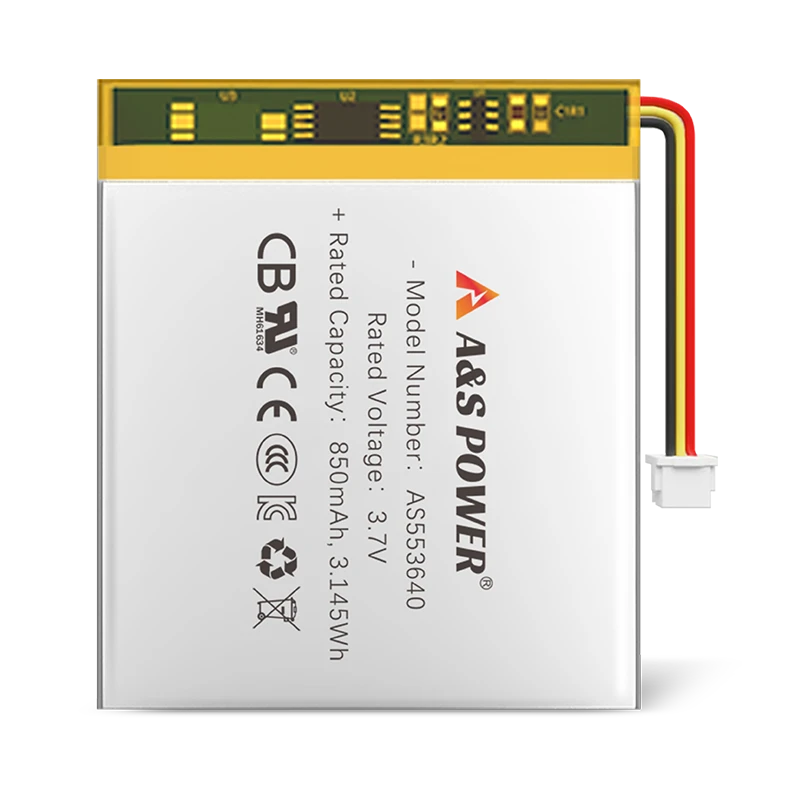
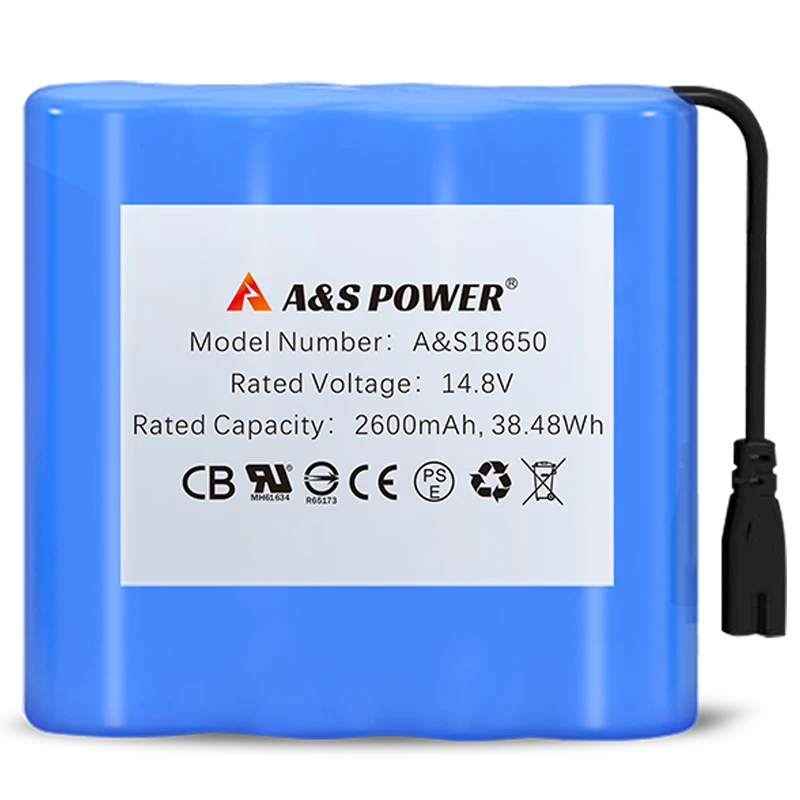
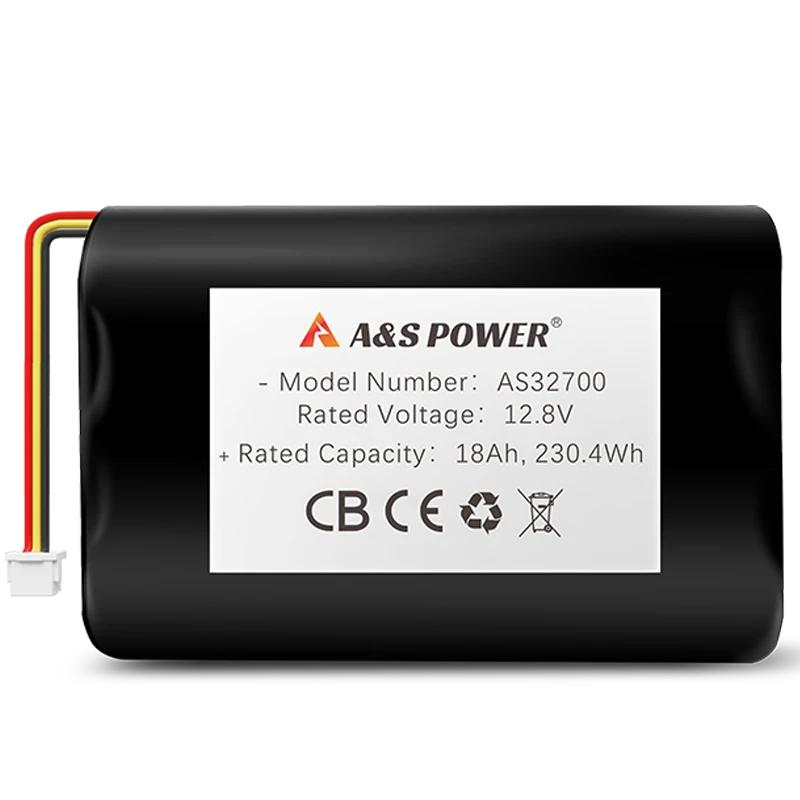
This is especially important for customized batteries. At A&S Power, we support customization of battery size, voltage, capacity, protection circuitry, wire, and plug according to the application. You can learn more about our custom LiPo battery manufacturing capabilities when developing an OEM or ODM battery pack.
Main LiPo Power Connector vs. Balance Plug
One of the most common sources of confusion is that a multi-cell LiPo battery can have two different connectors.
Main Power Connector
The main connector normally uses thicker wires and carries the battery's primary charge or discharge current, depending on the battery and system design.
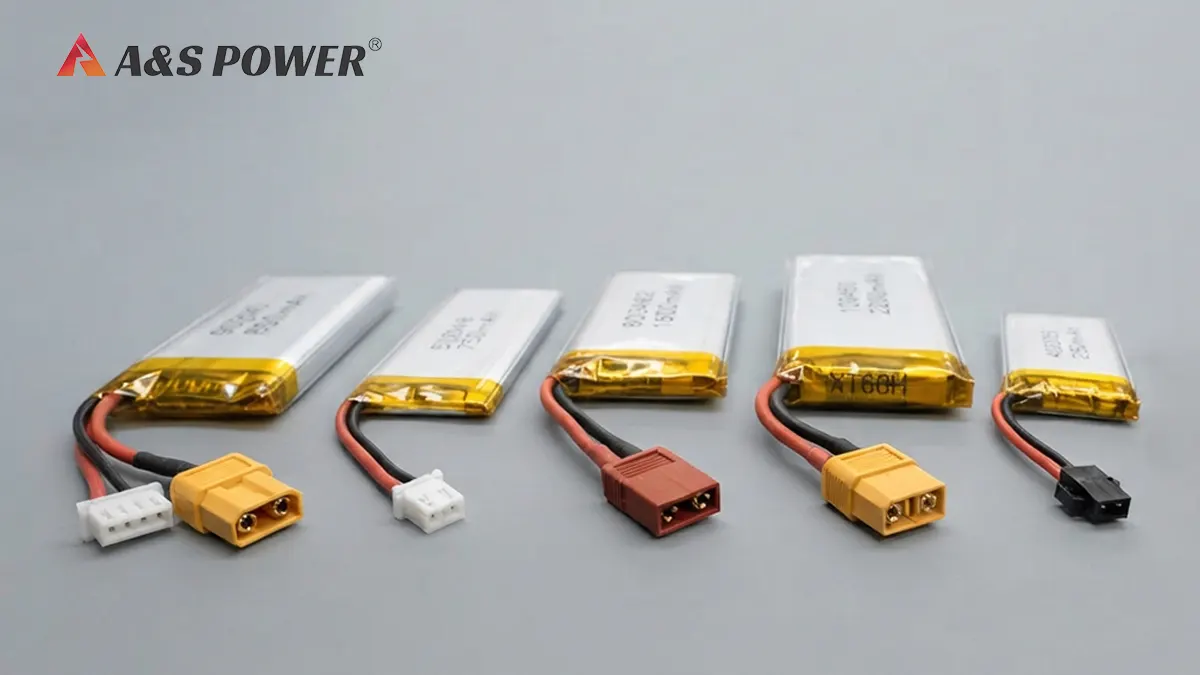
Common connector families found in RC and other battery applications include:
- XT30
- XT60
- XT90
- EC-series connectors
- Deans/T-plug
- Various JST-family connectors for smaller loads
The correct choice depends on the actual electrical requirements rather than simply the battery capacity.
A 2,000 mAh battery, for example, does not automatically require a particular connector. Two 2,000 mAh batteries can have completely different current requirements depending on their cells, application, discharge rate, and system design.
Balance Connector
The smaller multi-wire connector on a multi-cell LiPo battery is normally the balance connection.
For example, JST XH is widely used for LiPo balance connections. A common convention is that the number of positions corresponds to the number of cells plus one: a 2S battery uses a 3-position balance connection, while a 3S battery uses four positions.
However, I do not recommend identifying a balance connector by appearance alone. Connector series, pitch, pin arrangement, and wiring order all need to be verified.
JST's official XH connector specification identifies a 2.5 mm pitch and a 3 A AC/DC rating under its specified AWG #22 condition. That rating is a connector specification—not a statement that a complete LiPo battery balance lead should be operated at 3 A continuously. For the exact electrical and mechanical conditions, refer to the official JST XH connector specification .
Common LiPo Battery Plug Types Compared
The following table is a practical starting point rather than a universal current-rating chart. Actual allowable current should always be checked against the connector manufacturer's datasheet and the complete battery design.
| Connector Type | Typical Role | Common Application | Main Advantage | Main Limitation |
|---|---|---|---|---|
| XT30 | Main power | Small drones, compact RC systems | Small and lightweight | Less suitable for higher-current systems |
| XT60 | Main power | RC cars, drones, general LiPo systems | Widely used and robust | Larger than small JST-type connectors |
| XT90 | Main power | Higher-power RC systems | Larger contact system and higher-current applications | Larger and heavier |
| JST XH | Balance connection | Multi-cell LiPo balance leads | Compact and widely used | Not intended to replace a high-current main connector |
| JST PH | Low-current connection | Compact electronics | Small 2.0 mm-pitch format | Limited compared with larger power connectors |
| Deans/T-plug | Main power | RC and legacy battery systems | Compact and established | Requires correct mating connector and assembly |
| EC-series | Main power | RC and high-current applications | Designed for battery power connections | Size and current capability vary by series |
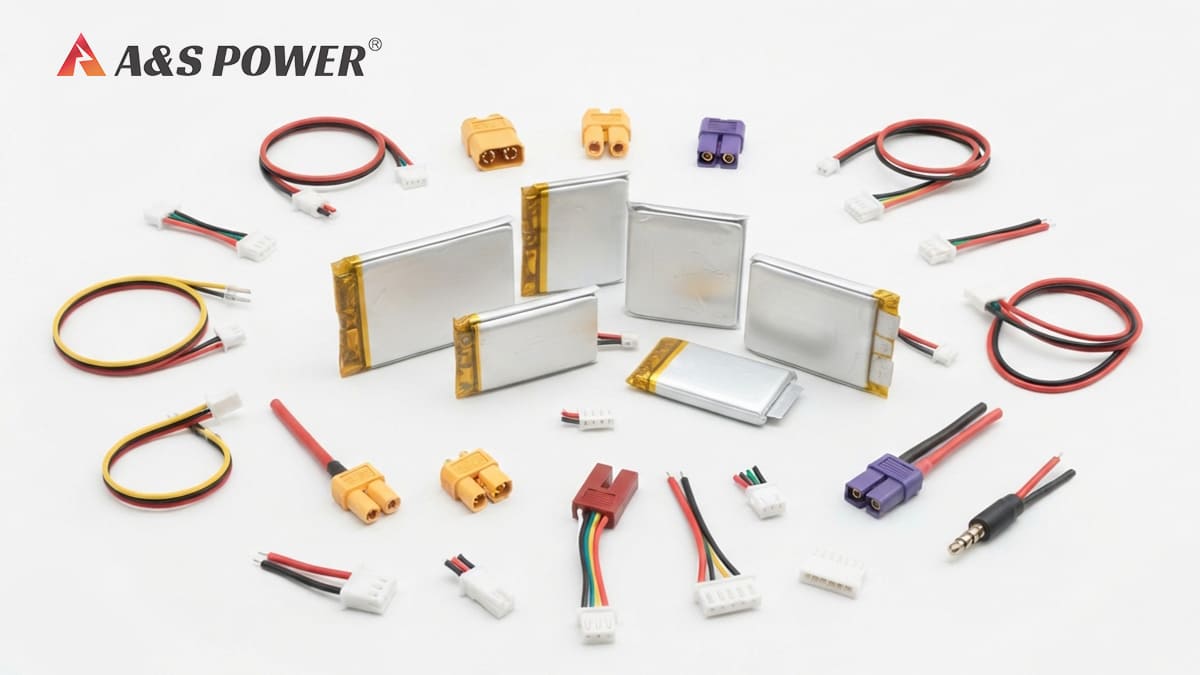
The important point is that connector names alone do not define the complete electrical design. Even within a connector family, the terminal, wire gauge, temperature, number of circuits, contact resistance, and application conditions matter.
For example, the official JST XH specification lists an applicable wire range of AWG #30 to #22, while its 3 A rating is specified under AWG #22 conditions. JST's official XH documentation should therefore be used when validating the connector for a specific design.
How to Choose the Right LiPo Connector Step by Step
1. Start With Continuous and Peak Current
This is the first specification I ask for.
Do not select a connector only from the battery capacity in mAh. Capacity tells you how much charge the battery stores; it does not directly tell you how much current the application will draw.
Instead, identify:
- Continuous operating current
- Peak or startup current
- Expected duration of the peak
- Charging current
- Operating temperature
- Wire length and gauge
A connector must be appropriate for the actual electrical load.
2. Check the Existing Device Connector
For a replacement battery, the simplest solution is normally to match the existing mating connector.
Before ordering, I recommend recording the connector:
- Manufacturer
- Series
- Part number
- Number of positions
- Pitch
- Gender or mating configuration
- Wire gauge
- Wire length
- Housing orientation
A connector that looks similar may still be mechanically incompatible.
This is particularly important with JST connectors. "JST" is not one connector specification. JST produces many different series with different pitches and geometries.
For example, the official JST XH series uses a 2.5 mm pitch. You can verify the dimensional and electrical specifications directly in JST's XH series documentation .
3. Consider Available Space
For portable electronics, wearables, medical equipment, GPS products, and compact IoT devices, connector size can become a mechanical constraint.
A larger connector may offer a more substantial power connection, but it also consumes more internal volume.
This is why I would not automatically recommend an XT60 simply because it is common. If the application only requires a compact low-current interface, a smaller connector may be more appropriate.
Conversely, using a very small connector in a high-current application simply to save space can create unnecessary electrical and thermal problems.
4. Match the Connector to the Wire
The connector and wire should be designed as one power path.
A high-current connector does not compensate for an undersized wire.
When reviewing an OEM battery specification, I look at the connector, terminal, wire gauge, cable length, expected current, and protection circuit together.
This is particularly important when the battery has long cable leads. Cable resistance can contribute to voltage drop and heat, while the connector introduces its own contact resistance.
5. Consider How Often the Battery Will Be Connected
A battery that is installed once during product assembly has different mechanical requirements from a battery that a user regularly plugs and unplugs.
For a serviceable product, consider:
- Mating and unmating frequency
- Locking mechanism
- Accessibility
- Connector retention
- Strain relief
- Vibration
- Accidental disconnection
For industrial or portable products, these mechanical factors can be just as important as the nominal electrical rating.
XT30 vs. XT60 vs. XT90: Which One Should You Use?
XT connectors are especially common in RC and FPV applications.
XT30 is a smaller connector intended for applications where reducing connector size and weight is important.
XT60 provides a larger connection and is widely used in RC cars, drones, and other LiPo applications.
XT90 is physically larger and is generally considered for systems with substantially greater power requirements.
However, I would not select one simply because an online table says "XT30 = X amps" or "XT60 = Y amps." Manufacturer ratings can depend on test conditions, temperature, contact configuration, wire size, and whether the rating refers to continuous or peak current.
The better engineering approach is to start with the actual load and then verify the connector manufacturer's published specification.
What About JST Connectors?
JST connectors are common in compact electronics, but the phrase "JST connector" is too broad to specify a battery interface.
Different JST series have different pitches, dimensions, terminal designs, and electrical specifications.
For example:
- JST XH: 2.5 mm pitch
- JST PH: 2.0 mm pitch
- JST SH: 1.0 mm pitch
These are not simply different sizes of the same connector and should not be assumed to be interchangeable.
The official JST XH documentation specifies 2.5 mm pitch, 3 A AC/DC under the stated AWG #22 condition, and an applicable wire range of AWG #30 to #22. For technical validation, refer to the official JST XH connector specification .
For an unknown connector, I recommend checking the original part number or measuring the pitch rather than ordering based only on a photograph.
Connector Selection for Custom LiPo Battery Packs
For an OEM battery, connector selection becomes part of the complete battery design.
At A&S Power, we support customization of battery size, voltage, capacity, protection circuitry, wire, and plug according to the application. Our custom LiPo battery manufacturing service is designed for OEM and ODM applications that require a battery configured around a specific product interface.
For example, when developing a custom LiPo battery for a medical device, wearable, GPS tracker, POS terminal, or industrial product, I would normally want to confirm:
- Battery voltage and capacity
- Continuous and peak current
- Charging requirements
- Battery dimensions
- Connector manufacturer and part number
- Mating connector on the device
- Wire gauge and cable length
- Balance connection, if required
- PCM/BMS requirements
- Required certifications and testing
This approach prevents the common situation where the battery electrical specifications are approved but the connector does not fit the final product.
For projects requiring a custom connector or cable assembly, you can review A&S Power's custom LiPo battery manufacturing capabilities , which include customized wire and plug configurations.
You can also review our custom battery solution for OEM/ODM battery design, including connector and cable customization.
Common LiPo Connector Selection Mistakes
Choosing by Battery Capacity Alone
A 3,000 mAh battery does not automatically need a particular plug. Current demand is the more relevant starting point.
Treating All JST Connectors as Interchangeable
They are not. Pitch and mechanical design must be verified.
Ignoring the Balance Connector
The balance connector has a different function from the main power connector. Its pin count and wiring must match the battery configuration and charger system.
Using an Adapter Without Checking the Complete Power Path
An adapter introduces additional contacts and connections. For high-current applications, every additional connection should be evaluated for compatibility, contact quality, and thermal performance.
Selecting a Connector Before the Battery Design Is Finalized
For an OEM project, connector selection should be confirmed together with the battery pack, cable, protection circuit, and device interface.
Conclusion
Choosing the right LiPo battery plug is not simply a matter of selecting the connector that looks familiar. The correct choice comes from matching current, wire gauge, connector specifications, mechanical dimensions, mating interface, operating environment, and application requirements.
For hobby applications, XT30, XT60, XT90, EC-series, Deans, and JST-family connectors may all have appropriate roles. For OEM battery packs, however, connector selection should be treated as part of the complete battery engineering process.
When I work through a custom LiPo battery requirement, I prefer to define the battery, protection circuit, cable, connector, and device interface together. This reduces compatibility problems during prototype testing and makes the transition from an approved sample to mass production more controlled.
For companies developing a new product, you can also review A&S Power's custom LiPo battery solutions to discuss battery size, voltage, capacity, connector, protection circuit, and other OEM requirements.
FAQ: LiPo Battery Plug Types
What is the most common LiPo battery connector?
There is no single connector that is correct for every LiPo battery. XT60 is widely encountered in RC and FPV applications, while smaller connectors are common in compact electronics. JST XH is widely used as a balance connector for multi-cell LiPo batteries.
Is XT60 better than XT30?
Neither is universally better. XT30 is smaller and suitable for applications where current requirements and space favor a compact connector. XT60 provides a larger connection and is commonly used in higher-power RC applications. The correct choice depends on the complete system requirements.
Can I use a JST connector for a LiPo battery?
Yes, if the specific JST series and terminal are appropriate for the electrical and mechanical requirements. "JST" alone is not enough information because JST manufactures many connector families.
What is a LiPo balance plug?
A balance plug provides access to individual cell junctions in a multi-cell battery so that the charging system can monitor and balance the cells. It is different from the main power connector.
How many pins does a LiPo balance connector need?
A common balance-connector convention is one more position than the number of cells in series. For example, a 3S pack commonly uses a four-position balance connector. The exact wiring and pinout must still be verified against the battery and charger documentation.
Should the connector be customized for an OEM LiPo battery?
For an OEM product, connector customization can be useful when the connector must match the product's mating interface, available space, current requirements, cable length, and assembly process. A&S Power supports customized wires and plugs for LiPo battery applications.
How do I tell which LiPo connector I need?
Start with the existing mating connector if you are replacing a battery. Record its manufacturer, series, part number, pitch, position count, wire gauge, and orientation. For a new OEM design, provide the battery manufacturer with the application's current, voltage, dimensions, connector interface, and cable requirements.