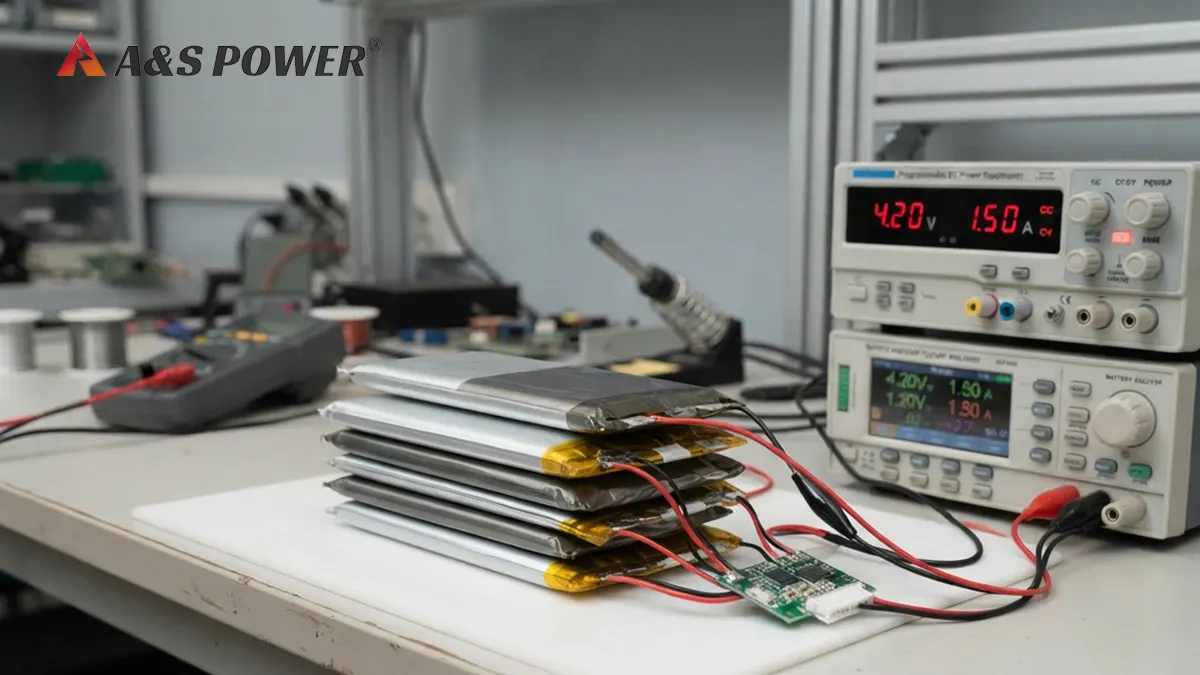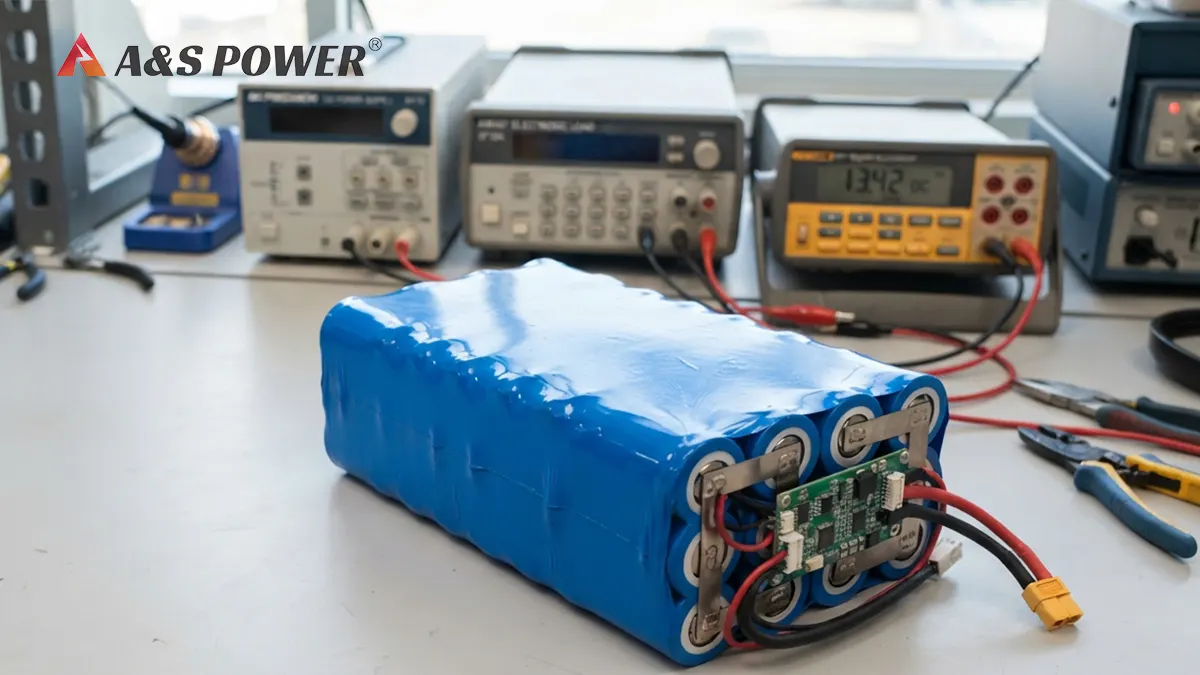




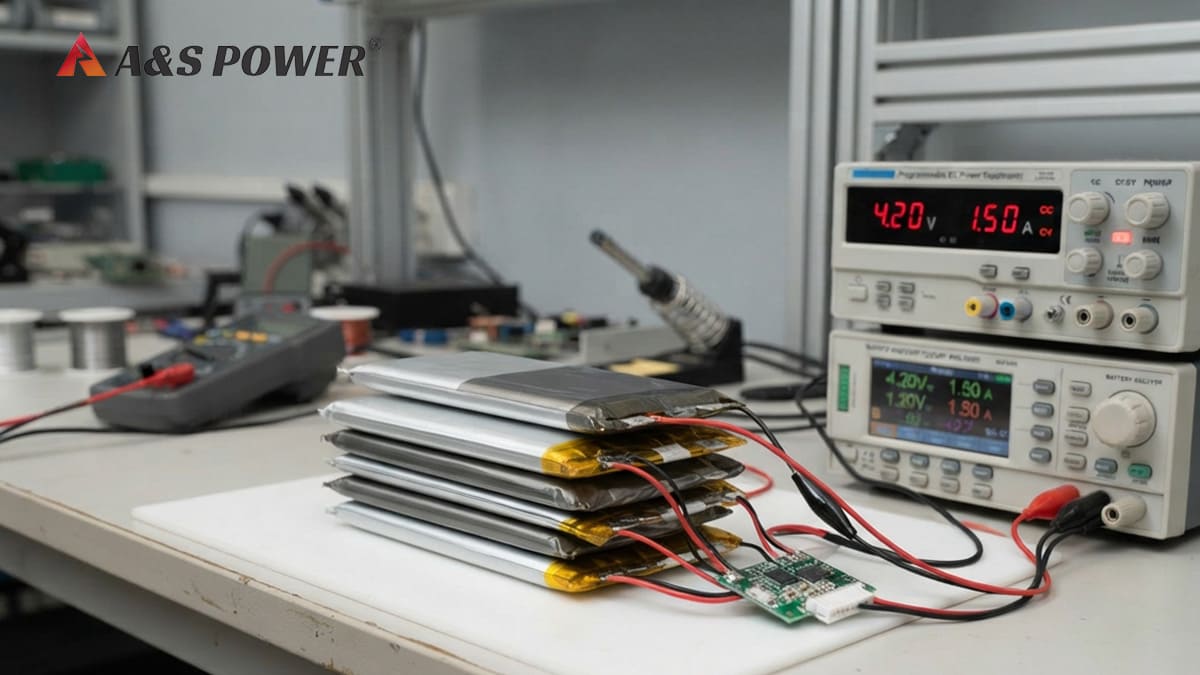
For a conventional 3.7V nominal lithium-polymer (Li-Polymer or LiPo) cell, the typical full-charge voltage is 4.20V per cell. The charger normally uses a constant-current/constant-voltage (CC/CV) profile: it charges at a controlled current until the cell reaches the specified charge voltage, then holds that voltage while the charging current gradually decreases.
However, 4.20V is not automatically the correct voltage for every Li-Polymer battery. Some lithium-ion polymer chemistries are designed for higher charge voltages such as 4.35V. The correct charge voltage must therefore come from the specific cell manufacturer's specification rather than from the battery's nominal voltage alone. Microchip's Li-Ion/Li-Polymer charging documentation provides selectable regulation voltages including 4.20V, 4.35V, 4.40V and 4.50V for different battery requirements.
From my experience working with custom battery projects, the important question is not simply "Is 4.2V the optimal voltage?" It is "What charge-voltage limit was the cell designed for, and how should that voltage be controlled throughout the charging process?"
What Is the Optimal Charge Voltage for a Li-Polymer Battery?
For the large number of conventional 3.7V nominal Li-Polymer cells used in portable electronics, 4.20V per cell is the standard charge-voltage target.
For example, A&S Power's AS102040 3.7V 700mAh LiPo battery specifies a 4.2V charge voltage and a 4.23V maximum charge voltage. Its standard charge current is 0.2C, while the maximum charge current is listed as 700mA.
A&S Power's AS502248 3.7V 500mAh LiPo battery similarly specifies 4.2V charge voltage and 4.23V maximum charge voltage, with a standard charging condition of 0.5C and a maximum charge current of 1C.
This distinction between nominal voltage and charge voltage is important:
| Battery parameter | Typical value for conventional LiPo |
|---|---|
| Nominal voltage | 3.7V |
| Full-charge voltage | 4.20V |
| Typical maximum specified voltage | Around 4.20–4.23V |
| Typical discharge cut-off | Around 3.0V |
| Standard charging method | CC/CV |
| Typical charging temperature | 0°C to 45°C, depending on cell |
These values are representative rather than universal. The actual specification always takes priority.
A typical Li-Polymer cell therefore should not be charged to 3.7V simply because its nominal voltage is 3.7V. Nominal voltage describes the approximate operating voltage of the cell, while the charge-voltage limit defines how high the cell voltage may rise during charging.
Why Does a 3.7V LiPo Battery Charge to 4.2V?
The 3.7V figure represents a nominal operating voltage, not the voltage of a fully charged cell.
During discharge, the cell voltage gradually moves downward. During charging, the voltage rises until it reaches the cell's specified upper voltage limit.
The charger then changes from constant-current charging to constant-voltage charging.
This is why a typical 3.7V LiPo cell can have:
- 3.7V nominal voltage
- 4.2V charge voltage
- approximately 3.0V discharge cut-off, depending on the cell specification
The same principle applies to battery packs connected in series.
| Configuration | Nominal voltage | Typical full-charge voltage* |
|---|---|---|
| 1S | 3.7V | 4.2V |
| 2S | 7.4V | 8.4V |
| 3S | 11.1V | 12.6V |
| 4S | 14.8V | 16.8V |
| 6S | 22.2V | 25.2V |
*Based on a conventional 4.20V-per-cell LiPo chemistry. The actual pack specification must be confirmed before charging.
For a multi-cell pack, I would never determine the charger voltage simply from the number of cells without checking the cell chemistry and manufacturer's specification.
How Does CC/CV Charging Work for Li-Polymer Batteries?
The charging profile is just as important as the voltage target.
Stage 1: Constant-Current Charging
During the first major stage, the charger supplies a controlled charging current while the battery voltage rises.
For example, a cell rated for 2,000mAh might be charged at 0.5C, corresponding to approximately 1,000mA, if that charging rate is permitted by its datasheet.
The exact current is application-specific. A higher charge current does not automatically mean a better charging solution.
TI charging documentation describes the constant-current phase as the period when the charger supplies the permitted charging current while the battery voltage remains below the regulation point.
Stage 2: Constant-Voltage Charging
When the cell reaches its specified charge voltage, the charger switches to constant-voltage operation.
For a conventional LiPo cell, that voltage is commonly 4.20V.
The charger holds approximately 4.20V while the charging current gradually decreases. Charging terminates when the current reaches the specified termination threshold or when another safety condition is met.
Microchip's Li-Ion/Li-Polymer charger documentation describes this same CC/CV process, including 4.2V regulation and charge termination.
Battery University also describes 4.20V/cell as a common Li-ion upper-voltage limit, with the current falling during the constant-voltage stage as the cell approaches full charge.
Is 4.2V Always Better Than 4.35V?
No.
The correct voltage depends on the specific cell chemistry and its design.
Some lithium-ion polymer cells are designed around a 4.20V upper charge limit, while certain high-voltage lithium-ion chemistries use higher limits such as 4.35V.
Modern charger ICs reflect this difference. Microchip's MCP73833/4 , for example, provides selectable regulation options including 4.20V, 4.35V, 4.40V and 4.50V to accommodate different battery requirements.
Therefore, a 4.35V charger should never be connected to a conventional 4.20V LiPo cell simply because the higher voltage appears to provide more capacity.
The charger voltage must match the cell specification.
A practical engineering rule is:
rather than:
This becomes especially important when developing a custom battery pack for an OEM product.
Does a Higher Charge Voltage Increase Battery Capacity?
A higher permitted charge voltage can increase the amount of energy stored in some lithium-ion cells, but this does not mean that increasing the voltage beyond the specified limit is a safe way to obtain more capacity.
For conventional lithium-ion cells, Battery University summarizes a trade-off between charge-voltage limit, stored energy and cycle life . Its published data show that reducing the upper charge voltage can reduce available capacity while potentially increasing cycle life. These figures are estimates and vary by cell chemistry and construction.
This illustrates an important engineering trade-off:
Higher charge voltage → potentially higher usable capacity, but greater electrochemical stress
Lower charge voltage → potentially lower usable capacity, but reduced upper-voltage stress
However, this does not mean that OEM engineers should arbitrarily lower the charging voltage. If a battery is specified for 4.20V, operating it at a lower voltage changes its usable capacity and charging behavior.
For a commercial product, the appropriate voltage should be selected based on the cell manufacturer's validated specification and the application's priorities.
What Happens If a LiPo Battery Is Overcharged?
Overcharging a lithium-polymer battery is a serious safety and reliability issue.
When the cell is charged beyond its specified upper voltage limit, the electrochemical system is pushed outside its intended operating range. This can accelerate degradation and, under severe conditions, create hazardous failure modes.
The University of Illinois battery-safety guidance recommends using a charger specifically rated for the Li-ion or LiPo battery and avoiding overcharging or over-discharging. It also emphasizes monitoring individual cell voltages in battery packs.
This is one reason why a custom LiPo battery pack normally needs more than just cells and wires.
Depending on the application, the battery design may incorporate:
- PCM protection
- BMS
- Overcharge protection
- Over-discharge protection
- Over-current protection
- Short-circuit protection
- NTC temperature sensing
- Cell balancing for series packs
- Charger communication or control
At A&S Power, we can customize Li-Polymer battery voltage, capacity, wiring, connectors and PCM protection according to the application requirements. Explore A&S Power custom Li-Polymer battery solutions .
What Is the Best Charging Voltage for a 3.7V LiPo Battery?
For a conventional 3.7V nominal LiPo cell, the typical charge-voltage target is:
But engineers should verify three separate specifications:
- Nominal voltage
- Charge voltage
- Maximum permitted charge voltage
For example, A&S Power's AS603030 3.7V 520mAh LiPo battery lists a 4.2V charge voltage and 4.23V maximum charge voltage. It also specifies a 0–45°C charging temperature range.
This illustrates why "4.2V" and "4.23V maximum" should not be treated as interchangeable specifications.
The first is the intended charging regulation voltage; the second defines an upper specification limit.
What Charging Voltage Should Be Used for a Custom LiPo Battery Pack?
For an OEM battery pack, I recommend defining the charging specification before finalizing the battery mechanical design.
The engineering process should consider:
1. Cell chemistry
Confirm whether the selected cell is a conventional 4.20V LiPo cell or a higher-voltage chemistry.
2. Series configuration
A 2S conventional LiPo pack requires approximately 8.4V at full charge, while a 3S pack requires approximately 12.6V.
3. Charging current
The maximum charging current must come from the cell specification. It should not be selected only according to charger output capability.
4. Protection circuit
The PCM/BMS should be designed around the actual cell and pack configuration.
5. Temperature
Charging temperature limits are part of the battery specification. For example, several A&S Power LiPo products specify charging from 0°C to +45°C. See the AS502248 product specification .
6. Product lifetime
A medical device, wearable, GPS tracker and industrial instrument may have very different priorities for capacity, charging speed, temperature range and cycle life.
This is where customization becomes more valuable than simply selecting an off-the-shelf battery.
A&S Power's custom battery solution supports customization of voltage, capacity, size, connectors, PCM and other battery-pack parameters.
A Practical LiPo Charge-Voltage Reference
The following table summarizes the most common configurations for conventional 3.7V nominal LiPo cells:
| Battery configuration | Nominal voltage | Typical charge voltage | Typical application |
|---|---|---|---|
| 1S LiPo | 3.7V | 4.20V | Wearables, GPS, portable electronics |
| 2S LiPo | 7.4V | 8.40V | Portable industrial equipment |
| 3S LiPo | 11.1V | 12.60V | Drones, instruments, robotics |
| 4S LiPo | 14.8V | 16.80V | Larger portable equipment |
| 6S LiPo | 22.2V | 25.20V | Higher-voltage equipment |
These values assume a conventional 4.20V-per-cell charging limit. A different cell chemistry requires a different calculation.
For example, if a high-voltage cell is specifically rated at 4.35V, a 2S pack would have a 8.70V maximum charge voltage rather than 8.40V.
That is why the number of series cells alone is not enough to specify a charger.
How We Specify Charge Voltage in OEM Battery Projects
When we develop a custom LiPo battery for an OEM customer, I treat charge voltage as part of the complete electrical system rather than as an isolated battery parameter.
The battery, charger, PCM/BMS, connector, thermistor and host device need to work together.
A&S Power currently provides Li-Polymer battery products covering common nominal voltages including 3.7V, 3.8V, 7.4V, 11.1V, 14.8V and higher configurations, with customization available for voltage, capacity, dimensions and protection circuits.
For example, our AS7565121 3.7V 16Ah LiPo battery specifies a 4.2V charge voltage, 3.2A standard charging current and 0–45°C charging range.
These real product specifications demonstrate an important point: charge voltage, charge current, capacity and temperature are interdependent design parameters.
Conclusion
For most conventional 3.7V nominal Li-Polymer batteries, 4.20V per cell is the standard full-charge voltage. The battery should normally be charged using a controlled CC/CV profile, with constant-current charging followed by constant-voltage charging and controlled termination.
But the optimal voltage is not determined by the words "LiPo battery" alone.
Some lithium-ion polymer cells are designed for higher charge voltages, including 4.35V-class chemistries. Therefore, the correct engineering approach is always to start with the cell manufacturer's specification, then match the charger, PCM/BMS, series configuration and temperature-control strategy to that specification.
For OEM products, selecting the right charge voltage is only one part of battery design. Mechanical dimensions, capacity, charging current, connector, protection circuit, operating temperature, certification and expected service life all need to be considered together.
If your product requires a custom Li-Polymer battery, A&S Power can help develop a custom LiPo battery solution based on the device's available space, power requirements and charging architecture.
Frequently Asked Questions
Is 4.2V the optimal charge voltage for a LiPo battery?
For many conventional 3.7V nominal LiPo cells, 4.20V per cell is the typical full-charge voltage. However, the cell manufacturer's specification always takes priority because some lithium-ion polymer chemistries use different upper charge-voltage limits.
Can I charge a 3.7V LiPo battery with a 4.35V charger?
Only if the specific battery is designed and rated for a 4.35V charging limit. A conventional 4.20V LiPo cell should not be charged to 4.35V simply to increase capacity. The charger voltage must match the battery chemistry and manufacturer's specification.
What is the charge voltage of a 2S LiPo battery?
For a conventional 4.20V-per-cell LiPo configuration, a 2S battery has a nominal voltage of 7.4V and a full-charge voltage of 8.4V.
Why does a 3.7V LiPo battery charge to 4.2V?
3.7V is the nominal voltage rather than the maximum voltage. During charging, the cell voltage rises to its specified upper charge limit, which is typically 4.20V per cell for conventional LiPo chemistry.
Does lower LiPo charging voltage increase battery life?
A lower upper-charge voltage can reduce voltage-related stress and may extend cycle life in some lithium-ion chemistries, but it also reduces the amount of energy stored. The actual trade-off depends on the specific cell and application. Battery University provides illustrative information on this capacity-versus-cycle-life relationship for lithium-ion cells.
What charging current should I use for a LiPo battery?
The charging current must follow the cell manufacturer's specification. Common specifications may use values such as 0.2C, 0.5C or 1C, but these values should not be assumed for every LiPo cell. For example, A&S Power product specifications list different standard and maximum charging currents depending on the specific LiPo model.
Does a LiPo battery need a BMS or protection circuit?
Protection requirements depend on the battery configuration and application. Protection may include overcharge, over-discharge, over-current, short-circuit and temperature protection. Series-connected packs may also require cell balancing. The battery protection system should be designed together with the cell and charger.
Can A&S Power customize the charge voltage of a LiPo battery?
Yes. A&S Power provides custom Li-Polymer battery solutions with configurable voltage, capacity, dimensions, connectors, wiring and PCM/protection functions. The final charge-voltage specification is selected according to the cell chemistry and pack configuration rather than simply changing the voltage arbitrarily. View A&S Power Custom Li-Polymer Battery Solutions .
Need a Custom Li-Polymer Battery?
If you are developing a wearable, medical device, GPS tracker, IoT product, industrial instrument or other portable electronic product, the correct charge voltage should be designed together with the cell chemistry, capacity, protection circuit and charging system.
Get Custom LiPo Battery Solution