





What's the Difference Between Volts and Amps? A Beginner's Guide
Quick Answer:
What is the difference between volts and amps?
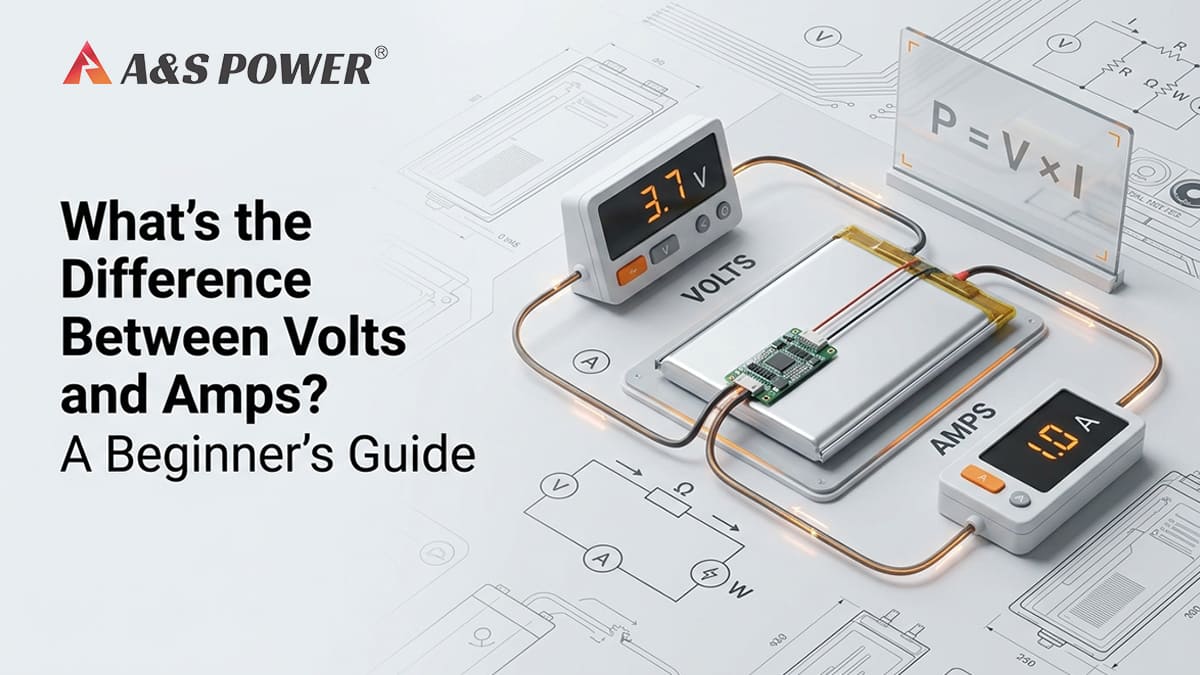
Volts measure electrical voltage, or the potential difference that drives current through a circuit. Amps measure electrical current, or the rate at which electric charge flows.
In simple terms, I think of volts as the electrical push and amps as the electrical flow. They are different measurements, but they work together. The amount of current that flows depends on the voltage and the resistance of the circuit, which is described by Ohm’s law:
I = V ÷ R
Where:
- I = current in amps (A)
- V = voltage in volts (V)
- R = resistance in ohms (Ω)
Voltage and current also determine electrical power:
P = V × I
So, if a device operates at 10 V and draws 2 A, its electrical power is approximately 20 W under those conditions. These relationships are fundamental when evaluating power supplies, electronic devices, and rechargeable batteries.
Introduction
Why Volts and Amps Are Easy to Confuse
When people first start learning about electricity, volts and amps are two of the numbers they encounter most often.
A battery may be labeled 3.7 V and 500 mAh. A power adapter may say 5 V, 2 A. An electronic device might require 12 V and 1.5 A.
At first glance, these numbers can look interchangeable because they all describe electrical performance. They are not.
From my experience working with rechargeable lithium batteries, I have found that one of the most common beginner mistakes is treating voltage and current as if they describe the same thing. They do not.
Voltage tells us about electrical potential. Current tells us about charge flow.
Understanding that distinction makes it much easier to understand battery specifications, chargers, power consumption, and custom battery design.
What Is Voltage and What Do Volts Measure?
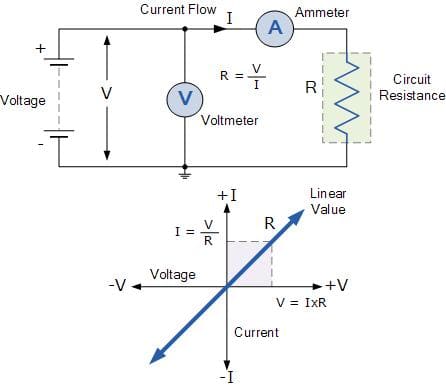
Voltage is the electrical potential difference between two points in a circuit. It is measured in volts (V).
A useful beginner analogy is water pressure.
Imagine a water system. Pressure provides the force that can drive water through a pipe. In an electrical circuit, voltage provides the potential difference that can drive current through a conductive path.
This analogy is not a perfect description of electricity, but it is useful when learning the basic relationship between voltage and current.
The Open University describes voltage as the electrical “push” that enables current to flow when a complete circuit exists.
What Does a Higher Voltage Mean?
A higher voltage does not automatically mean that a device consumes more current.
Instead, the effect of voltage depends on the circuit.
For a simple resistive load, Ohm’s law tells us:
I = V ÷ R
If resistance remains constant, increasing voltage increases current.
For example:
| Voltage | Resistance | Current |
|---|---|---|
| 3 V | 10 Ω | 0.30 A |
| 5 V | 10 Ω | 0.50 A |
| 10 V | 10 Ω | 1.00 A |
| 12 V | 10 Ω | 1.20 A |
This is why voltage compatibility matters when selecting a battery or power supply. Applying the wrong voltage can cause a device to operate incorrectly or, depending on the equipment, damage components.
What Are Amps and What Does Current Measure?
Amps, short for amperes, measure electric current.
Current describes the rate at which electric charge moves through a circuit. One ampere corresponds to one coulomb of charge flowing per second.
In practical electronics, current is often expressed in smaller units such as:
- 1 A = 1,000 mA
- 1 mA = 0.001 A
- 1 µA = 0.001 mA
For example, a small wearable device might operate at hundreds of milliamps, while a larger motor or power system may require several amps or considerably more.
The important point is that amps describe current, not battery capacity.
That distinction becomes especially important when working with lithium batteries.
Volts vs Amps: What Is the Difference?
The simplest way to remember the difference is:
| Electrical Quantity | What It Describes | Unit | Symbol |
| Voltage | Electrical potential difference | Volt | V |
| Current | Rate of electric charge flow | Ampere | A |
| Resistance | Opposition to current flow | Ohm | Ω |
| Power | Rate of energy transfer | Watt | W |
| Capacity | Amount of charge a battery can deliver over time | Ampere-hour | Ah / mAh |
So, if I see a battery specification such as 3.7 V, 1,000 mAh, the two numbers tell me different things.
3.7 V is the nominal voltage.
1,000 mAh is the battery's rated capacity.
Neither number by itself tells me the maximum current the battery can safely deliver. That requires additional information, such as the cell's discharge rating, internal resistance, protection design, and application requirements.
How Do Volts and Amps Work Together?
Voltage and current are closely related, but neither should be considered in isolation.
Ohm's law provides the basic relationship:
V = I × R
It can also be rearranged as:
I = V ÷ R
and:
R = V ÷ I
For example, if a circuit has a voltage of 5 V and resistance of 10 Ω:
I = 5 ÷ 10 = 0.5 A
If the same resistance is connected to 10 V:
I = 10 ÷ 10 = 1 A
This is a simplified resistive example. Real electronic devices can contain regulators, motors, switching circuits, capacitors, inductive loads, and other components, so their current behavior may not follow a simple fixed-resistance model.
That is why engineers normally evaluate the complete electrical load rather than assuming that every device behaves like a resistor.
What Is the Relationship Between Volts, Amps and Watts?
Once voltage and current are understood, watts become much easier to understand.
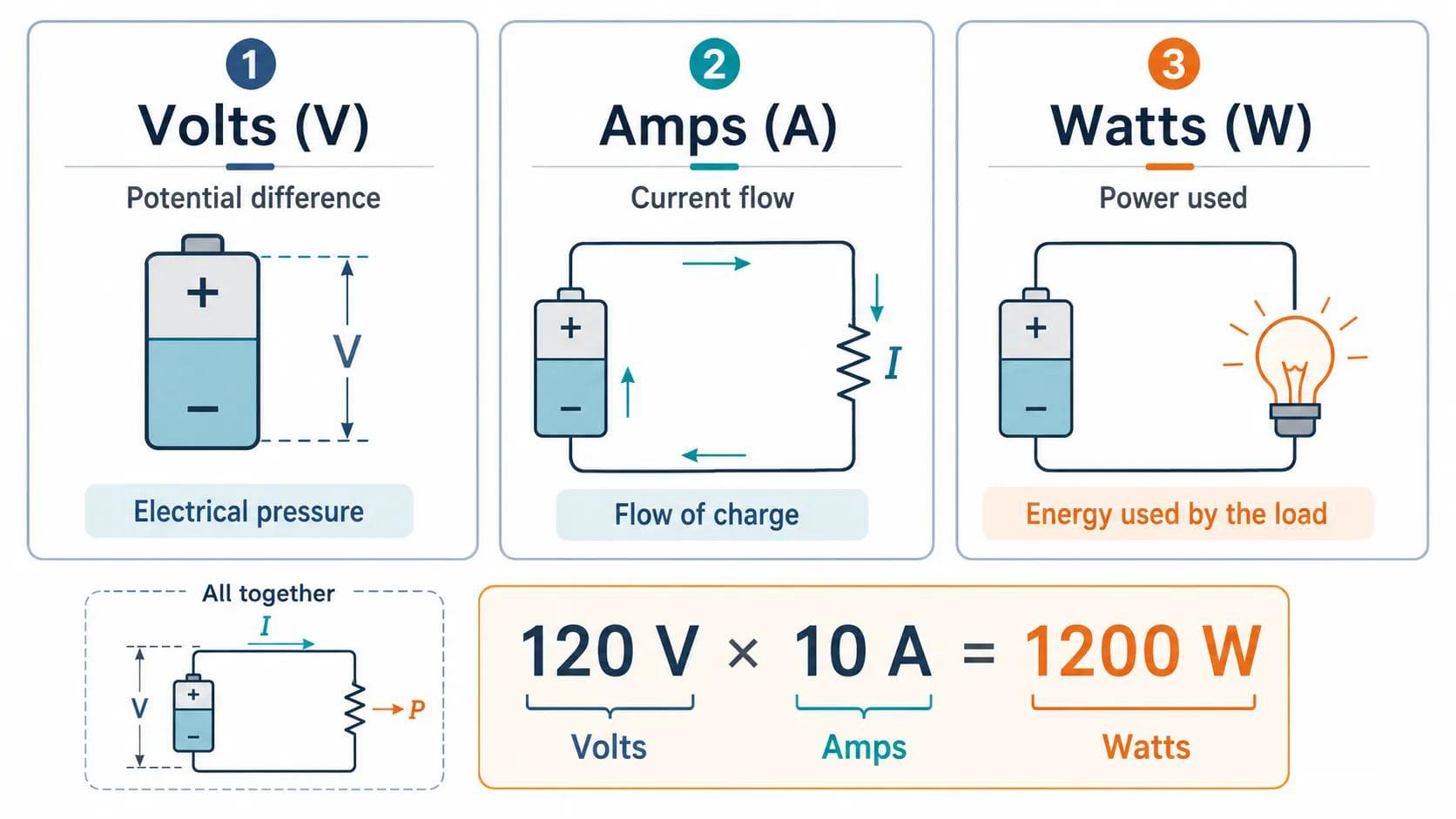
Electrical power is calculated as:
P = V × I
For example:
5 V × 2 A = 10 W
A 5 V device drawing 2 A is therefore using approximately 10 W of electrical power under those conditions.
Here are several examples:
| Voltage | Current | Power |
| 3.7 V | 1 A | 3.7 W |
| 5 V | 1 A | 5 W |
| 5 V | 2 A | 10 W |
| 12 V | 2 A | 24 W |
| 24 V | 2 A | 48 W |
The Open University similarly defines electrical power as the product of current and potential difference: power = voltage × current.
This relationship is particularly useful when estimating the electrical demand of battery-powered equipment.
How Do Volts and Amps Apply to Batteries?
Battery specifications can become confusing because manufacturers normally provide several different electrical parameters.
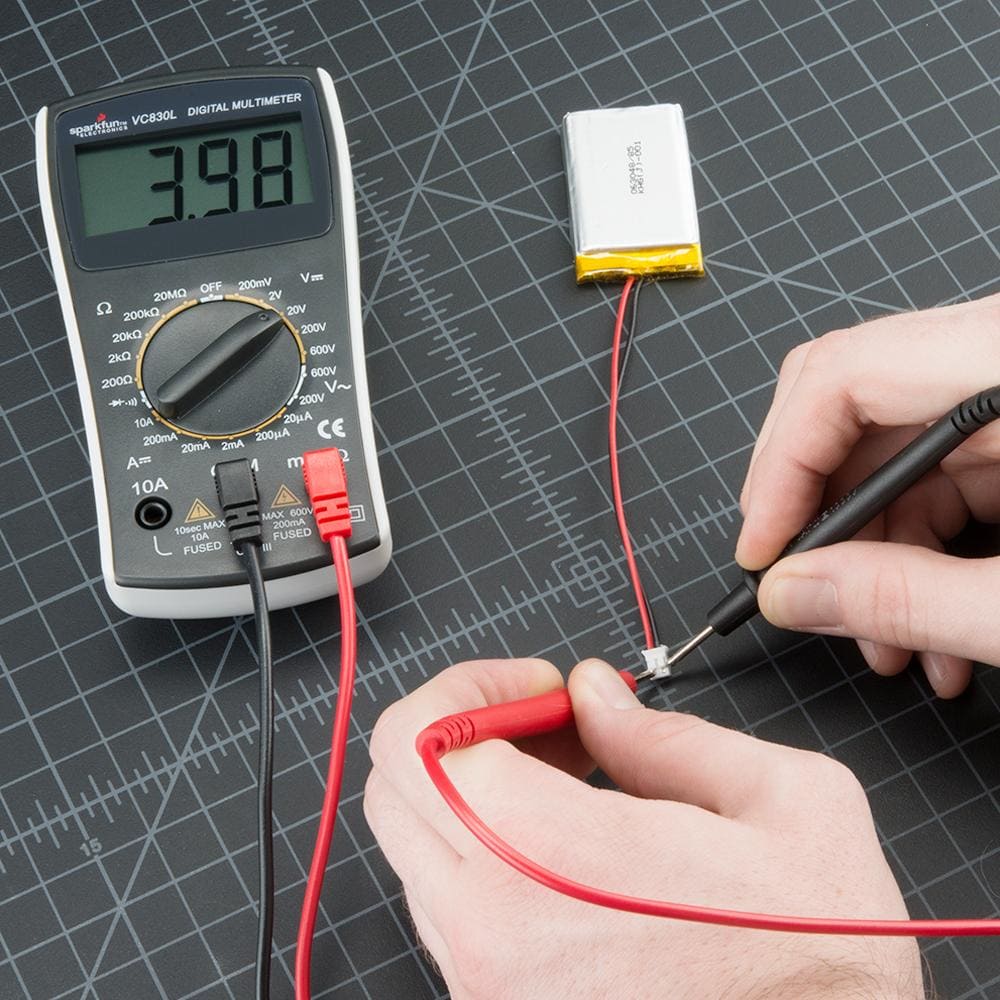
For a rechargeable lithium battery, I may see:
- Nominal voltage
- Capacity
- Standard charge current
- Maximum charge current
- Standard discharge current
- Maximum discharge current
- Internal resistance
- Cut-off voltage
- Operating temperature
These values describe different characteristics.
For example, A&S Power's AS606060 lithium polymer battery is specified at 3.7 V nominal voltage and 3,000 mAh capacity, with a listed maximum charge/discharge current of 3,000 mA.
Another example is the A&S Power AS401230 LiPo Battery, which is specified at 3.7 V and 120 mAh, with a listed maximum charge/discharge current of 120 mA.
These examples demonstrate an important point: voltage, capacity, and current rating are separate specifications.
A battery with a larger capacity does not automatically have a higher voltage. Likewise, a higher voltage battery does not automatically have a higher current capability.
What Is the Difference Between Amps and Amp-Hours?
This is another common source of confusion.
Amps (A) measure current.
Amp-hours (Ah) measure battery capacity.
For example, a battery rated at 2 Ah theoretically represents 2 amp-hours of charge capacity under its specified test conditions.
A simplified calculation might look like:
Runtime ≈ Battery capacity ÷ Load current
So, if a 2 Ah battery supplied a constant 0.5 A load, the idealized result would be:
2 Ah ÷ 0.5 A = 4 hours
However, real battery runtime is usually different because of discharge conditions, efficiency, temperature, battery aging, voltage limits, and the behavior of the electronic load.
For engineering projects, I therefore treat this equation as a starting estimate rather than a guaranteed runtime.
Why Voltage Matters When Choosing a Battery
When selecting a battery for an electronic product, voltage is usually one of the first parameters I check.
The battery voltage must be compatible with the device's electrical architecture.
For example, a typical single lithium polymer cell is commonly specified around 3.7 V nominal, while its actual voltage changes during charging and discharging. A&S Power's technical documentation lists 3.7 V as the nominal voltage for its LiPo cells, with charging commonly reaching approximately 4.2 V per cell.
For a 2S LiPo configuration, two cells are connected in series, producing approximately 7.4 V nominal.
This is why battery packs may be labeled:
- 1S = approximately 3.7 V nominal
- 2S = approximately 7.4 V nominal
- 3S = approximately 11.1 V nominal
- 4S = approximately 14.8 V nominal
The actual voltage range depends on the cell chemistry and pack design, so engineers should always evaluate the manufacturer's specified charge and discharge limits rather than relying only on the nominal number.
Why Current Matters in Battery Design
Voltage tells me whether the electrical level is appropriate. Current tells me whether the battery can support the required load.
Suppose a portable device requires 2 A during normal operation but occasionally reaches a higher startup current.
A battery specification that only matches the voltage is not enough.
I would also evaluate:
- Continuous discharge current
- Peak or pulse current
- Internal resistance
- Protection circuit limits
- Temperature
- Connector and wire ratings
- Expected battery aging
For custom lithium battery projects, this is one reason I prefer to start with the actual device load profile rather than simply selecting a battery based on capacity.
A custom battery pack can be designed around voltage, capacity, discharge current, physical dimensions, connector requirements, and protection electronics. A&S Power's custom battery solution process specifically considers electrical design parameters such as nominal voltage, capacity, charge/discharge current, and series/parallel configuration.
A Simple Real-World Example
Let's consider a small portable electronic device.
Assume it operates from a 3.7 V battery and normally draws 0.5 A.
Its approximate electrical power is:
3.7 V × 0.5 A = 1.85 W
Now imagine the device needs 1 A under a heavier load:
3.7 V × 1 A = 3.7 W
The voltage has not changed, but the current and power have increased.
This simple example shows why engineers need to consider both voltage and current when evaluating battery performance.
Common Mistakes Beginners Make About Volts and Amps
Mistake 1 — Thinking More Amps Means More Voltage
It does not.
A power supply can provide a fixed voltage while the connected device draws the current it requires, within the supply's capabilities.
Mistake 2 — Treating mAh as Amps
mAh is a capacity unit, not an instantaneous current measurement.
A 1,000 mAh battery is not necessarily a “1 amp battery.” The actual allowable current depends on the battery design and manufacturer's specifications.
Mistake 3 — Assuming Higher Voltage Is Always Better
Higher voltage is not automatically better.
The correct voltage is the one compatible with the device's electrical design.
Mistake 4 — Looking Only at Battery Capacity
A high-capacity battery may provide longer runtime, but it still needs to satisfy the device's voltage and current requirements.
How I Look at Voltage and Current When Selecting a Battery
When I evaluate a battery requirement for an OEM project, I normally start with five basic questions:
| Parameter | Question I Ask |
| Voltage | What nominal and operating voltage does the device require? |
| Current | What is the normal and peak load current? |
| Capacity | How much runtime is required? |
| Size | What physical space is available? |
| Safety | What protection and certification requirements apply? |
This approach is more useful than simply asking, “How many mAh do I need?”
For a real product, electrical requirements and mechanical constraints have to work together.
For example, a medical device may require a compact battery with stable voltage, controlled discharge performance, a specific connector, protection circuitry, and appropriate compliance documentation. A GPS tracker may prioritize low weight and energy efficiency, while a high-power industrial device may place much greater emphasis on discharge current.
Conclusion
Understanding the difference between volts and amps is one of the first steps toward understanding electrical and battery-powered systems. Volts measure electrical potential, while amps measure the flow of electric current. Together, voltage and current determine how electrical power is delivered to a device.
For battery applications, I recommend looking beyond voltage or capacity alone. The battery voltage must match the device's electrical requirements, while its continuous and peak current capability must support the actual load. Capacity, measured in Ah or mAh, is another important factor because it influences potential operating time.
This becomes particularly important when selecting a lithium polymer or lithium-ion battery for an OEM product. A suitable battery may need to balance voltage, current, capacity, dimensions, connector requirements, protection circuitry, charging specifications, and operating conditions.
At A&S Power, we consider these electrical and mechanical requirements when developing customized lithium battery solutions for different applications. By understanding the relationship between volts, amps, watts, and battery capacity, engineers and product developers can make more informed battery selection and design decisions.
If you are developing a battery-powered product, I recommend evaluating the complete electrical load profile rather than selecting a battery based on mAh alone. The right battery is not simply the one with the highest capacity—it is the one whose electrical, physical, and safety characteristics match the requirements of the finished device.
FAQ: Volts, Amps and Batteries
Q1: What is the difference between volts and amps?
Volts measure electrical potential difference, while amps measure electric current. Voltage describes the electrical “push,” while current describes the rate of charge flow.
Q2: Are volts or amps more important?
Neither is universally more important. The correct voltage must match the device, while the battery or power source must also be capable of supplying the required current.
Q3: Does higher voltage mean higher current?
Not necessarily. According to Ohm's law, current depends on both voltage and resistance. In a simple resistive circuit, increasing voltage increases current if resistance remains constant.
Q4: How are volts, amps and watts related?
They are related by the formula:
Watts = Volts × Amps
For example, 12 V × 2 A equals 24 W.
Q5: Is mAh the same as amps?
No. Amps measure current, while mAh measures battery capacity. A battery's mAh rating does not by itself specify its maximum discharge current.
Q6: How many volts does a typical LiPo battery have?
A common single-cell LiPo battery has a nominal voltage of approximately 3.7 V. Its voltage changes during charging and discharging, so the nominal value should not be confused with its full operating voltage range.
Q7: How do I know how much current my battery needs to provide?
Start with the device's normal operating current and identify its maximum or peak current demand. Then evaluate the battery's continuous and peak discharge ratings, protection circuit, connector, wiring, temperature conditions, and expected aging.
Q8: Can I use a battery with the same voltage but a different capacity?
In many applications, yes, provided the voltage range, physical dimensions, connector, charging requirements, discharge capability, protection system, and other electrical specifications are compatible. Capacity mainly affects potential operating time, but it is not the only selection criterion.
-

 May.2026.09.24Optimal Li-Polymer Battery Charge Voltage ExplainedLearn More
 -
 May.2026.09.24Optimal LiFePO4 Charge Voltage Explained: 12V, 24V and 48VLearn More
 -
 May.2026.09.22Can All Lithium Batteries Be Recharged?Learn More
 -
 May.2026.09.21UN3480 vs UN3481: Lithium-Ion Battery Shipping GuideLearn More
 -
 May.2026.09.2121700 Battery Specifications: Capacity, Size, Voltage, and UsesLearn More