



Introduction
Choosing the right custom lithium battery supplier is one of the most important decisions in an OEM product development project. A battery may account for only one part of the finished product, but its performance, safety, dimensions, charging characteristics, and supply stability can directly affect the entire product.
For procurement teams, comparing suppliers based only on unit price, advertised production capacity, or a list of certifications is rarely enough. Two manufacturers may quote batteries with identical nominal voltage and capacity, yet offer very different levels of engineering support, component traceability, production consistency, and technical responsibility.
The challenge becomes more significant when a project requires a customized lithium-ion battery pack, lithium polymer battery, or LiFePO4 battery rather than a standard catalog product.
At A&S Power, we believe OEM battery procurement should begin with technical requirements and supplier verification, not price negotiations. Based on our experience supporting rechargeable battery OEM and ODM projects, we recommend evaluating suppliers across engineering capability, cell sourcing, quality management, product testing, regulatory compliance, and long-term production support.
This guide explains what procurement teams should demand before selecting a custom lithium battery manufacturer.
Quick Answer: What Should OEM Procurement Teams Demand?
The best custom lithium battery supplier for an OEM project should demonstrate the following capabilities:
- Application-specific battery engineering and customization.
- Transparent cell sourcing and component traceability.
- Documented manufacturing and quality control procedures.
- Prototype development and application-based validation.
- Relevant, configuration-specific safety and compliance documentation.
- Controlled production processes and engineering change management.
- Reliable production capacity and long-term supply support.
- Clear commercial terms, technical communication, and after-sales responsibility.
The key principle is simple: A qualified supplier must demonstrate that it can design, manufacture, test, document, and consistently reproduce the exact battery configuration your product requires.
1. Engineering Capability: Can the Supplier Design Around Your Application?
A professional OEM battery supplier should understand the equipment before recommending a battery.
Voltage and capacity are only the starting points. A complete technical evaluation should consider:
- Nominal voltage and operating voltage range.
- Required capacity and energy consumption.
- Continuous and peak discharge current.
- Charging voltage and charging current.
- Battery dimensions, weight, and installation space.
- Operating and charging temperatures.
- Connector type, cable length, and polarity.
- BMS or PCM protection requirements.
- Communication interfaces, where applicable.
For example, a portable medical device and an industrial inspection instrument may both require a 7.4V lithium battery pack. However, their discharge profiles, charging requirements, mechanical structures, and safety considerations can be completely different.
A supplier that recommends a battery based only on voltage and capacity is not performing a complete engineering assessment.
What procurement teams should demand:
Request a preliminary technical proposal that includes the proposed cell configuration, electrical specifications, mechanical drawing, protection circuit requirements, connector details, and identified design assumptions.
At A&S Power, our OEM/ODM customization covers lithium-ion, lithium polymer, and LiFePO4 battery solutions, including voltage, capacity, dimensions, wiring, connectors, and battery protection requirements.
If you are still comparing different battery manufacturers and evaluating which type of supplier best fits your project, our guide on how to choose a custom lithium battery manufacturer explains the key factors to consider before making a sourcing decision.
For project-specific requirements, explore our custom lithium battery solutions to learn more about our OEM and ODM capabilities.
2. Cell Sourcing: Can the Supplier Prove Component Traceability?
Battery cell quality has a direct influence on finished-pack performance and consistency.
A supplier should be able to identify the proposed cell manufacturer, cell model, relevant specifications, and sourcing arrangements. For production orders, procurement teams should also understand how incoming cells are identified and linked to manufacturing batches.
Important verification points include:
- Original cell manufacturer and model.
- Cell datasheet and rated operating limits.
- Manufacturing date or lot identification.
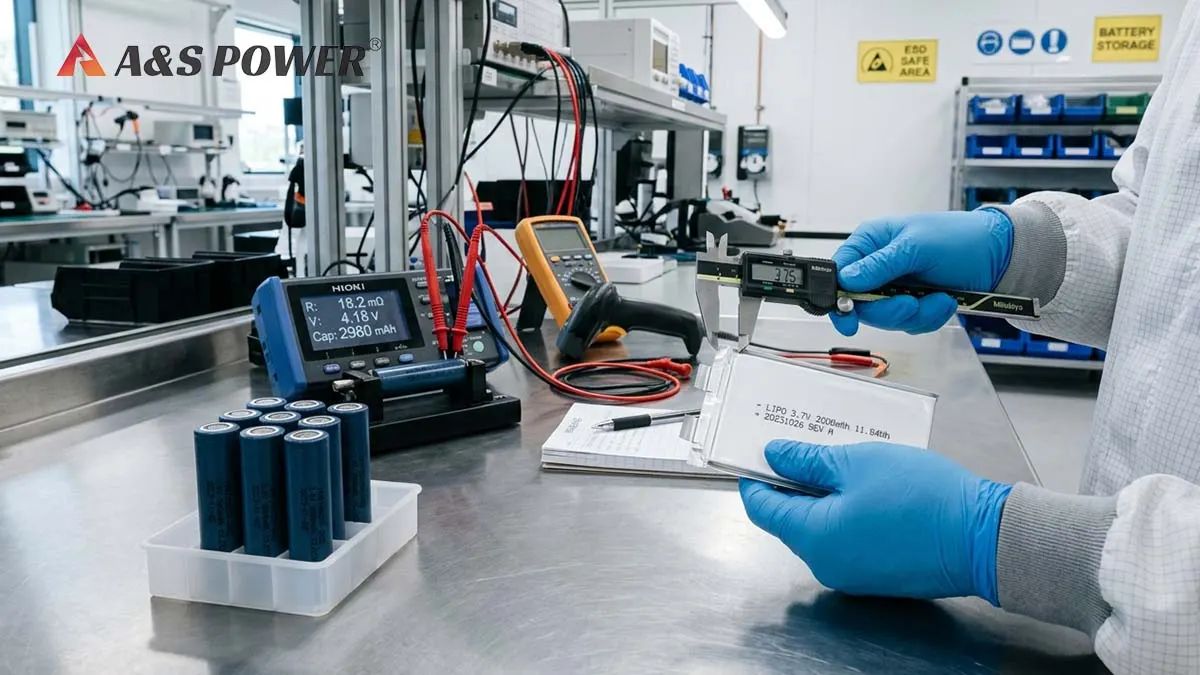
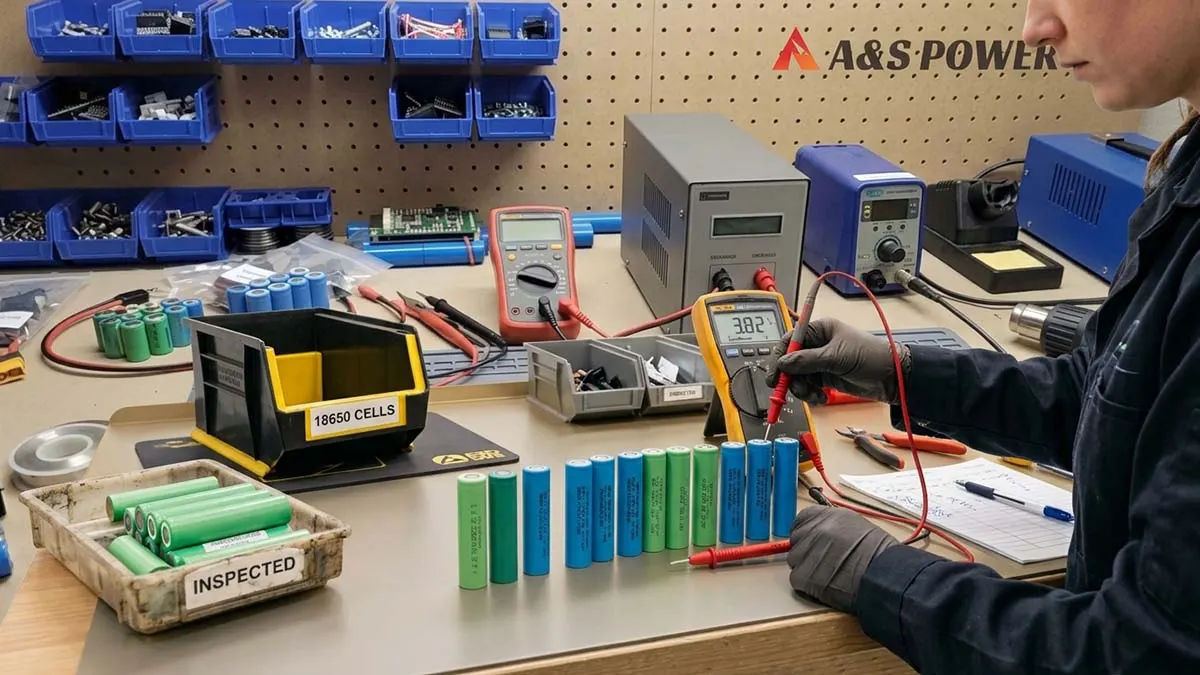
- Incoming capacity and voltage inspection.
- Internal resistance measurement where specified.
- Storage conditions and inventory management.
- Procedures for handling nonconforming cells.
Be particularly cautious when a supplier offers unusually low prices but cannot explain the origin of its cells.
A capacity measurement alone does not establish whether a cell is new, authentic, or correctly stored. Similarly, a cell that passes one electrical test is not automatically suitable for every application.
For OEM programs, cell selection should be supported by technical specifications and a traceable sourcing process.
3. Quality Control: What Happens Beyond the Final Inspection?
A supplier's quality management system should cover the entire manufacturing process, rather than relying exclusively on testing finished batteries.
Procurement teams should understand how quality is controlled at three stages.
Incoming Quality Control (IQC)
Incoming inspection verifies whether purchased materials meet approved requirements.
Depending on the battery design, this may include cell specifications, dimensions, voltage, capacity, internal resistance, PCM/BMS components, wires, connectors, and protective materials.
In-Process Quality Control (IPQC)
Production inspection should monitor critical assembly operations, including cell matching where required, electrical connections, welding, insulation, wiring, protection circuit installation, and pack assembly.
The specific controls depend on the battery construction and manufacturing process.
Final Quality Control (FQC)
Finished battery inspection may include:
- Open-circuit voltage measurement.
- Capacity testing under defined conditions.
- Charge and discharge performance.
- Protection circuit functionality.
- Polarity and connector verification.
- Dimensions and appearance.
- Label and specification verification.
The test conditions and acceptance criteria should be defined before production. A capacity result without the discharge current, temperature, voltage cut-off, and test method is difficult to compare reliably.
Recommended Supplier Quality Documents
| Document or record | What procurement should verify |
|---|---|
| Quality management certificate | Scope, validity, and issuing organization |
| Approved battery specification | Controlled electrical and mechanical requirements |
| Cell datasheet | Manufacturer, model, and operating limits |
| Incoming inspection records | Material acceptance and identification |
| Production inspection records | Critical process monitoring |
| Final test reports | Actual results against defined limits |
| Nonconformance records | How defective products are identified and handled |
| Corrective action reports | Root-cause investigation and preventive measures |
An ISO 9001 certificate can demonstrate that a supplier operates a quality management system within its certified scope. However, it does not independently prove that a particular battery model meets its technical requirements.
Procurement teams should therefore evaluate actual production records alongside management-system certificates.
4. Prototype Testing: Does the Battery Work in the Real Product?
A successful sample test is an important milestone, but it should not be confused with complete product validation.
The battery must operate correctly within the intended equipment, charger, controller, and mechanical environment.
For example, a battery may pass a basic discharge test but still experience voltage drop during peak loads, charging interruptions, excessive temperature rise, or communication problems after integration.
A structured validation plan should consider:
- Electrical performance under expected operating loads.
- Charging compatibility with the intended charger.
- Continuous and peak discharge requirements.
- Protection behavior under defined fault conditions.
- Temperature performance within specified operating limits.
- Mechanical fit, cable routing, and connector compatibility.
- Communication performance, if the battery uses a smart BMS.
- Repeated charge-discharge performance where required.
Testing should follow the requirements of the actual application. Not every battery needs the same test program, and no single test can establish overall reliability.
What procurement teams should demand: An agreed prototype specification, test plan, acceptance criteria, test results, and documented approval before mass production.
A pilot production run can also help identify assembly and process issues that may not appear when evaluating only a few engineering samples.
5. Certifications: Are They Relevant to the Exact Battery?
Certification is another area where procurement teams need to look beyond marketing claims.
A supplier may list UL, IEC, CE, KC, UN38.3, and RoHS documentation. However, the existence of a certificate or test report does not automatically mean every battery manufactured by that company is covered.
The applicable requirements depend on battery chemistry, construction, intended application, destination market, and finished-product design.
| Standard or requirement | Main purpose | What buyers should verify |
|---|---|---|
| UN 38.3 | Lithium battery transport testing | Applicable test evidence and test summary for the battery type |
| IEC 62133-2 | Safety requirements for portable sealed secondary lithium cells and batteries | Applicable product configuration and test scope |
| UL 1642 | Safety standard for lithium cells | Whether the specified cell is covered |
| UL 2054 | Safety standard for household and commercial batteries | Whether the relevant battery pack is covered |
| CE requirements | Applicable European product legislation | Applicable legislation and conformity evidence |
| RoHS | Restriction of certain hazardous substances | Material compliance documentation |
One important distinction: UN 38.3 is a transport testing requirement, not a general product safety certification. Likewise, UL 1642 applies to lithium cells, while UL 2054 addresses batteries.
For international shipments, request the applicable UN 38.3 test summary and confirm that the supplied battery configuration is represented by the supporting test documentation. The UNECE Manual of Tests and Criteria provides the official reference for lithium battery transport testing, including Section 38.3 and its applicable amendments.
For portable sealed lithium batteries, procurement teams can also consult the official IEC 62133-2 standard, which specifies safety requirements and tests under intended use and reasonably foreseeable misuse.
For European projects, also evaluate the applicable obligations under the EU Batteries Regulation (EU) 2023/1542. Requirements can vary according to battery category and the economic operator's role.
At A&S Power, our battery certification library provides product-level certification information for different lithium battery models. Buyers should always confirm the applicable documentation for their specific project.
6. Production Capacity: Can the Supplier Maintain Consistency?
A supplier may successfully produce a prototype but struggle when an OEM project moves into regular production.
Procurement teams should evaluate more than the manufacturer's stated daily output.
Ask about:
- Actual production capacity for the required battery type.
- Available production lines and critical equipment.
- Current production commitments.
- Material procurement lead times.
- Capacity planning for forecast demand.
- Batch-to-batch inspection procedures.
- Backup arrangements for critical components.
- Repeat-order consistency.
For example, a manufacturer specializing in lithium polymer pouch cells may have a different production structure from one assembling cylindrical lithium-ion or LiFePO4 battery packs.
The relevant question is not whether the factory has a large production facility. It is whether its actual processes and resources match your battery design and expected order volume.
A pilot run, production records, and capacity review provide more useful evidence than a general statement that the factory can handle large orders.
7. Change Management and Long-Term Supply Support
One of the most overlooked procurement risks is an undocumented component or design change after sample approval.
A supplier might replace a cell model, connector, protection component, wire specification, or other critical material because of availability or cost considerations.
Even when the replacement appears similar, it may affect electrical performance, mechanical compatibility, reliability, or certification status.
OEM buyers should establish a written change-control process covering:
- Cell and component substitutions.
- Battery specification revisions.
- BMS hardware or firmware changes.
- Manufacturing process changes.
- Certification impact assessments.
- Customer notification and approval.
- Production batch identification.
The supplier should also explain how it handles product complaints, failure analysis, corrective actions, and repeat orders.
A reliable OEM partnership is not limited to the first shipment. It should support the entire product lifecycle.
8. Compare Total Procurement Value, Not Just Unit Price
The lowest quotation does not necessarily represent the lowest procurement cost.
A battery quote may exclude engineering development, tooling, certification testing, special connectors, packaging, inspection, or shipping-related requirements.
Procurement teams should compare suppliers using the same technical and commercial scope.
| Cost factor | Questions to clarify |
|---|---|
| Battery unit price | Does it include the agreed cell, BMS, wiring, and enclosure? |
| Engineering fees | Are design and development charges included? |
| Prototype costs | Are sample production and revisions charged separately? |
| Tooling costs | Are molds or custom fixtures required? |
| Certification costs | Who pays for additional testing or certification? |
| MOQ | What is the minimum order quantity for the approved configuration? |
| Lead time | Are sample and mass-production schedules clearly separated? |
| Warranty | What are the coverage conditions and claim procedures? |
| Logistics | Are packaging and dangerous-goods shipping responsibilities defined? |
I recommend sending the same RFQ specification to every shortlisted supplier. This makes technical and commercial comparisons more meaningful and reduces the risk of selecting a quotation that appears cheaper simply because it excludes important requirements.
9. OEM Battery Supplier Evaluation Scorecard
To make supplier selection more objective, procurement, engineering, and quality teams can use a weighted evaluation model.
The following scorecard is a suggested internal procurement framework, not an industry certification or universal standard.
| Evaluation category | Suggested weight | Key assessment |
|---|---|---|
| Engineering capability | 20% | Custom design and application understanding |
| Cell sourcing and traceability | 15% | Cell authenticity and material control |
| Quality management | 20% | IQC, IPQC, FQC, and corrective actions |
| Testing and validation | 15% | Prototype and application testing |
| Certification support | 10% | Applicable safety and compliance documents |
| Production and supply stability | 10% | Capacity and repeat-order consistency |
| Commercial and technical support | 10% | Quotation transparency and after-sales service |
| Total | 100% |
A procurement team can use the following interpretation as an initial screening tool:
- 85–100 points: Strong candidate for further technical and commercial qualification.
- 70–84 points: Potential candidate, but outstanding issues should be resolved.
- Below 70 points: Significant gaps require further investigation.
A high overall score should never override a critical safety, compliance, or traceability failure. Those issues should be treated as mandatory approval conditions.
10. Warning Signs When Selecting a Custom Battery Supplier
During supplier evaluation, certain warning signs deserve additional attention.
1. Quotation without technical review
A supplier that immediately confirms a price without understanding the application may not have evaluated the actual electrical and mechanical requirements.
2. Unclear cell sourcing
If the supplier cannot identify the cell model or provide relevant supporting specifications, procurement teams should investigate further.
3. Generic certification claims
A company-wide certificate list does not establish that the exact battery configuration is covered.
4. No controlled technical documentation
Missing specifications, drawings, or revision records can create confusion between sample approval and mass production.
5. No formal change-control process
Undocumented component substitutions can introduce unexpected performance and compliance risks.
6. Unrealistic delivery promises
A credible supplier should explain material availability, development stages, production scheduling, and potential supply constraints rather than promising every order can be delivered immediately.
7. Poor communication after sample delivery
If technical questions and failure investigations are difficult to resolve during development, long-term production support may become even more challenging.
Before approving a supplier, procurement teams should also conduct a more detailed background and technical assessment. Read our guide on how to vet a custom lithium battery supplier to learn how to identify potential risks involving cell sourcing, old inventory, product documentation, and manufacturing quality.
11. What Information Should You Include in an OEM Battery RFQ?
A well-prepared Request for Quotation (RFQ) helps manufacturers understand the project and provide comparable proposals.
Before contacting a custom lithium battery supplier, procurement teams should prepare the following information:
| RFQ requirement | Information to provide |
|---|---|
| Application | Device type and intended operating environment |
| Battery chemistry | Li-ion, LiPo, or LiFePO4, if already specified |
| Voltage | Nominal voltage and required operating range |
| Capacity | Target capacity or runtime requirement |
| Discharge | Continuous current, peak current, and duration |
| Charging | Charging voltage, current, and charger information |
| Dimensions | Maximum length, width, thickness, and weight |
| Connection | Connector, cable length, polarity, and wire requirements |
| Protection | PCM/BMS functions and communication requirements |
| Certification | Target market and applicable compliance requirements |
| Quantity | Prototype quantity, initial order, and estimated annual demand |
| Schedule | Sample approval and target mass-production date |
Not every project will have all these specifications finalized. A capable engineering supplier should identify missing information, explain technical assumptions, and help develop a suitable proposal rather than making unsupported commitments.
12. Why Consider A&S Power for Your OEM Battery Project?
At A&S Power, we understand that OEM customers need more than a battery with a specified voltage and capacity. They need a supplier capable of supporting customization, engineering coordination, quality control, and ongoing production requirements.
Shenzhen A&S Power Technology Co., Ltd. has been developing rechargeable battery solutions since 2011, serving customers in consumer electronics, industrial equipment, medical-related devices, and other application markets.
Our OEM and ODM battery solutions include:
- Lithium-ion battery packs: Cylindrical and customized rechargeable battery configurations.
- Lithium polymer batteries: Custom pouch battery dimensions, capacities, and electrical specifications.
- LiFePO4 batteries: Rechargeable lithium iron phosphate battery solutions for suitable applications.
- Battery protection customization: PCM/BMS protection functions designed around project requirements.
- Mechanical customization: Connectors, wires, cables, dimensions, enclosures, and labeling.
- Certification support: Access to relevant product certification records and project-specific documentation.
Our certification library includes records covering UL, IEC/CB, UN38.3, CE, KC, and other applicable requirements across different battery models. Actual coverage must be verified against the selected battery configuration.
For new projects, we recommend starting with the application, electrical requirements, mechanical limitations, and target market. Our technical team can then assess the proposed battery configuration and discuss the next development steps.
Looking for a custom lithium battery solution for your OEM project?
Visit our custom lithium battery solution page or contact A&S Power to discuss your OEM requirements.
Conclusion: Choose a Supplier That Can Support the Entire OEM Project
Selecting the best custom lithium battery supplier requires more than comparing prices and production capabilities.
Procurement teams should demand evidence of engineering competence, traceable components, documented quality control, application-based testing, relevant certifications, controlled production changes, and long-term supply support.
A supplier that can demonstrate these capabilities is better positioned to support the transition from initial concept to prototype approval and repeat mass production.
At A&S Power, we believe a successful OEM battery project starts with understanding the customer's application and continues through every stage of product development and manufacturing.
The right supplier should not simply deliver the battery you requested. It should help ensure that the battery is technically appropriate, consistently manufactured, properly documented, and suitable for your product's long-term requirements.
After completing supplier verification, the next step is to compare qualified manufacturers based on their engineering capabilities, quality systems, certification support, and long-term production reliability. Our guide to the process of vetting a custom lithium battery supplier provides additional guidance for procurement teams conducting a detailed supplier assessment.
Frequently Asked Questions
1. How do I choose the best custom lithium battery supplier for an OEM project?
Evaluate the supplier's engineering capabilities, cell sourcing, manufacturing quality controls, testing procedures, certification support, production capacity, and change management. Request objective documentation and test samples before approving mass production.
2. What is the difference between a battery manufacturer and a battery trading company?
A battery manufacturer typically controls some or all of the battery design, assembly, or production processes, while a trading company primarily coordinates sourcing and sales. However, business classification alone does not establish technical capability. OEM buyers should verify who is responsible for engineering, quality inspection, component sourcing, and after-sales support.
3. What certifications should an OEM lithium battery supplier provide?
Requirements depend on the battery type, application, and destination market. Commonly relevant documentation includes UN38.3 transport test summaries, IEC 62133-2 test reports, UL 1642 cell documentation, and UL 2054 battery documentation. Buyers should verify the applicable scope and configuration rather than relying on certificate names alone.
4. What information is required for a custom lithium battery quotation?
Generally, suppliers need the target voltage, capacity, continuous and peak discharge current, charging requirements, dimensions, application, connectors, protection requirements, target market, and estimated order quantity. Drawings and reference samples can help improve quotation accuracy.
5. Can custom lithium battery manufacturers support small prototype orders?
Many OEM battery manufacturers support engineering samples and prototype development before mass production. However, sample availability, development fees, minimum quantities, and lead times vary according to the battery design, materials, and manufacturing requirements. Confirm these conditions before starting the project.
6. How can procurement teams verify lithium battery quality?
Request approved specifications, cell datasheets, incoming inspection records, production inspection procedures, final electrical test reports, and traceability information. Where appropriate, conduct sample validation and a supplier quality audit.
7. Why is cell traceability important in OEM battery procurement?
Cell traceability helps identify the source and production batch of the cells used in a battery pack. It supports quality investigations, component verification, supplier accountability, and the management of potential defects or material changes.
8. What should an OEM buyer compare besides battery unit price?
Compare engineering fees, sample costs, tooling, certification expenses, MOQ, production lead time, inspection requirements, packaging, warranty conditions, logistics, and long-term supply support. A complete cost comparison should use the same approved technical specification and commercial scope for every supplier.