



Quick Answer:
No, not all lithium batteries can be recharged.
The word “lithium” does not automatically mean that a battery is rechargeable. Lithium batteries include both primary batteries, which are designed for single use, and secondary batteries, which are designed to be charged and discharged repeatedly.
In practical terms, common rechargeable lithium technologies include lithium-ion (Li-ion), lithium polymer (LiPo), and lithium iron phosphate (LiFePO4). Primary lithium batteries, including many lithium-metal chemistries used in coin cells, sensors, meters, and backup applications, are not designed to accept a charging current. Panasonic explicitly warns that primary lithium batteries are not rechargeable, while FDA documentation also distinguishes primary lithium batteries from rechargeable secondary lithium batteries.
This distinction is important because attempting to recharge a battery that was designed for single use can create leakage, overheating, pressure buildup, fire, or other hazards.
Key Takeaways
- Not every lithium battery is rechargeable.
- Lithium-ion batteries are rechargeable secondary batteries.
- Lithium polymer (LiPo) batteries are rechargeable lithium-ion technology.
- LiFePO4 batteries are also rechargeable lithium-ion batteries.
- Many lithium-metal primary batteries are not rechargeable.
- Rechargeability depends on the electrochemical design and intended battery construction, not simply on the presence of lithium.
- A rechargeable lithium battery still requires the correct charging voltage, current, protection system, and charger.
- For OEM applications, battery chemistry, cell configuration, PCM/BMS, charger compatibility, and applicable certifications should be considered as one system.
Introduction
I often see the same question when customers begin evaluating lithium batteries for a new product: Can all lithium batteries be recharged?
The confusion is understandable. Modern electronics use lithium batteries everywhere, and the term “lithium battery” is frequently used as a general description. Smartphones, medical devices, GPS products, industrial equipment, laptops, power tools, and energy-storage systems commonly use rechargeable lithium-ion technology.
But technically, “lithium battery” is a much broader category than “lithium-ion battery.” Some lithium batteries are designed for repeated charging, while others are specifically designed for one-time use.
The difference comes from the battery's chemistry and electrochemical construction. For an OEM application, understanding the distinction is therefore just as important as comparing voltage, capacity, dimensions, or discharge current.
That is why I recommend starting with the battery's exact chemistry and manufacturer specification, rather than assuming that every lithium battery can be connected to a charger. For developers evaluating different rechargeable technologies, our rechargeable lithium battery solutions provide examples of how Li-ion, LiPo, and LiFePO4 technologies are applied in OEM products.
1. What Makes a Lithium Battery Rechargeable?
The fundamental difference between primary and secondary batteries is the reversibility of the electrochemical process.
A secondary battery is designed so that an external electrical input can drive the electrochemical system back toward a rechargeable state. During discharge, the battery converts stored chemical energy into electrical energy. During charging, the external power source drives the battery's internal electrochemical process in the opposite direction.
The U.S. Department of Energy's explanation of lithium-ion battery technology describes lithium-ion batteries as rechargeable systems in which lithium-ion electrochemical reactions can be reversed during charging.
A primary battery, in contrast, is designed primarily for a single discharge cycle. Its chemistry and internal construction are not intended to safely reverse the discharge reaction through normal charging.
2. Primary Lithium Batteries: Designed for One-Time Use
Primary lithium batteries are generally designed to be used once and then replaced. They are often selected for applications where long shelf life, low self-discharge, compact size, or reliable operation over a long period is more important than rechargeability.
Examples can include certain lithium coin cells and lithium primary cylindrical cells used in specialized electronic devices.
A useful example is the distinction between rechargeable and non-rechargeable battery products explained by Panasonic's battery FAQ resources.
The key point is simple: a primary lithium battery should not be connected to a charger unless the manufacturer explicitly states that the battery is rechargeable and specifies the appropriate charging method.
3. Rechargeable Lithium Battery Types
When engineers discuss rechargeable lithium batteries, they are usually referring to secondary lithium-ion battery systems. Several chemistry and construction options are available.
3.1 Lithium-Ion Batteries
Lithium-ion is a broad battery family rather than one single chemistry. Different cathode materials can produce different combinations of energy density, power capability, cycle life, cost, and thermal characteristics.
The UL Research Institutes explanation of lithium-ion batteries provides additional technical background on the structure and operation of lithium-ion battery systems.
Lithium-ion batteries are widely used in consumer electronics, industrial equipment, medical devices, power tools, electric mobility, and energy storage.
3.2 Lithium Polymer Batteries
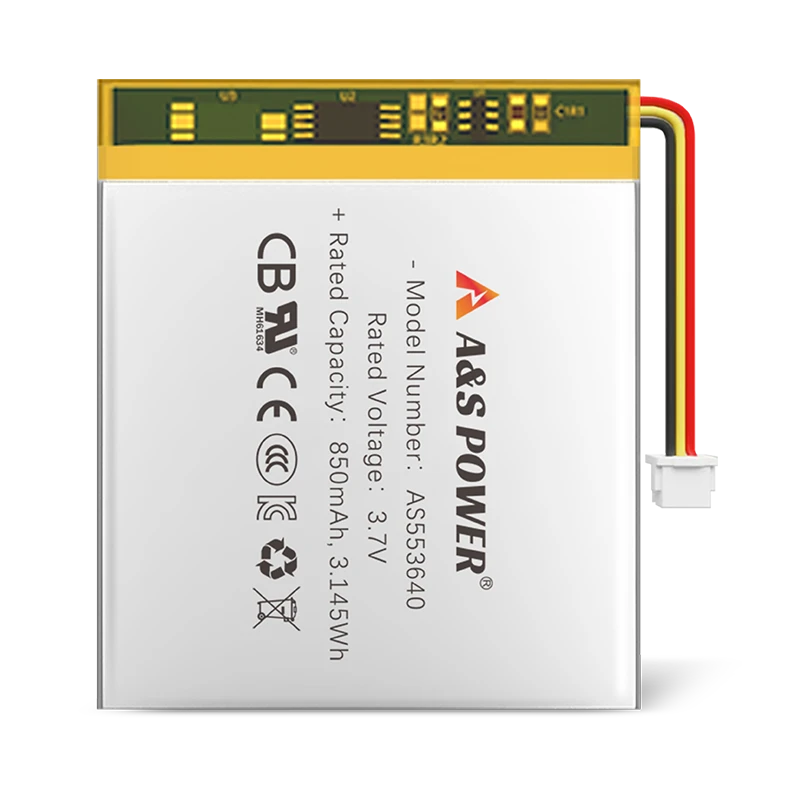
Lithium polymer, commonly abbreviated as LiPo, is a rechargeable lithium battery technology widely used when flexible form factors, thin profiles, or customized shapes are important.
In our own OEM work, LiPo batteries are frequently customized around a customer's available space, required capacity, voltage, connector, protection circuit, and current requirements. Our custom rechargeable lithium polymer battery guide explains these design considerations in greater detail.
The fact that a LiPo battery is rechargeable does not mean it can be connected to any charger. Charging voltage, current, termination conditions, temperature limits, and protection circuitry must all be matched to the battery design.
3.3 LiFePO4 Batteries
Lithium iron phosphate, commonly called LiFePO4 or LFP, is another rechargeable lithium-ion chemistry. It is widely considered when safety characteristics, long cycle life, and stable operating behavior are important design requirements.
For a more detailed explanation of the chemistry and applications, see our LiFePO4 battery guide.
LiFePO4 batteries are still rechargeable lithium batteries, but their charging voltage and charging profile are different from those of other lithium-ion chemistries. The charger and battery management system therefore need to be designed for the selected chemistry.
4. Primary vs. Rechargeable Lithium Batteries
| Characteristic | Primary Lithium Battery | Rechargeable Lithium Battery |
|---|---|---|
| Rechargeable? | No | Yes |
| Typical use | Single-use or long-shelf-life applications | Applications requiring repeated charge and discharge |
| Common examples | Some lithium coin cells and primary lithium cells | Li-ion, LiPo, LiFePO4 |
| Charging system | Not intended for charging | Requires an appropriate charger |
| Protection | Depends on battery type and application | Often incorporates PCM/BMS and other protection functions |
| Service model | Battery replacement | Repeated charging and discharging |
5. Why You Should Never Assume a Lithium Battery Is Rechargeable
One of the most important safety rules we communicate to customers is that a battery's appearance does not determine whether it is rechargeable.
Two batteries can look similar while having completely different internal chemistry and charging requirements. A cylindrical lithium battery, coin cell, or pouch battery therefore cannot be classified as rechargeable simply by its physical appearance.
The U.S. Consumer Product Safety Commission provides information on battery-related safety standards and hazards through its battery safety and standards resources.
If a battery is labeled as non-rechargeable, it should be treated as a primary battery. If the label or documentation does not clearly specify rechargeability, the correct approach is to identify the exact battery model and consult the manufacturer's technical documentation.
6. What Can Happen If You Try to Recharge a Non-Rechargeable Lithium Battery?
Attempting to recharge a battery that was not designed for rechargeable operation can produce unwanted chemical reactions and internal pressure. Depending on the cell design and conditions, possible hazards can include leakage, overheating, venting, internal damage, or fire.
For lithium battery safety, the charging system should always be matched to the battery chemistry and manufacturer's specified limits. This is particularly important because lithium battery failures can be influenced by overcharge, short circuit, mechanical damage, high temperature, and other abnormal conditions.
The U.S. Consumer Product Safety Commission's lithium-ion battery safety material provides additional information about lithium-ion battery hazards and safe handling considerations.
For this reason, a non-rechargeable lithium battery should never be connected to a charger as an experiment or as a way to extend its service life.
7. Does Rechargeable Mean the Battery Can Be Charged With Any Charger?
No. Rechargeability does not mean universal charger compatibility.
A rechargeable lithium battery has defined charging limits. These can include maximum charging voltage, recommended charging current, termination conditions, temperature limits, and sometimes communication requirements between the battery and charger.
For example, a rechargeable lithium-ion battery designed for one voltage range cannot simply be treated as interchangeable with a battery designed for another voltage. Similarly, a LiFePO4 battery requires a charging profile appropriate for its chemistry.
This is why battery packs used in professional products often include a protection circuit module (PCM) or battery management system (BMS). Depending on the design, these circuits can provide functions such as overcharge protection, over-discharge protection, over-current protection, short-circuit protection, and temperature monitoring.
Battery manufacturers such as Panasonic also distinguish between rechargeable battery products and primary battery products in their technical documentation and product guidance.
8. How Many Times Can a Rechargeable Lithium Battery Be Recharged?
There is no universal answer such as “all lithium batteries can be recharged 500 times” or “1,000 times.”
Cycle life depends on the battery chemistry, cell design, discharge depth, charging conditions, operating temperature, current level, storage conditions, and the end-of-life criteria selected for the application.
For example, two lithium battery packs with the same nominal voltage and capacity can have significantly different cycle-life characteristics because they use different cells, protection systems, thermal conditions, or operating profiles.
For medical and regulated equipment, battery performance should be evaluated against the specific requirements of the finished device rather than relying on a generic cycle-life number. Regulatory documentation such as the FDA documentation for rechargeable lithium battery-powered medical equipment also illustrates why battery performance and safety need to be considered as part of the overall product design.
9. What Determines the Life of a Rechargeable Lithium Battery?
Rechargeable lithium battery life is influenced by several variables.
Depth of Discharge
Repeatedly using a battery through a very large portion of its available capacity can affect long-term cycle performance. In many applications, controlling the usable state-of-charge range can help manage battery aging.
Charging Conditions
Charging current, charging voltage, temperature, and termination strategy all influence battery behavior. The appropriate limits depend on the specific cell chemistry and manufacturer's specifications.
Temperature
High temperatures can accelerate battery aging, while low temperatures can affect charging performance and increase safety concerns. Battery operating and charging temperature ranges should therefore be defined during product development.
Battery Management
A properly designed PCM or BMS can provide important protection functions. However, the protection circuit does not make an unsuitable battery safe for every application. The battery, charger, protection system, wiring, connector, and device should be considered as one system.
10. Is the 80% Rule Important for Lithium Batteries?
You may encounter advice suggesting that rechargeable lithium batteries should always be charged to 80% or discharged only to a particular percentage. Such rules are often simplified recommendations rather than universal requirements.
The actual recommended operating range depends on the battery chemistry, cell manufacturer, application, and desired balance between usable energy and long-term battery aging.
For example, if an application does not require the entire nominal capacity on every cycle, operating within a controlled state-of-charge range may be considered during battery-system design.
We explain this topic in more detail in our article, What Is the 80% Rule for LiPo Batteries?, where we discuss why the “80% rule” should not be treated as a universal charging law for every lithium battery.
11. How Do I Know Whether a Lithium Battery Is Rechargeable?
The safest way is to identify the exact battery model and check its technical documentation.
Look for information such as:
- Rechargeable or non-rechargeable designation
- Battery chemistry
- Nominal voltage
- Maximum charging voltage
- Recommended charging current
- Operating temperature range
- Protection circuit requirements
- Battery management system specifications
- Relevant safety and transportation certifications
If the battery is being integrated into a commercial product, we recommend confirming these parameters before selecting the charger or designing the charging circuit.
For OEM applications, A&S Power develops custom rechargeable lithium battery solutions based on required voltage, capacity, dimensions, current, connector configuration, PCM/BMS requirements, and application conditions.
12. Rechargeable Lithium Battery Safety and Certification
Rechargeability is only one part of battery-system design. For commercial products, the battery may also need to meet applicable safety, transportation, electromagnetic, environmental, or market-specific requirements.
Depending on the application and destination market, relevant standards and testing may include UL, IEC, UN 38.3, CE, CB, CCC, KC, PSE, RoHS, or other applicable requirements.
For example, UL 1642 covers lithium batteries, while other standards and certification systems may apply to battery packs, end products, transportation, or specific markets. The applicable standard depends on the actual product configuration and intended use.
The FDA also provides a searchable database of recognized consensus standards, including UL 1642 information.
For customers evaluating battery certification requirements, our A&S Power battery certification resources provide an overview of the certifications and testing documentation available for our battery products.
13. Which Rechargeable Lithium Battery Is Right for an OEM Product?
The right rechargeable lithium battery depends on the actual application rather than simply choosing the chemistry with the highest nominal capacity.
| Design Requirement | Important Battery Parameter | Why It Matters |
|---|---|---|
| Long operating time | Capacity and energy | Determines how much energy the device can store and use. |
| Compact product | Cell dimensions and energy density | Available installation space may determine the battery format. |
| High current load | Cell discharge capability and resistance | The battery must support the device's continuous and peak current demands. |
| Frequent cycling | Cycle-life characteristics | Battery chemistry and operating conditions influence long-term performance. |
| Outdoor equipment | Temperature range and protection | Environmental conditions can affect charging and discharge behavior. |
| Regulated equipment | Safety standards and certification | The battery may need to meet specific regulatory and market requirements. |
For an OEM battery project, we normally start with the device requirements rather than choosing a cell first. Voltage, capacity, peak current, continuous current, available space, charging method, temperature range, expected cycle life, connector, communication requirements, and certification targets all influence the final battery design.
A&S Power provides OEM and ODM rechargeable lithium battery solutions, including Li-ion, LiPo, and LiFePO4 battery packs with customized voltage, capacity, dimensions, connectors, and protection systems.
Explore A&S Power Battery SolutionsConclusion: Not Every Lithium Battery Is Rechargeable
The answer to “Can all lithium batteries be recharged?” is clearly no.
Lithium batteries include both primary and rechargeable technologies. Primary lithium batteries are designed for one-time use and should not be connected to a charger. Rechargeable lithium-ion technologies, including Li-ion, LiPo, and LiFePO4, are specifically designed for repeated charge and discharge when operated within their specified limits.
For product developers and OEM purchasing teams, the most important step is to identify the exact chemistry and battery specification before selecting a charger or integrating the battery into a device. Voltage, charging current, temperature, protection circuitry, cycle-life requirements, and certification requirements should all be evaluated together.
At A&S Power, we approach rechargeable battery development from the complete application rather than treating the cell as an isolated component. This allows us to match the battery chemistry, configuration, protection system, mechanical dimensions, and electrical requirements to the customer's actual product.
Frequently Asked Questions
1. Can all lithium batteries be recharged?
No. Some lithium batteries are primary batteries designed for one-time use, while lithium-ion, lithium polymer, and LiFePO4 batteries are rechargeable secondary battery technologies.
2. What is the difference between primary and rechargeable lithium batteries?
Primary lithium batteries are designed for single-use applications and are not intended to be recharged. Rechargeable lithium batteries use electrochemical systems designed for repeated charge and discharge cycles.
3. Can lithium-ion batteries be recharged?
Yes. Lithium-ion batteries are rechargeable and are widely used in electronics, industrial equipment, medical devices, energy storage systems, and many other applications.
4. Can LiPo batteries be recharged?
Yes. Rechargeable lithium polymer batteries are a type of rechargeable lithium-ion battery technology and require a suitable charging and protection system.
5. Can LiFePO4 batteries be recharged?
Yes. Lithium iron phosphate, or LiFePO4, is a rechargeable lithium battery chemistry commonly used in energy storage, industrial equipment, mobility, and other applications.
6. What happens if you try to recharge a non-rechargeable lithium battery?
Attempting to recharge a primary lithium battery can create unsafe conditions, including leakage, overheating, internal damage, venting, or fire. Primary lithium batteries should not be recharged unless specifically designed and approved for that purpose.
7. How many times can a rechargeable lithium battery be charged?
There is no single cycle-life number for all rechargeable lithium batteries. Cycle life depends on chemistry, cell design, depth of discharge, charging conditions, temperature, current, and operating conditions.
8. How do I choose the right rechargeable lithium battery?
Battery selection should consider voltage, capacity, dimensions, current requirements, charging method, operating temperature, cycle-life requirements, protection circuitry, certifications, and the application's safety requirements.