




Custom LiPo Battery vs. Cylindrical 18650 Pack: Which Is Better for Your Device?
Quick Answer:
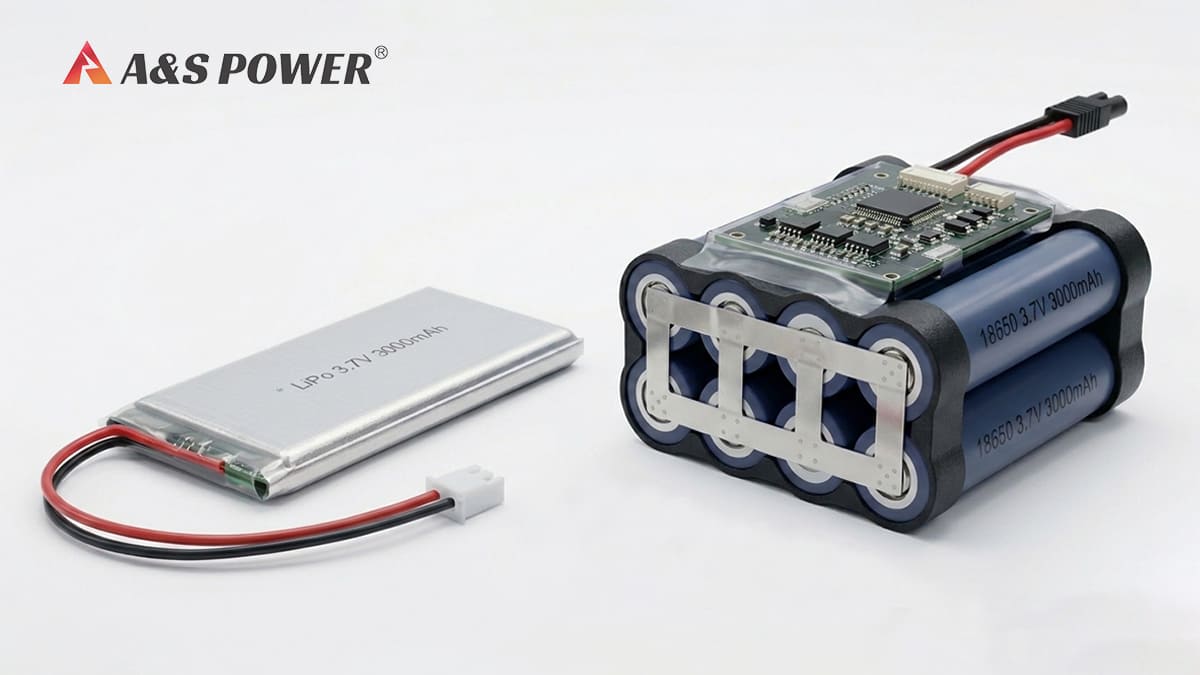
A custom LiPo battery is usually the better choice for thin, lightweight, space-constrained, or highly customized devices, while an 18650 battery pack is often better for standardized, rugged, modular, and cost-sensitive applications.
When choosing between the two, I recommend looking beyond capacity and price. The key factors include available space, battery dimensions, weight, current demand, runtime, operating temperature, mechanical structure, charging requirements, protection, certification, and production volume.
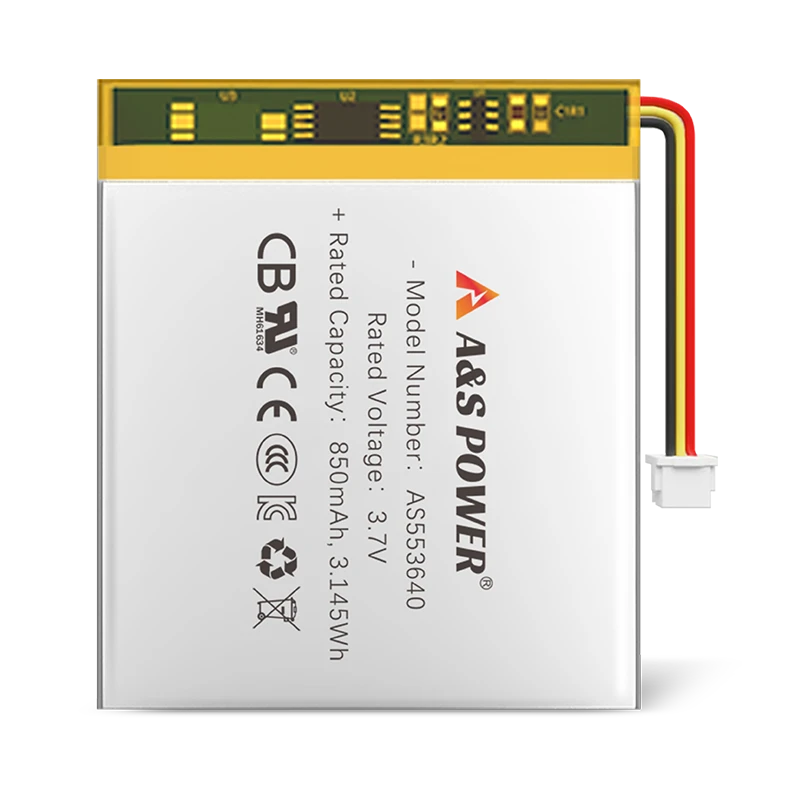
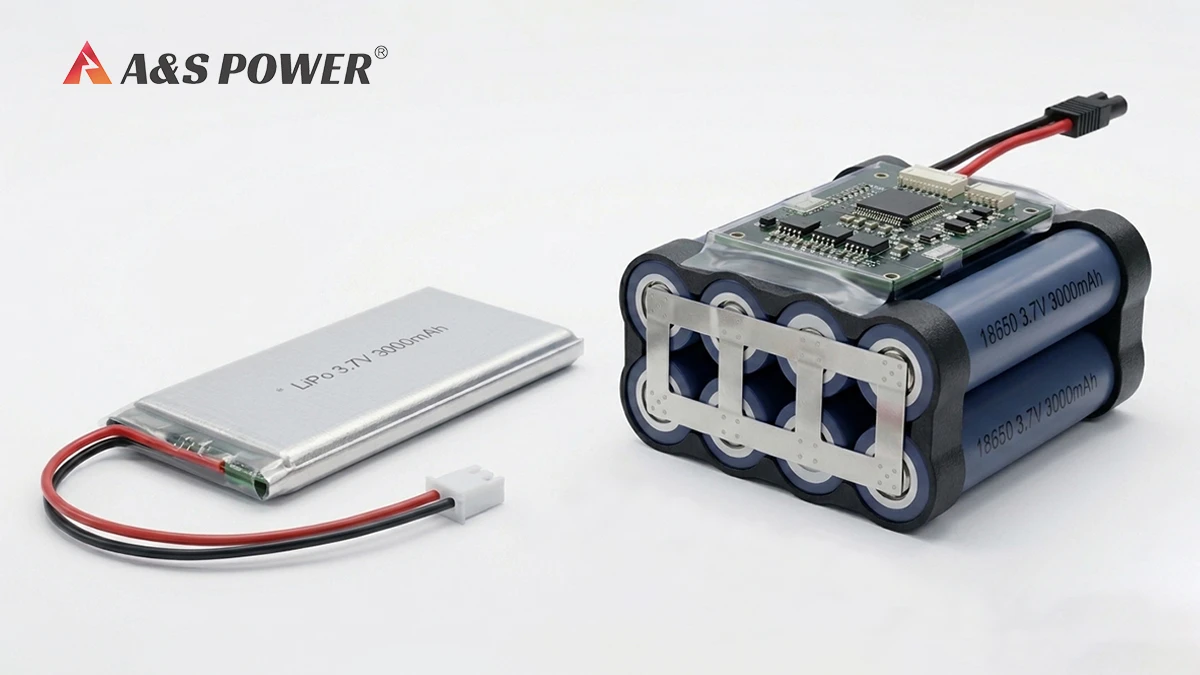
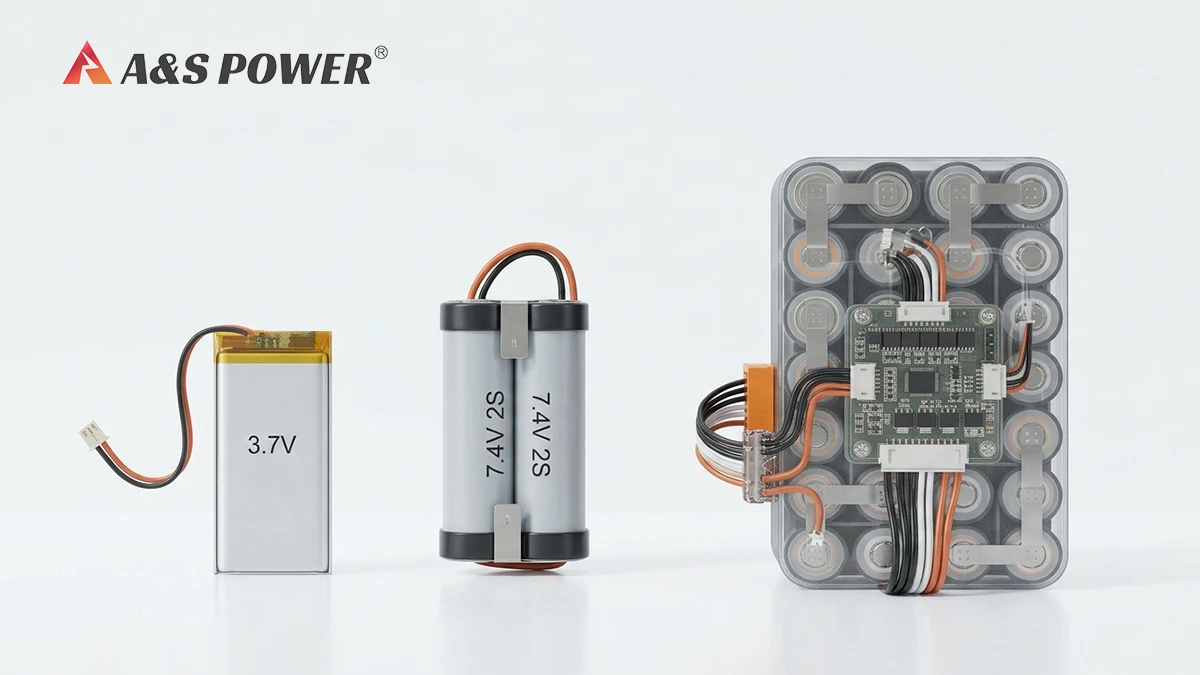
A custom LiPo battery uses a flexible pouch format, allowing engineers to customize its length, width, thickness, capacity, wiring, connector, and protection configuration. This makes it particularly suitable for GPS trackers, medical devices, wearables, IoT products, handheld electronics, and other compact equipment.
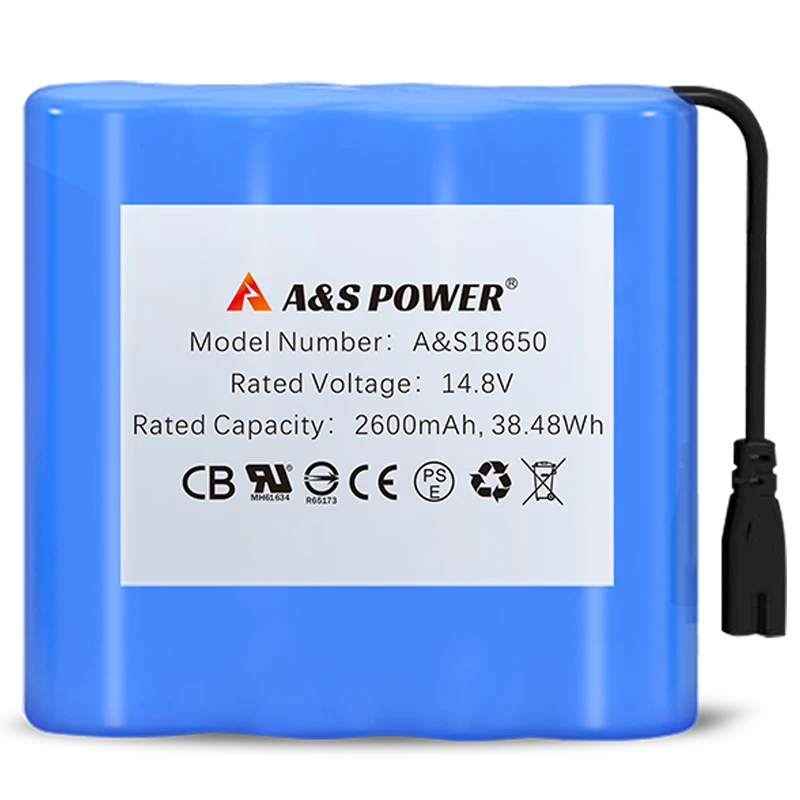
An 18650 battery pack uses standardized cylindrical cells, typically measuring 18 mm in diameter and 65 mm in length per cell. Its standardized format, rigid construction, modular series-parallel configuration, and established supply chain can make it attractive for industrial equipment, power tools, portable power systems, and other products with sufficient internal space.
There is no universal winner. The better battery is the one that best matches the device's mechanical, electrical, thermal, safety, and commercial requirements.
Introduction
Choosing between a custom LiPo battery and a cylindrical 18650 battery pack is not simply a matter of comparing battery capacity or price. For OEM product development, the battery has to fit the device's mechanical structure, power requirements, weight target, charging system, and expected operating environment.
I often see battery selection become difficult when a product needs both compact dimensions and reliable runtime. A cylindrical 18650 pack offers the advantages of a standardized cell format, rigid construction, and flexible series-parallel configurations. A custom LiPo battery, in contrast, gives engineers much more freedom to control the battery's length, width, thickness, weight, connector, and protection configuration.
So, which one is actually better?
The answer depends on the device. In this guide, I compare custom LiPo batteries and 18650 packs from a practical OEM perspective, including size, weight, energy density, discharge performance, cycle life, safety, cost, customization, and application suitability. My goal is to help product engineers and purchasing teams select the battery architecture that fits their actual device requirements rather than choosing based on generic battery specifications alone.
Custom LiPo Battery vs. 18650 Battery Pack: The Main Difference
Although both technologies belong to the rechargeable lithium-ion battery family, their physical construction is very different.
An 18650 cell has a standardized cylindrical format measuring approximately 18 mm in diameter and 65 mm in length. The cell is enclosed in a rigid metal can, making it mechanically robust and relatively easy to integrate into modular battery packs.
A LiPo battery normally uses a pouch structure with aluminum-laminated packaging. Instead of being restricted to one standardized cylindrical dimension, the cell can be developed around the available space of the product.
From my experience with OEM battery design, this mechanical difference often has a greater impact on the final product than the chemistry itself.
| Design Factor | Custom LiPo Battery | 18650 Battery Pack |
|---|---|---|
| Cell format | Flexible pouch | Cylindrical |
| Standard dimensions | Highly customizable | 18 × 65 mm per 18650 cell |
| Shape flexibility | Excellent | Limited |
| Thin-device integration | Excellent | Difficult |
| Mechanical protection | Requires enclosure/support | Rigid metal casing |
| Weight optimization | Usually favorable for compact designs | Higher due to cylindrical casing and pack structure |
| High-discharge options | Available, depending on cell design | Available, depending on cell model |
| Pack modularity | Moderate | Excellent |
| Manufacturing standardization | Lower for custom designs | High |
| Initial customization cost | Generally higher | Generally lower |
| Best application | Wearables, medical, GPS, IoT, compact electronics | Tools, industrial equipment, power banks, larger packs |
These are general engineering tendencies rather than guaranteed performance figures. Actual results depend on the selected cell and complete pack design.
1. Which Battery Uses Space More Efficiently?
For compact electronics, this is usually the first question I ask.
Custom LiPo Has a Major Form-Factor Advantage
An 18650 cell has to retain its cylindrical geometry. When several cells are assembled together, the circular cross-section creates unused spaces between cells. The pack may also require holders, insulation, nickel strips, BMS components, wiring, and mechanical supports.
A LiPo pouch cell can instead be designed around the enclosure.
For example, if a device has a long and narrow internal cavity, a rectangular LiPo battery can be specified to occupy that area without forcing the mechanical team to redesign the housing around cylindrical cells.
This is particularly valuable for:
- Wearable electronics
- GPS trackers
- Medical monitoring equipment
- Handheld devices
- Smart beauty devices
- IoT sensors
- Portable consumer electronics
A&S Power's custom LiPo service supports customized dimensions, voltage, capacity, wires, connectors, and protection circuits, which is particularly useful when battery geometry is part of the original product design rather than an afterthought.
When 18650 Can Still Be the Better Choice
I would not automatically replace an 18650 pack with LiPo.
If the product already has enough space for cylindrical cells, the standard format can simplify mechanical design and sourcing. An 18650 pack can also be a practical choice where the battery is enclosed in a rigid housing and physical durability is a major consideration.
2. Which One Is Lighter?
For portable products, weight can influence the user experience as much as runtime.
LiPo pouch cells eliminate much of the rigid metal casing associated with cylindrical cells. This allows the battery designer to optimize the battery around a specific weight and dimensional target.
However, I would avoid claiming that every LiPo battery is automatically lighter than every 18650 pack. Battery weight depends on capacity, chemistry, protection components, enclosure requirements, and the number of cells.
The more accurate statement is:
LiPo provides greater freedom to optimize the battery's weight and physical package for a specific device.
That distinction is important when comparing batteries at the engineering level.
3. What About Energy Density and Runtime?
Energy density is frequently used to declare one technology the winner, but the reality is more complicated.
Cell-level energy density and pack-level energy density are not the same thing.
An 18650 cell can provide strong energy density and excellent consistency, but a complete pack also needs space for cell arrangement, interconnections, insulation, BMS electronics, and mechanical support.
A LiPo pouch can use a flatter or irregular space more effectively. Therefore, a LiPo battery may deliver a better package-level result even when its individual cell energy density is not dramatically higher.
For this reason, I recommend comparing:
Pack energy = Nominal voltage × Capacity
rather than comparing mAh alone.
For example:
- 3.7 V × 2 Ah = 7.4 Wh
- 7.4 V × 2 Ah = 14.8 Wh
The voltage configuration matters just as much as capacity when evaluating total stored energy.
4. Which Battery Provides Better Discharge Performance?
This depends heavily on the specific cell.
High-drain 18650 cells are widely available, and some cylindrical lithium-ion cells are designed specifically for high-current applications.
LiPo pouch cells can also be manufactured for high-discharge applications, particularly where a high power-to-weight ratio is important.
Therefore, I would not use a simple rule such as “LiPo always has higher discharge current.”
Instead, I compare:
- Continuous discharge current
- Peak discharge current
- Internal resistance
- Operating temperature
- Voltage sag
- Required C-rate
- Cycle conditions
For an OEM project, the correct battery is the one whose tested electrical characteristics match the actual load profile.
5. Which Battery Has a Longer Cycle Life?
Cycle life is another area where general internet comparisons can be misleading.
There is no universal cycle-life number for “LiPo” or “18650.” The result depends on cell chemistry, electrode design, charge voltage, discharge depth, temperature, charge rate, discharge rate, and end-of-life definition.
Some engineering sources report typical 18650 cycle-life ranges of several hundred to more than 1,000 cycles, while LiPo figures can also range widely depending on the cell design.
For this reason, I recommend requesting an actual cell datasheet and test conditions rather than accepting a generic marketing claim.
If cycle life is critical, I would specify:
- Charge voltage
- Discharge cutoff voltage
- Charge/discharge current
- Temperature
- Depth of discharge
- Capacity-retention requirement
Only then can two battery technologies be compared fairly.
6. Which Battery Is Safer?
Safety should be evaluated at the cell and pack-system level, not simply by saying that one format is safe and another is unsafe.
The rigid casing of an 18650 cell provides strong mechanical protection. LiPo pouch cells, on the other hand, use flexible laminated packaging and therefore need appropriate mechanical support, insulation, and protection from puncture, compression, and abnormal swelling.
A correctly engineered LiPo battery can still be a reliable and safe power source.
For rechargeable lithium batteries used in portable applications, IEC 62133-2 specifies safety requirements and tests covering intended use and reasonably foreseeable misuse.
For OEM development, I also consider:
- Overcharge protection
- Over-discharge protection
- Short-circuit protection
- Overcurrent protection
- Temperature monitoring
- Cell balancing for multi-cell packs
- Mechanical protection
- Appropriate charging control
- Transportation testing
- Applicable product certification
This is why the battery protection circuit should be considered part of the product architecture, not an optional accessory.
7. Which Battery Is More Cost-Effective?
For many high-volume projects, 18650 has an important cost advantage because the format is standardized and widely manufactured.
A custom LiPo battery normally requires additional engineering work because the cell dimensions, tabs, protection circuit, connector, wire length, and sometimes the battery enclosure are designed specifically for the application.
However, the cheapest battery is not necessarily the lowest-cost solution.
If a custom LiPo pack allows me to reduce the size of the enclosure, eliminate unused internal space, reduce product weight, or simplify mechanical integration, the total product cost may still be competitive.
I therefore recommend evaluating total system cost, not only battery price.
8. Which Battery Should OEM Designers Choose?
My practical selection approach is simple.
Choose a Custom LiPo Battery When:
- The enclosure is thin or space-constrained.
- The battery needs a custom length, width, or thickness.
- Weight is a major product requirement.
- The device has an irregular internal cavity.
- The battery needs to sit against a flat surface.
- A custom connector or wire arrangement is required.
- The product is a wearable, GPS tracker, medical device, IoT product, or compact electronics device.
Choose an 18650 Pack When:
- The device has sufficient cylindrical space.
- Mechanical robustness is important.
- Standardized cells are preferred.
- The product needs a modular battery architecture.
- Cost efficiency is a major consideration.
- The application benefits from established cylindrical-cell sourcing.
- The battery is installed inside a robust enclosure.
9. Custom Battery Design Should Start With the Device, Not the Cell
One mistake I see repeatedly is starting a battery project by asking:
“What capacity can you provide?”
That is not enough information to design the correct battery.
I prefer to start with the device requirements:
Voltage → Capacity → Current → Runtime → Dimensions → Weight → Connector → Protection → Charging → Environment → Certifications
For example, a manufacturer may request a “3.7V 2,000mAh battery,” but that specification does not tell me whether the battery needs to deliver 1A continuously, 5A intermittently, operate at low temperatures, fit inside a 6 mm enclosure, or communicate with the host device.
Those requirements can completely change the recommended battery architecture.
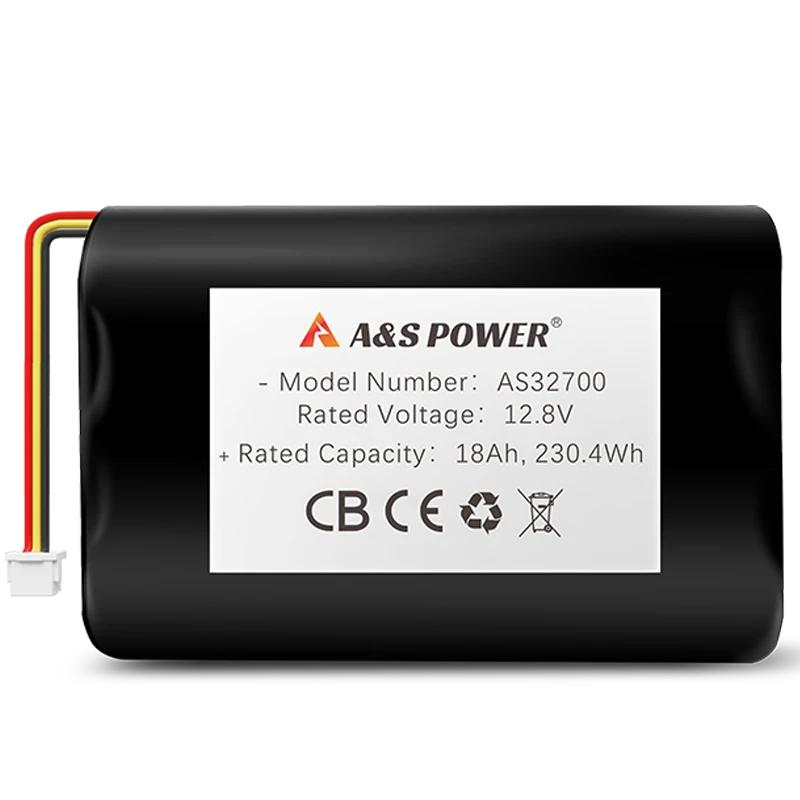
A&S Power's custom battery engineering process supports battery size, voltage, capacity, PCM, wires, connectors, and other pack-level requirements, which is the approach I recommend for OEM projects where the battery has to fit the device rather than simply be purchased as an off-the-shelf component.
10. My Final Recommendation: LiPo or 18650?
If I have to make the decision quickly, I use this rule:
Choose custom LiPo when product integration is the priority. Choose 18650 when standardization and mechanical robustness are the priority.
For a wearable, GPS tracker, compact medical monitor, smart device, or thin IoT product, I would usually investigate LiPo first because its customizable pouch format gives the mechanical engineering team much more freedom.
For an industrial device, power tool, larger portable system, or application with an established cylindrical battery compartment, I would seriously consider an 18650 pack.
The important point is that neither technology is universally better.
The correct choice depends on the complete electrical, mechanical, thermal, safety, and commercial requirements of the product.
Conclusion
When I compare a custom LiPo battery with a cylindrical 18650 battery pack, I do not see the decision as a simple competition between two battery technologies.
I see it as a question of product architecture.
LiPo offers exceptional freedom in size, thickness, weight, and shape, making it particularly attractive for compact and highly integrated products. 18650 packs provide the advantages of a standardized cylindrical format, rigid cell construction, modular assembly, and established sourcing.
For OEM engineers, the best battery is therefore the one that meets the complete product specification—not simply the battery with the highest advertised capacity or lowest unit price.
If your device has strict space, weight, connector, voltage, or capacity requirements, a custom battery design can be evaluated before the mechanical structure is finalized. That approach usually gives the battery and product teams a much better chance of achieving the required performance without expensive redesigns later.
For custom LiPo and lithium-ion battery projects, A&S Power provides OEM/ODM battery customization covering cell selection, dimensions, voltage, capacity, protection circuits, wiring, connectors, and pack integration.
FAQs: Custom LiPo Battery vs. 18650 Pack: Which Is Better?
Is LiPo better than 18650?
LiPo is generally better for thin, lightweight, and highly customized products, while 18650 is often better for standardized, rugged, and cost-sensitive battery packs. The best choice depends on the device's electrical and mechanical requirements.
Can a LiPo battery replace an 18650 battery pack?
Yes, a LiPo pack can replace an 18650 pack in some applications, but it is not always a direct drop-in replacement. Voltage, capacity, current, charging method, dimensions, BMS/PCM configuration, connectors, and mechanical protection must all be reviewed.
Which lasts longer, LiPo or 18650?
There is no universal answer. Cycle life depends on the specific cell and operating conditions. Quality 18650 cells can offer long cycle life, but LiPo pouch cells can also provide reliable service when correctly selected and operated.
Is LiPo safer than 18650?
Neither format should be judged by packaging alone. 18650 cells have rigid metal casings, while LiPo cells require appropriate mechanical protection. Both require proper charging and protection circuitry and should be evaluated against applicable safety requirements.
Is a custom LiPo battery more expensive than an 18650 pack?
The initial engineering and customization cost of a LiPo pack can be higher. However, a custom LiPo battery may reduce overall product cost when its optimized dimensions, weight, and space utilization simplify the device design.
What should I provide to a battery manufacturer for a custom quote?
I recommend providing the required voltage, capacity, dimensions, maximum continuous and peak current, operating temperature, charging requirements, connector type, estimated annual quantity, protection requirements, and applicable certifications.
-

 May.2026.08.24What Is a Smart Battery?Learn More
 -
 May.2026.08.24Custom Battery Pack vs. Off-the-Shelf Battery: OEM Cost & Time ComparisonLearn More
 -
 May.2026.08.21Soft Pouch LiPo vs. Hard Plastic Enclosure Lithium Pack: Durability & SafetyLearn More
 -
 May.2026.08.20Custom LiPo Battery vs. Cylindrical 18650 Pack: Which Is Better for Your Device?Learn More
 -
 May.2026.08.19Custom Lithium Battery Pack Voltage & Capacity Selection GuideLearn More