




How to Select a LiPo Battery for a Portable Medical Device
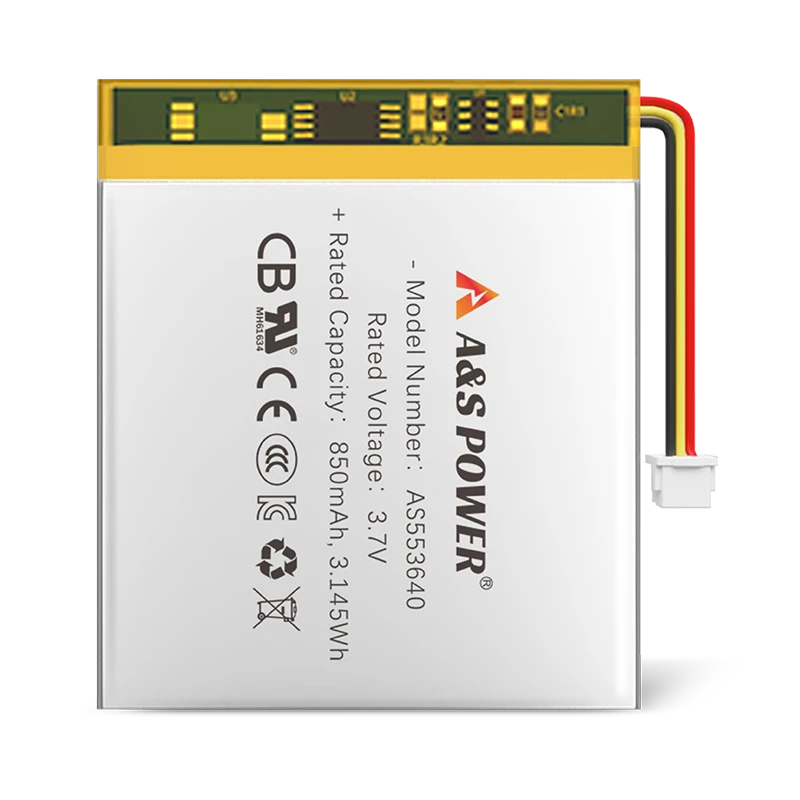
Selecting a lithium polymer (LiPo) battery for a portable medical device requires more than finding a battery with the right voltage and capacity. The battery must support the device's operating cycle, fit within its enclosure, deliver stable power under different load conditions, and meet the safety and regulatory requirements applicable to the finished medical equipment.
For medical device manufacturers, battery selection is particularly important because an unsuitable power source can affect operating time, charging reliability, device availability, and overall product safety.
A suitable LiPo battery should therefore be selected based on five key considerations: electrical performance, battery capacity, physical dimensions, protection circuitry, and compliance requirements. These factors should be evaluated together during the early stages of product development rather than treated as separate purchasing specifications.
Start by defining the device's operating voltage, average and peak current, required runtime, and available battery space. Then evaluate the cell's capacity, discharge capability, charging limits, temperature range, protection circuit, and applicable safety documentation. The selected battery must be validated together with the device electronics and charger.
Why Are LiPo Batteries Used in Portable Medical Devices?
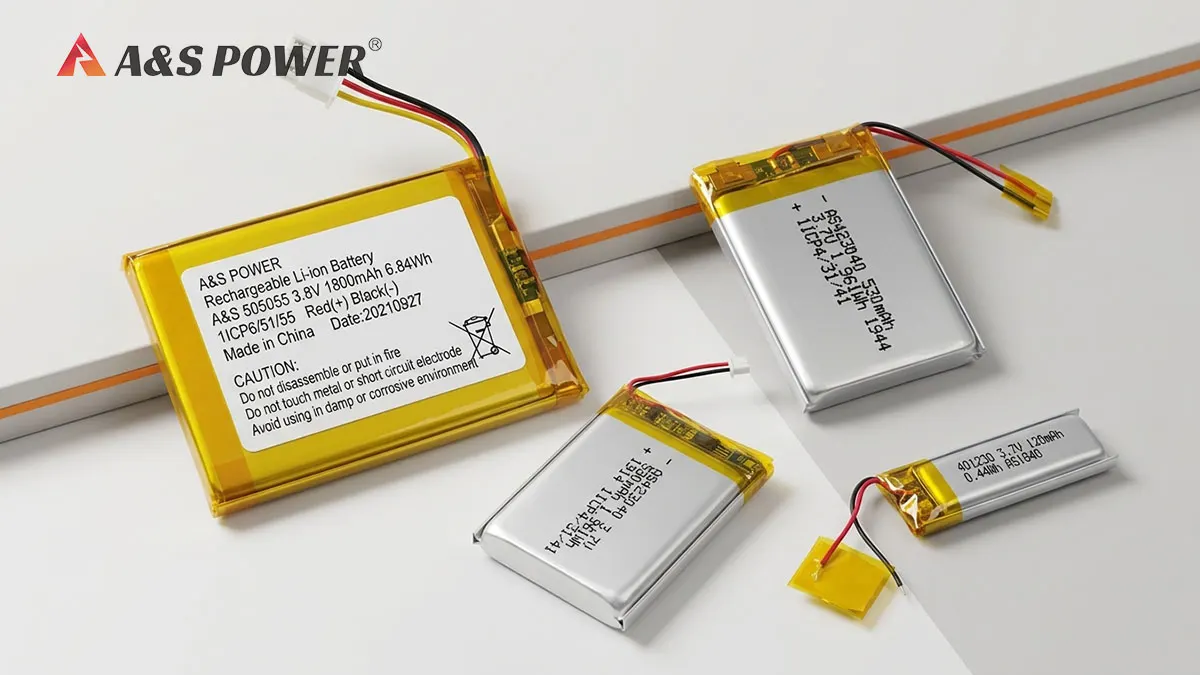
Lithium polymer batteries are widely considered for portable medical equipment because their pouch-cell construction offers flexibility in product integration.
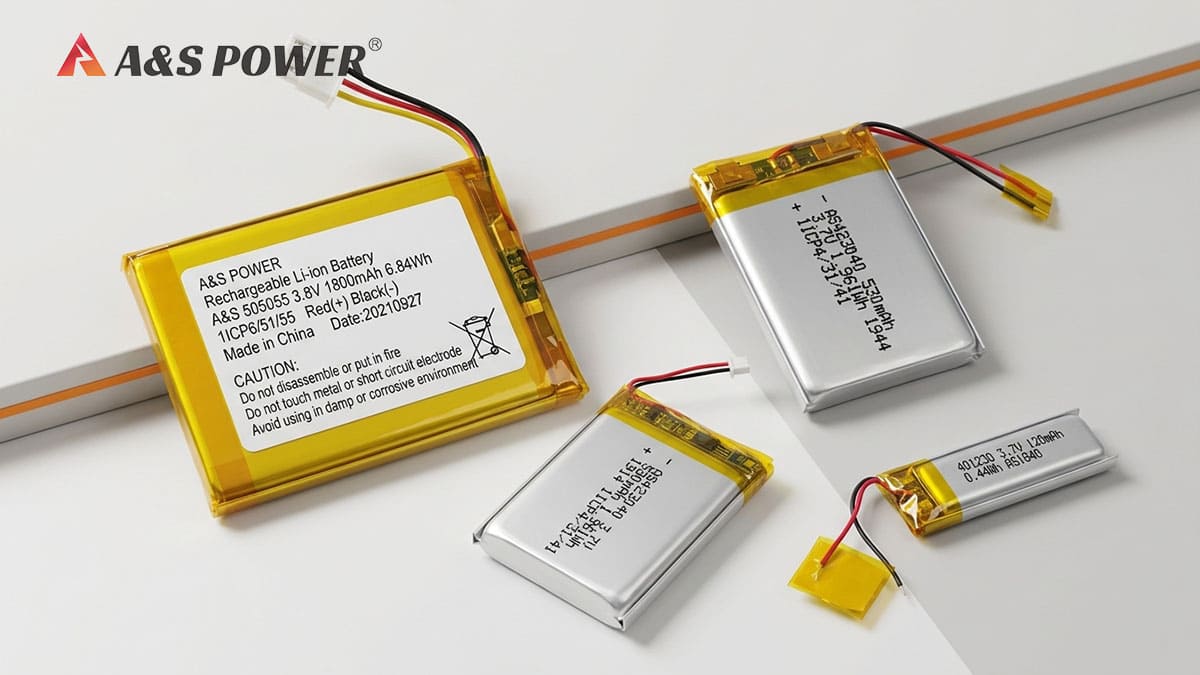
Unlike conventional cylindrical cells, LiPo pouch cells can be manufactured in different lengths, widths, and thicknesses. This allows engineers to design battery compartments around the available space inside compact medical equipment.
Common applications include:
However, LiPo is not automatically the best choice for every medical application. The final battery chemistry and configuration should depend on the required energy, discharge characteristics, operating environment, service life, and safety assessment.
For devices with strict size and weight limitations, a custom lithium polymer battery pack can provide greater mechanical design flexibility than a standard battery format. A&S Power's custom lithium polymer battery engineering capabilities include battery size, voltage, wiring, connectors, and protection circuit customization.
1. Determine the Voltage Requirements of the Medical Device
Operating voltage is one of the first specifications engineers should establish.
The battery's nominal voltage must be compatible with the device's power architecture, including its main control board, sensors, display, communication modules, and other electronic components.
A typical lithium polymer cell has a nominal voltage of approximately 3.7V, although the actual operating voltage changes with its state of charge.
| Battery Configuration | Nominal Voltage | Typical Application Consideration |
|---|---|---|
| 1S | 3.7V | Compact, low-voltage medical equipment |
| 2S | 7.4V | Devices requiring a higher input voltage |
| 3S | 11.1V | Equipment with higher voltage requirements |
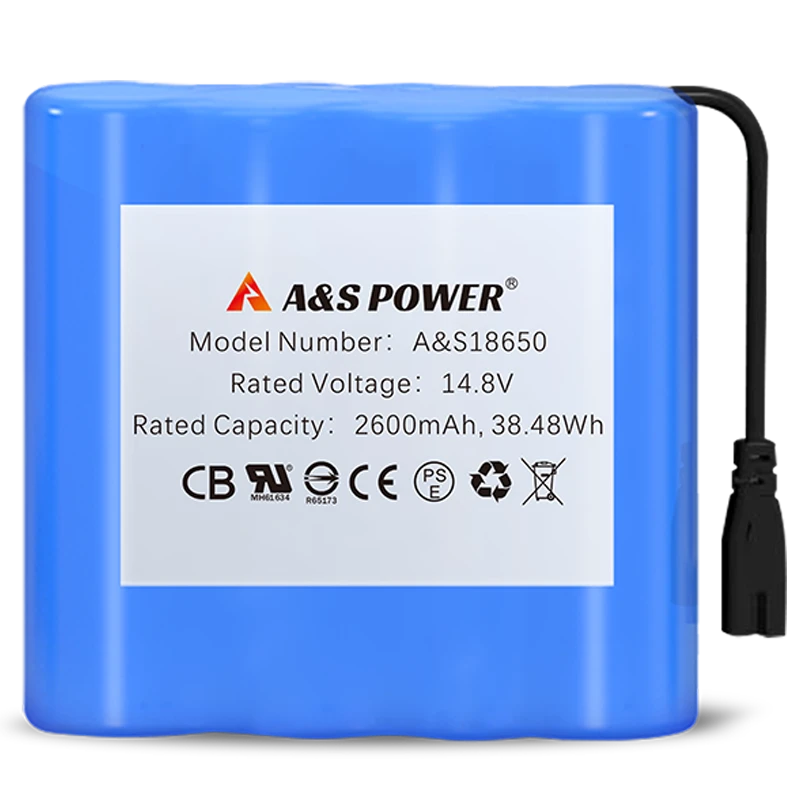
| 4S | 14.8V | Applications requiring a higher-voltage battery system |
Note: These are nominal voltage values, not fixed output voltages. Actual voltage limits depend on the selected cell specifications.
Engineers must also consider the fully charged voltage, minimum operating voltage, and voltage range accepted by the device.
For example, a single-cell lithium polymer battery generally reaches approximately 4.2V when fully charged. The device must be designed to operate safely across the battery's permitted voltage range.
If the electronics require a stable voltage, a suitable DC-DC conversion circuit may be necessary.
Practical recommendation: Before selecting a battery, confirm the device's operating voltage range, maximum input voltage, minimum shutdown voltage, and whether voltage regulation is required.
2. Calculate the Required Battery Capacity
Battery capacity directly influences how long a portable medical device can operate between charging cycles.
However, choosing capacity based only on the device's average current consumption can result in insufficient operating time.
Engineers should consider the complete power consumption profile, including standby current, normal operating current, peak current, display activity, wireless communication, alarms, and other intermittent functions.
For example, assume a portable medical monitoring device has:
The theoretical battery capacity is:
However, 2,400mAh should not automatically be selected as the final battery specification.
The design should account for conversion losses, battery aging, temperature effects, operating conditions, and the required end-of-life operating time.
A more practical estimation is:
The usable capacity fraction must be based on the intended discharge limits, temperature conditions, and battery performance data rather than an assumed universal percentage.
For applications requiring a guaranteed operating period, engineers should also validate battery capacity under representative device loads.
Consider Peak Current, Not Just Average Current
Some medical devices consume significantly more power during specific operating conditions.
For example, a device may have relatively low average consumption but experience short current peaks when activating a motor, pump, wireless transmitter, or other power-intensive component.
The selected battery must support both continuous discharge current and peak discharge current.
When evaluating a LiPo battery, confirm:
A battery with sufficient capacity may still be unsuitable if its discharge capability cannot support the device's peak power requirements.
3. Evaluate Battery Size, Weight, and Mechanical Integration
Portable medical devices often have limited internal space.
The battery must fit within the enclosure without interfering with the PCB, display, sensors, connectors, wiring, or other internal components.
LiPo pouch cells offer useful flexibility because their dimensions can be customized to accommodate different enclosure designs.
| Parameter | What Engineers Should Check |
|---|---|
| Length and width | Compatibility with the battery compartment |
| Thickness | Available internal clearance |
| Weight | Overall device portability |
| Connector | Compatibility with the device's PCB |
| Cable length | Routing and assembly requirements |
| Insulation | Protection against electrical contact and mechanical damage |
| Mounting | Prevention of movement and excessive pressure |
A battery should not be forced into a compartment that is too small.
Pouch cells require appropriate mechanical protection against puncture, compression, bending, and abrasion. The enclosure should also accommodate dimensional tolerances and changes in battery thickness during normal service life.
When a standard battery cannot meet the available space requirements, a custom LiPo battery pack may be worth considering.
For OEM medical equipment, customization can include battery dimensions, capacity, voltage configuration, connector type, wire length, and protection circuit design.
See A&S Power's custom lithium battery pack solutions for more information about battery integration and OEM/ODM development.
4. Select an Appropriate Battery Protection Circuit
Battery protection is particularly important in medical equipment because an electrical fault can interrupt device operation and potentially affect patient safety.
A LiPo battery pack should incorporate protection functions appropriate to its cell configuration and intended application.
Common protection functions include:
Overcharge Protection
Prevents the battery from exceeding its permitted charging voltage.
Over-discharge Protection
Disconnects the battery when its voltage falls below the specified protection threshold.
Overcurrent Protection
Protects the battery and associated electrical components when current exceeds the permitted operating limit.
Short-circuit Protection
Helps prevent excessive current flow if the battery output terminals are accidentally shorted.
Temperature Protection
Uses temperature monitoring to prevent charging or discharging outside the specified operating limits.
Depending on the application, additional functions may include cell balancing, battery identification, state-of-charge reporting, and communication with the host device.
PCM or BMS: Which Is More Appropriate?
The terms PCM and BMS are sometimes used interchangeably, but they can describe different levels of battery management functionality.
A basic protection circuit module (PCM) generally provides essential protection functions.
A more advanced battery management system (BMS) may additionally support functions such as cell monitoring, balancing, communication, and battery status reporting.
The required solution depends on the battery configuration and device architecture.
For example, a single-cell portable device may require a relatively simple protection circuit, while a multi-cell battery pack may require more comprehensive monitoring and balancing.
Important: Protection circuitry does not replace the device manufacturer's overall risk management and electrical safety assessment. The battery pack, charger, host electronics, and charging interface must be evaluated as a complete system.
A&S Power provides customization of battery protection boards, including overcharge, over-discharge, short-circuit, and temperature-related protection options, depending on project requirements. More information is available on its battery engineering and technology page.
5. Check Charging Requirements and Battery Operating Temperature
Charging conditions directly influence battery performance, service life, and safety.
Before selecting a LiPo battery, engineers should confirm that the charging system is compatible with the selected cell specifications.
Important charging parameters include:
Many conventional single-cell LiPo batteries use a constant-current/constant-voltage (CC/CV) charging profile, with a maximum charging voltage commonly specified at 4.2V per cell.
However, the exact charging voltage and current must always follow the selected cell manufacturer's specifications. Not every lithium-based cell uses the same charging limits.
Temperature is another important consideration.
Medical devices may operate in different environments, including hospitals, clinics, home-care settings, and outdoor locations.
Engineers should establish the expected operating, charging, and storage temperature ranges during product development.
Charging a battery outside its permitted temperature range can create safety and degradation risks.
For applications where charging must be controlled carefully, an NTC thermistor or another suitable temperature-monitoring arrangement may be integrated into the battery pack.
The device's charging controller must correctly interpret the temperature signal and stop or restrict charging when necessary.
6. Understand the Relevant Medical Device and Battery Safety Standards
Battery compliance is one of the most important considerations when developing a portable medical device.
However, different standards address different parts of the product.
Engineers should distinguish between battery-level safety testing, transportation requirements, and finished medical equipment compliance.
| Standard or Requirement | Main Scope | Relevance to Battery Selection |
|---|---|---|
| IEC 62133-2 | Safety requirements for portable sealed rechargeable lithium cells and batteries | Relevant to lithium battery safety |
| IEC 60601-1 | Basic safety and essential performance of medical electrical equipment | Relevant to the finished medical device |
| IEC 60601-1-2 | Electromagnetic disturbances and medical electrical equipment | Relevant to device-level EMC evaluation |
| UN 38.3 | Lithium battery transportation testing | Relevant to battery shipping |
| UL 2054 | Safety requirements for household and commercial batteries | May be relevant depending on the product and certification route |
| UL 1642 | Lithium battery cell safety | May be relevant to the selected cell and applicable certification requirements |
IEC 62133-2: Battery Safety
IEC 62133-2 specifies safety requirements and tests for portable sealed rechargeable lithium cells and batteries under intended use and reasonably foreseeable misuse.
The U.S. FDA recognized IEC 62133-2:2017+A1:2021 in its medical device consensus standards database under recognition number 19-55.
Manufacturers should verify the currently recognized edition and applicable transition provisions before preparing a regulatory submission.
Refer to the FDA Recognized Consensus Standards Database – IEC 62133-2 for the official recognition details.
IEC 60601-1: Medical Electrical Equipment Safety
IEC 60601-1 addresses the basic safety and essential performance of medical electrical equipment.
It is important to understand that battery compliance alone does not establish compliance of the complete medical device.
The finished product must be evaluated according to its intended use, electrical architecture, charging arrangement, operating conditions, and applicable regulatory requirements.
The FDA's Recognized Consensus Standards Database provides information about recognized medical device standards.
UN 38.3: Transportation Safety
UN 38.3 applies to the transportation of lithium batteries.
It includes a series of tests designed to evaluate lithium battery safety during transportation.
Manufacturers and distributors should be able to provide the appropriate UN 38.3 test summary for the applicable battery design.
See the U.S. Department of Transportation PHMSA lithium battery guidance for additional information.
A critical distinction: IEC 62133-2, IEC 60601-1, and UN 38.3 are not interchangeable certifications. Each addresses a different aspect of safety or compliance.
7. Evaluate Battery Life and Long-Term Reliability
Medical equipment may be expected to operate reliably over an extended service period.
Battery selection should therefore consider not only initial capacity but also performance degradation over repeated charging and discharging cycles.
Important factors include:
Battery cycle life is influenced by cell chemistry, temperature, charge voltage, discharge rate, and usage patterns.
A cycle-life figure should never be evaluated without understanding the test conditions behind it.
For example, a battery tested under a particular temperature and discharge rate may produce different results when used in a medical device with intermittent high-current loads.
For long-term applications, manufacturers should define battery replacement criteria and verify that the device can maintain its required operating performance throughout the intended service period.
8. Work with a Custom LiPo Battery Manufacturer Early in Development
For portable medical device manufacturers, involving a battery supplier during the design stage can help reduce mechanical and electrical integration problems.
Instead of selecting a standard battery first and modifying the device around it, engineers can define the battery requirements alongside the enclosure, PCB, charging circuit, and power management architecture.
A qualified battery manufacturer should be able to discuss:
A&S Power provides OEM and ODM rechargeable lithium battery solutions, including custom lithium polymer battery packs.
Its customization capabilities cover battery dimensions, voltage, capacity, connectors, wiring, and protection circuit configurations.
For medical equipment developers, these capabilities can help align the battery pack with the device's electrical and mechanical design requirements.
Explore A&S Power's custom lithium polymer battery solutions or custom battery pack solutions to discuss application-specific requirements.
Practical Checklist: What Information Should You Provide When Requesting a Medical Device Battery?
Providing complete technical information helps a battery manufacturer evaluate whether a proposed cell or battery pack is suitable for the application.
Before requesting a quotation, prepare the following information:
| Requirement | Information to Provide |
|---|---|
| Application | Type of portable medical device |
| Nominal voltage | Required battery voltage |
| Capacity | Required mAh or Wh |
| Operating time | Minimum operating hours per charge |
| Average current | Typical operating current |
| Peak current | Maximum current and duration |
| Battery dimensions | Maximum available length, width, and thickness |
| Weight | Maximum acceptable battery weight |
| Connector | Connector model, polarity, and cable length |
| Protection | Required PCM/BMS functions |
| Charging | Charging voltage, current, and method |
| Temperature | Operating, charging, and storage ranges |
| Certifications | Target markets and applicable standards |
| Service life | Expected operating period and replacement requirements |
For medical applications, it is also helpful to provide a power consumption profile and an overview of the device's charging and operating modes.
These details allow the battery manufacturer to assess electrical compatibility, mechanical feasibility, and potential design risks before production.
Looking for a Custom LiPo Battery for Your Medical Device?
A&S Power supports OEM and ODM lithium polymer battery customization for different equipment applications. Share your voltage, capacity, dimensions, connector, charging, and protection requirements with our team to discuss a battery solution for your project.
Conclusion
Selecting a LiPo battery for a portable medical device requires a system-level approach.
Voltage and capacity are important starting points, but they are not sufficient on their own. Engineers must also evaluate peak current, physical dimensions, protection circuitry, charging conditions, temperature limits, battery aging, and applicable safety standards.
A custom LiPo battery pack can provide useful flexibility when standard battery dimensions or configurations do not match the medical device's requirements.
The most effective approach is to involve the battery manufacturer early, establish clear technical specifications, and validate the complete battery and device system before mass production.
A&S Power supports OEM and ODM lithium polymer battery customization for different equipment applications. Medical device developers can contact the engineering team to discuss battery dimensions, voltage, capacity, connectors, protection circuits, and other project requirements.
Frequently Asked Questions
1. What type of LiPo battery is suitable for a portable medical device?
The appropriate battery depends on the device's voltage, capacity, discharge current, operating time, available space, and safety requirements. A custom single-cell or multi-cell LiPo battery pack may be suitable depending on the electrical architecture.
2. How do I calculate the required LiPo battery capacity for medical equipment?
Multiply the device's average current consumption by the required operating time to estimate the theoretical capacity. Then account for conversion losses, battery aging, temperature, discharge limits, and the required end-of-life operating time.
3. Does a medical device LiPo battery need IEC 62133-2 certification?
IEC 62133-2 is an important battery safety standard for portable rechargeable lithium batteries and is recognized by the FDA for relevant medical device applications. Whether and how conformity should be demonstrated depends on the device, target market, and regulatory submission strategy.
4. Is UN 38.3 the same as medical device battery certification?
No. UN 38.3 addresses lithium battery transportation safety. It does not establish that a battery or finished medical device meets all medical electrical safety requirements.
5. Can a LiPo battery be customized for a medical device?
Yes. Depending on the cell design and manufacturing feasibility, battery dimensions, voltage, capacity, connectors, cable length, and protection circuit functions can be customized to meet device requirements.
6. What information should I provide when ordering a custom medical device battery?
Provide the nominal voltage, required capacity, operating current, peak current, operating time, maximum battery dimensions, connector specifications, charging parameters, temperature range, protection requirements, and target-market compliance requirements. Detailed information helps the manufacturer assess the design before sample development and production.
-

 May.2026.11.17How to Select a LiPo Battery for a Portable Medical DeviceLearn More
-
 May.2026.11.16Custom Lithium Battery Supplier Checklist: What to Inspect Before Ordering SamplesLearn More
-
 May.2026.11.11Choosing a Lithium Battery Factory: 8 Questions That Separate Real Manufacturers from MiddlemenLearn More
-
 May.2026.11.11How to Evaluate a Custom Battery Manufacturer's Quality Control SystemLearn More
-
 May.2026.11.1018650 Battery Supplier Verification: 9 Checks Before You Approve a ManufacturerLearn More