



Introduction
Choosing an 18650 battery supplier is not simply a matter of comparing capacity, unit price, or delivery time. For businesses developing battery-powered products, the supplier's manufacturing capability, cell authenticity, quality control system, and documentation directly influence product safety, performance, and long-term supply stability.
The challenge is that two 18650 cells can look almost identical while having significantly different internal construction, electrical characteristics, and manufacturing quality. A supplier may also present impressive specifications without providing sufficient evidence that the delivered cells consistently meet them.
This makes supplier verification an essential part of battery procurement, particularly for OEMs, electronics manufacturers, and companies purchasing lithium-ion cells or customized battery packs in bulk.
At A&S Power, we believe that evaluating a battery supplier requires looking beyond product descriptions and marketing claims. Buyers should examine the actual manufacturing process, technical documents, test records, and batch-level quality controls before approving a supplier.
In this guide, we explain nine practical checks that procurement teams and engineers can use to evaluate an 18650 battery manufacturer before placing a production order.
Quick Answer: How Do You Verify an 18650 Battery Supplier?
To verify an 18650 battery supplier, check its manufacturing identity, cell authenticity, technical specifications, capacity and internal resistance test results, safety certifications, batch traceability, production quality controls, sample consistency, and after-sales responsibilities.
A reliable supplier should be able to provide verifiable technical documentation and demonstrate that the delivered products match the approved specifications under defined testing conditions.
Key Takeaways
- Verify whether the supplier is an actual manufacturer, authorized distributor, or trading company.
- Confirm the original cell manufacturer and model rather than relying on wrapper markings.
- Compare datasheets with independently measured electrical and mechanical parameters.
- Request capacity and internal resistance test reports with clearly defined test conditions.
- Verify that certifications apply to the specific cell or battery model being purchased.
- Check production batch identification, manufacturing dates, and traceability records.
- Evaluate the supplier's inspection procedures and manufacturing quality controls.
- Test samples from production-representative batches before approving mass production.
- Establish written quality, warranty, and corrective-action requirements.
1. Verify the Supplier's Actual Manufacturing Identity
The first step is determining who will actually manufacture and supply your 18650 batteries.
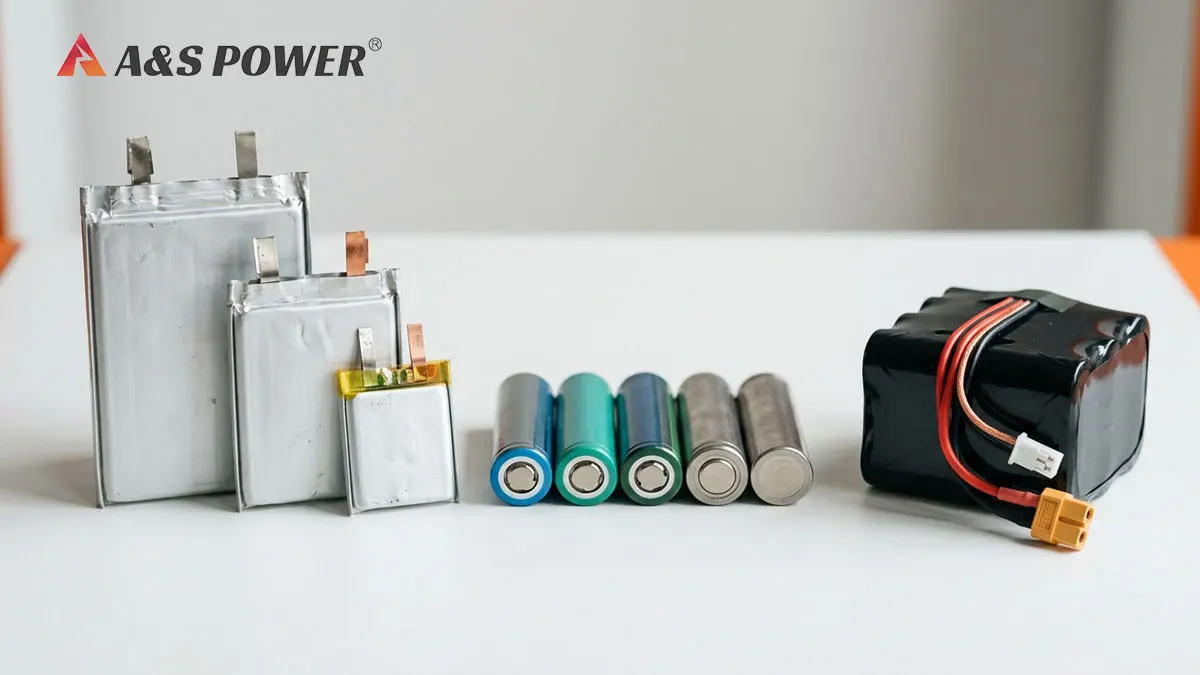
The term manufacturer is frequently used broadly in the battery industry. Some companies manufacture cylindrical cells, while others purchase cells from established producers and assemble them into battery packs. Distributors and trading companies may also provide sourcing and customization services.
These business models are not necessarily problematic. However, buyers need to understand which company is responsible for cell manufacturing, battery assembly, testing, and product quality.
Ask the supplier:
- Is the company an original cell manufacturer, battery pack manufacturer, or authorized distributor?
- Where are the cells manufactured and where are the battery packs assembled?
- Can the company provide its registered business information and factory address?
- Does it operate its own production and testing facilities?
- Which manufacturing processes are outsourced?
Request a live factory inspection, production-line photographs, or an independent factory audit when the order value and application justify it.
What we recommend: Do not automatically reject a trading company, but require full transparency about its supply chain and responsibility for product quality.
2. Confirm Cell Authenticity and Original Manufacturer Information
Cell authenticity is one of the most important checks when purchasing 18650 lithium-ion batteries.
Counterfeit, rewrapped, and low-quality cells can imitate the appearance of products from established manufacturers. A printed brand name or attractive wrapper does not prove that a cell is genuine.
A research study published in ACS Energy Letters, "Safety and Quality Issues of Counterfeit Lithium-Ion Cells", identified counterfeit and low-quality lithium-ion cells with significant differences in actual capacity, internal construction, and safety characteristics.
In one documented example, cells advertised as 5,000mAh delivered only 1,200mAh during testing. The study also identified cells with missing or inadequate internal safety components.
This demonstrates why visual inspection alone cannot establish authenticity.
Ask your supplier for:
- Original cell manufacturer and model number.
- Official manufacturer datasheet.
- Purchase or sourcing documentation where applicable.
- Batch or production identification information.
- Confirmation of authorized sourcing when branded cells are supplied.
Check the cell dimensions, weight, voltage, terminal construction, and printed identification against the original manufacturer's published specifications.
If branded cells are being supplied, contact the original manufacturer or its authorized channel when necessary to confirm the sourcing relationship.
For a deeper technical reference, buyers can also review NASA's counterfeit commercial-off-the-shelf lithium-ion cell verification study. It demonstrates why cell appearance and printed markings alone cannot establish authenticity.
Important: Never approve an 18650 cell solely because its appearance, wrapper, or printed capacity resembles an authentic product.
3. Examine the Technical Datasheet and Specification Consistency
A professional 18650 battery supplier should provide a detailed technical datasheet rather than a simple product description.
The datasheet should clearly identify the model and define the electrical and mechanical limits of the cell.
At minimum, review the following specifications:
| Parameter | What Buyers Should Verify |
|---|---|
| Nominal voltage | Rated voltage and battery chemistry |
| Rated capacity | Typical and minimum capacity |
| Charging voltage | Maximum charging voltage |
| Standard charging current | Recommended charging conditions |
| Maximum charging current | Permitted charging limit |
| Continuous discharge current | Maximum continuous operating current |
| Pulse discharge current | Current limit and pulse duration |
| Discharge cut-off voltage | Minimum operating voltage |
| Internal resistance | Measurement method and specified limit |
| Dimensions | Diameter and overall length |
| Weight | Published cell weight and tolerance |
| Operating temperature | Charging and discharging temperature ranges |
| Cycle life | Test conditions and end-of-life capacity |
For example, a conventional cylindrical 18650 cell has a nominal format of approximately 18mm in diameter and 65mm in length. Actual dimensions and tolerances must be confirmed using the manufacturer's datasheet.
Pay particular attention to the difference between typical and minimum capacity. A supplier quoting only typical capacity may not provide sufficient information for evaluating production acceptance.
Also check whether discharge ratings refer to continuous or short-duration pulse operation. These values are not interchangeable.
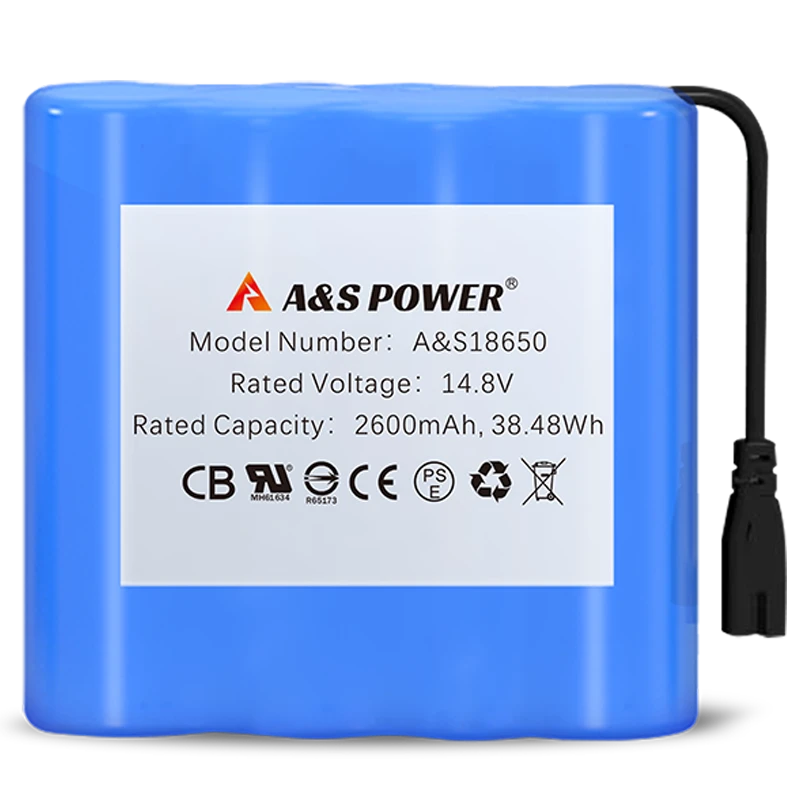
Buyers evaluating complete battery assemblies can compare available 18650 lithium-ion battery pack configurations and specifications from A&S Power to understand how cell selection, voltage, capacity, and pack dimensions relate to actual OEM requirements.
Our recommendation: Require the supplier to confirm the exact approved datasheet revision and agree that mass-produced cells will meet the same specifications.
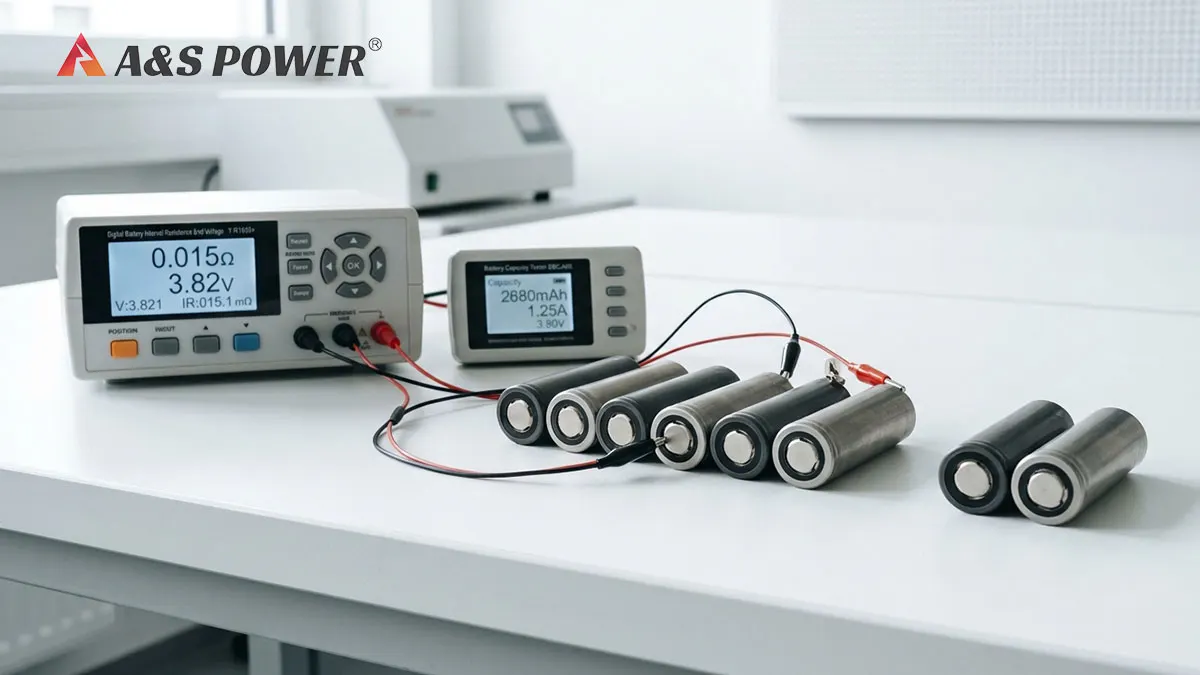
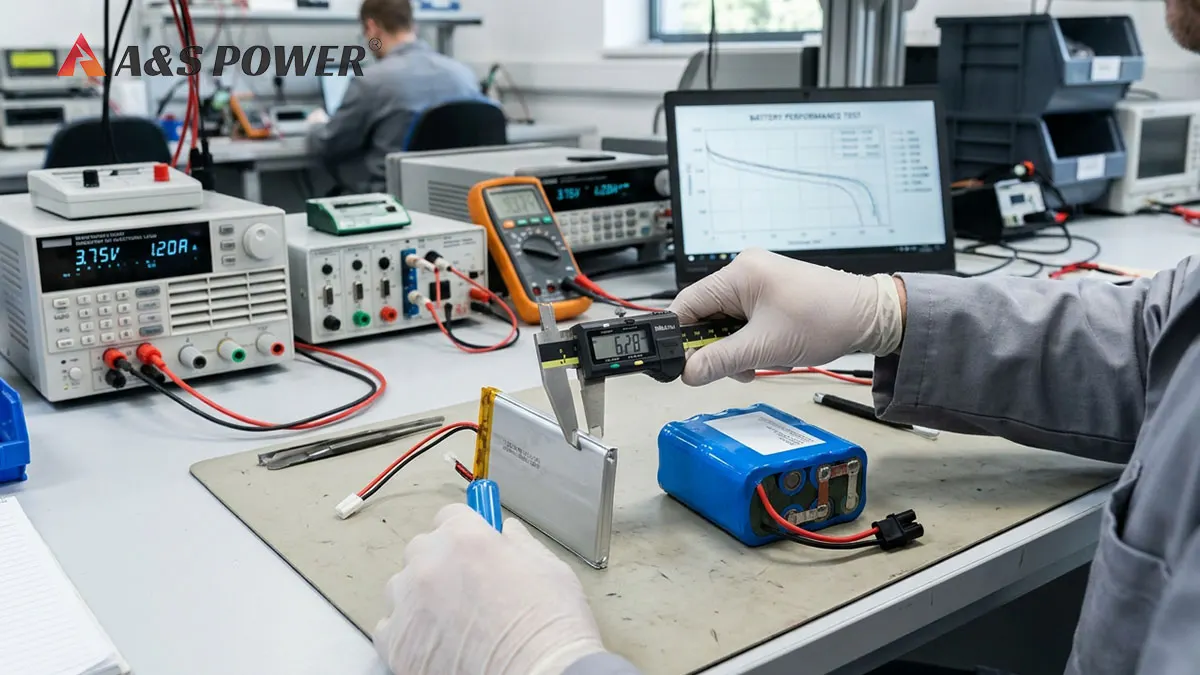
4. Verify Capacity and Internal Resistance Through Testing
A datasheet describes what a cell is supposed to achieve. Testing determines whether the supplied cells actually meet those specifications.
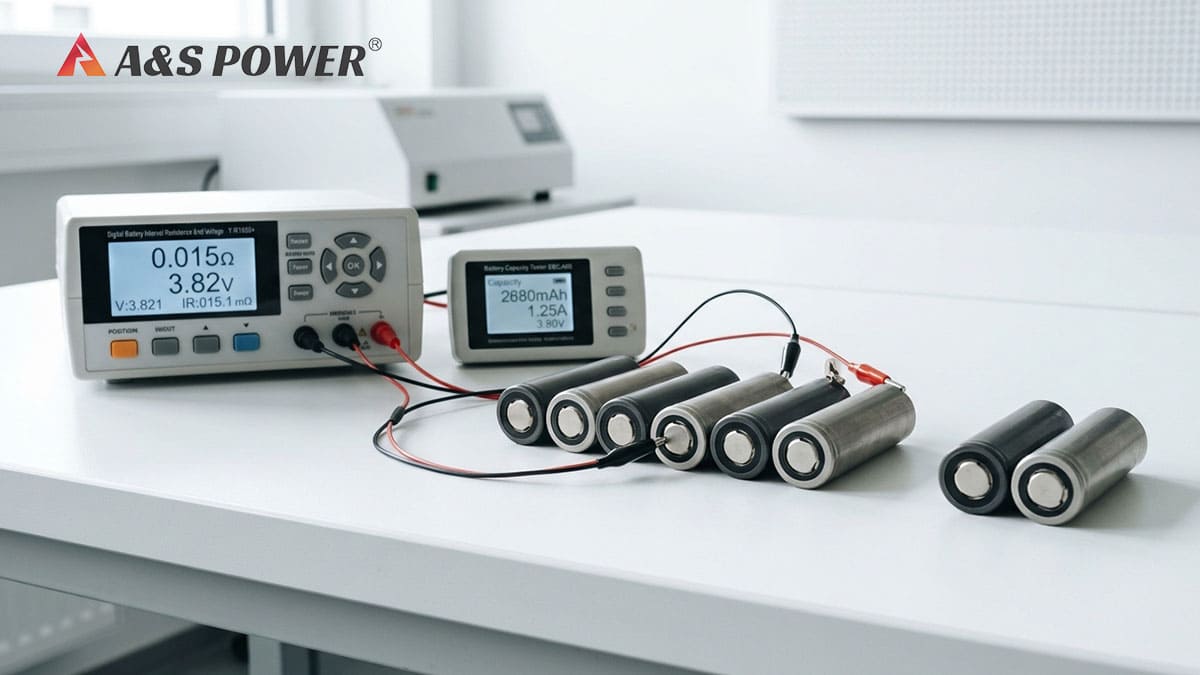
Capacity and internal resistance are two important parameters to verify during incoming inspection.
Capacity Testing
A controlled capacity test should define:
- Charging method and charging voltage.
- Charging current.
- Resting time after charging.
- Discharge current.
- Discharge cut-off voltage.
- Ambient temperature.
- Measurement equipment.
For example, if a supplier specifies a 2,600mAh cell, the buyer should confirm the measured capacity under the exact conditions stated in the approved datasheet.
A capacity result without testing conditions is difficult to evaluate because discharge current, temperature, and cut-off voltage can affect the measured result.
Internal Resistance Testing
Internal resistance influences voltage drop and heat generation under load.
A cell with higher internal resistance may experience greater voltage sag during discharge, particularly in high-current applications.
However, AC internal resistance and DC internal resistance are different measurement methods. Results should not be compared directly without considering the testing frequency, method, temperature, and state of charge.
For consistent incoming inspection, request the supplier's measurement method, equipment information, acceptance limits, and actual test records.
| Inspection Item | Verification Purpose |
|---|---|
| Open-circuit voltage | Identify abnormal voltage or inconsistent cell condition |
| Discharge capacity | Confirm usable capacity |
| AC internal resistance | Evaluate cell consistency using a defined method |
| Cell weight | Identify potential physical inconsistencies |
| Cell dimensions | Confirm mechanical compatibility |
| Appearance | Identify dents, damaged insulation, corrosion, or other defects |
For higher-volume purchases, consider independent sampling and laboratory testing instead of relying exclusively on supplier-generated reports.
5. Verify Safety Certifications and Compliance Documents
Certification is another essential part of 18650 battery supplier verification.
However, different certifications address different requirements. Buyers should not assume that one certificate automatically covers every cell, battery pack, or end application.
The most relevant documents may include:
- UL 1642: A safety standard covering lithium batteries at the cell level.
- UL 2054: A safety standard for household and commercial batteries.
- IEC 62133-2: Specifies safety requirements and testing for portable sealed secondary lithium cells and batteries. See the official IEC 62133-2 standard.
- UN 38.3: Covers transportation testing requirements for lithium cells and batteries.
- CE and other market-related compliance documentation: May be relevant depending on the finished product, applicable legislation, and target market.
When reviewing certification documents, verify:
- The certificate holder and manufacturer information.
- The exact cell or battery model covered.
- The applicable standard and edition.
- The issuing certification body or testing organization.
- The report number and validity or current status, where applicable.
- Whether the certified configuration matches the product being purchased.
For transportation, request the applicable UN 38.3 test summary. The U.S. Department of Transportation's PHMSA guidance on lithium battery test summaries explains the documentation requirements. Buyers can also consult the UN Manual of Tests and Criteria for the underlying testing framework.
When comparing suppliers, it is also useful to review their actual certification records rather than relying on a list of certification logos. The A&S Power battery certification library provides examples of relevant battery certification documentation.
Important: A certification document for one battery configuration does not automatically establish compliance for a different configuration. Always verify the actual scope.
6. Check Production Batch Traceability and Manufacturing Dates
Batch traceability is essential for maintaining consistent battery quality throughout the supply relationship.
If a customer reports abnormal capacity, unexpected voltage differences, or premature battery failure, the manufacturer should be able to identify the relevant production batch and investigate the problem.
Ask whether the supplier records:
- Cell manufacturer and model.
- Production batch or lot number.
- Manufacturing date or date code, where available.
- Incoming inspection results.
- Capacity and internal resistance grading records.
- Battery assembly and inspection records.
- Shipment and outgoing inspection information.
Manufacturing date is particularly important because lithium-ion cells can experience degradation during storage. Storage temperature, state of charge, and storage duration all influence their condition.
Do not evaluate cell freshness using a universal age limit without considering the original manufacturer's storage recommendations and actual storage conditions.
For bulk procurement, request a batch identification system that connects delivered products to their inspection and production records.
A supplier that cannot identify which production lot was shipped makes quality investigations and corrective actions considerably more difficult.
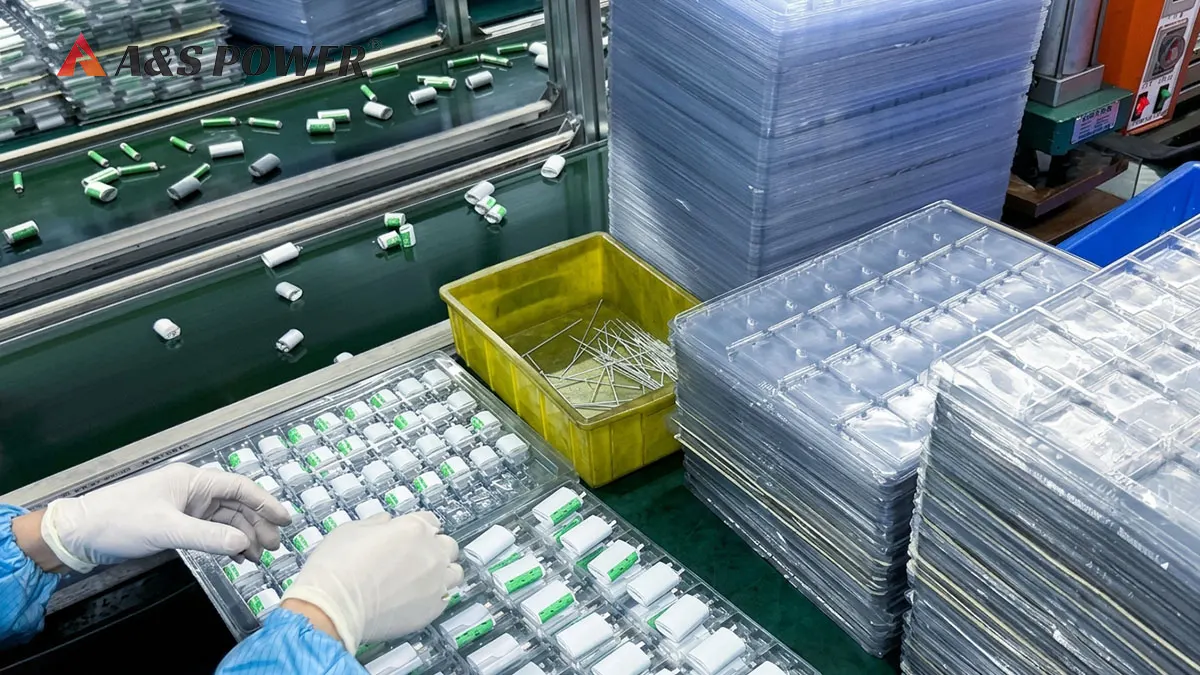
7. Evaluate Factory Quality Control and Production Capability
A supplier's quality management system should cover more than final product inspection.
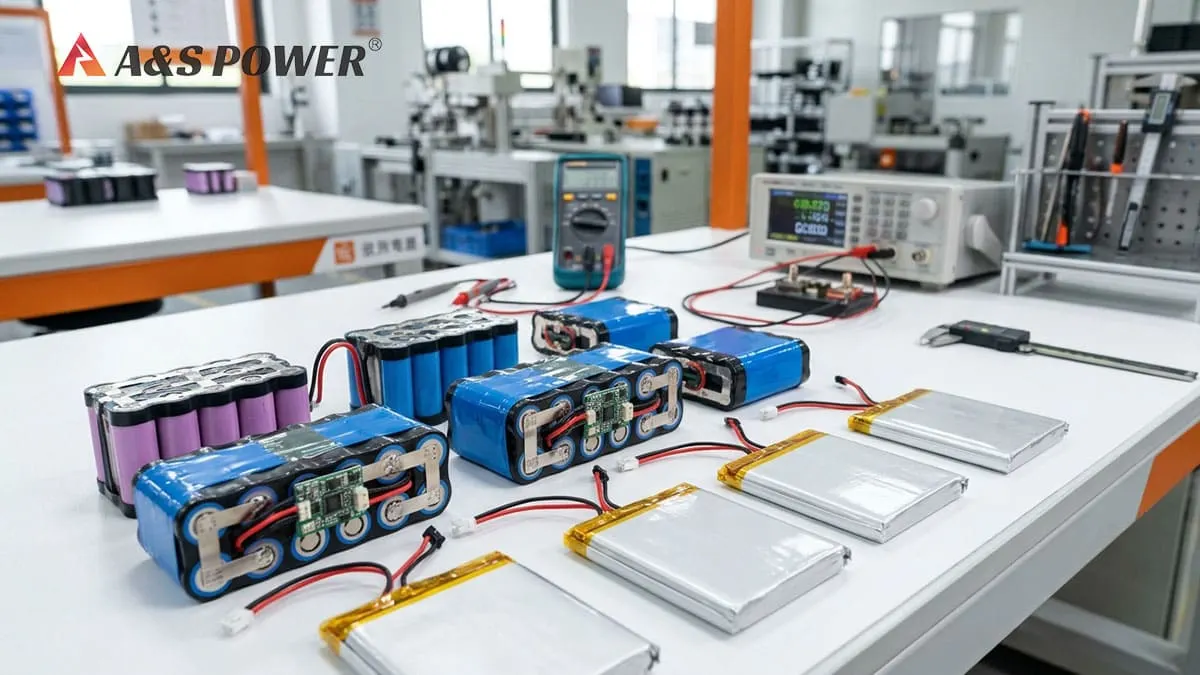
For 18650 battery manufacturing and pack assembly, quality controls may include incoming material inspection, cell sorting, welding process control, insulation protection, BMS integration, electrical testing, and final inspection.
During a factory audit, pay attention to the following areas:
| Production Area | What to Check |
|---|---|
| Incoming inspection | Verification of cell model, voltage, appearance, and incoming quality |
| Cell grading | Capacity and internal resistance classification |
| Cell matching | Consistency of cells used in multi-cell packs |
| Spot welding | Welding parameters and connection quality |
| Insulation | Protection against unintended short circuits |
| BMS integration | Correct protection settings and electrical compatibility |
| Functional testing | Voltage, charging, discharging, and protection checks |
| Final inspection | Appearance, dimensions, labeling, and packaging |
Ask how nonconforming materials are identified and isolated, how inspection equipment is calibrated, and how corrective actions are documented.
Production capacity also deserves attention. A supplier should be able to explain its actual production capability, available equipment, workforce, production scheduling, and subcontracting arrangements.
However, a large factory or impressive production capacity does not automatically guarantee consistent product quality.
The most useful evidence is a combination of documented procedures, actual inspection records, and repeatable production results.
8. Request Production-Representative Samples Before Mass Production
Sample approval is an important stage between supplier evaluation and bulk purchasing.
A sample should represent the actual materials, cell model, manufacturing process, and configuration intended for mass production.
Avoid approving a product based only on specially selected samples if the supplier cannot demonstrate that regular production follows the same specifications.
For 18650 battery cells, evaluate:
- Actual capacity under defined conditions.
- Internal resistance consistency.
- Cell voltage consistency.
- Physical dimensions and weight.
- Appearance and insulation condition.
- Discharge performance under the intended load.
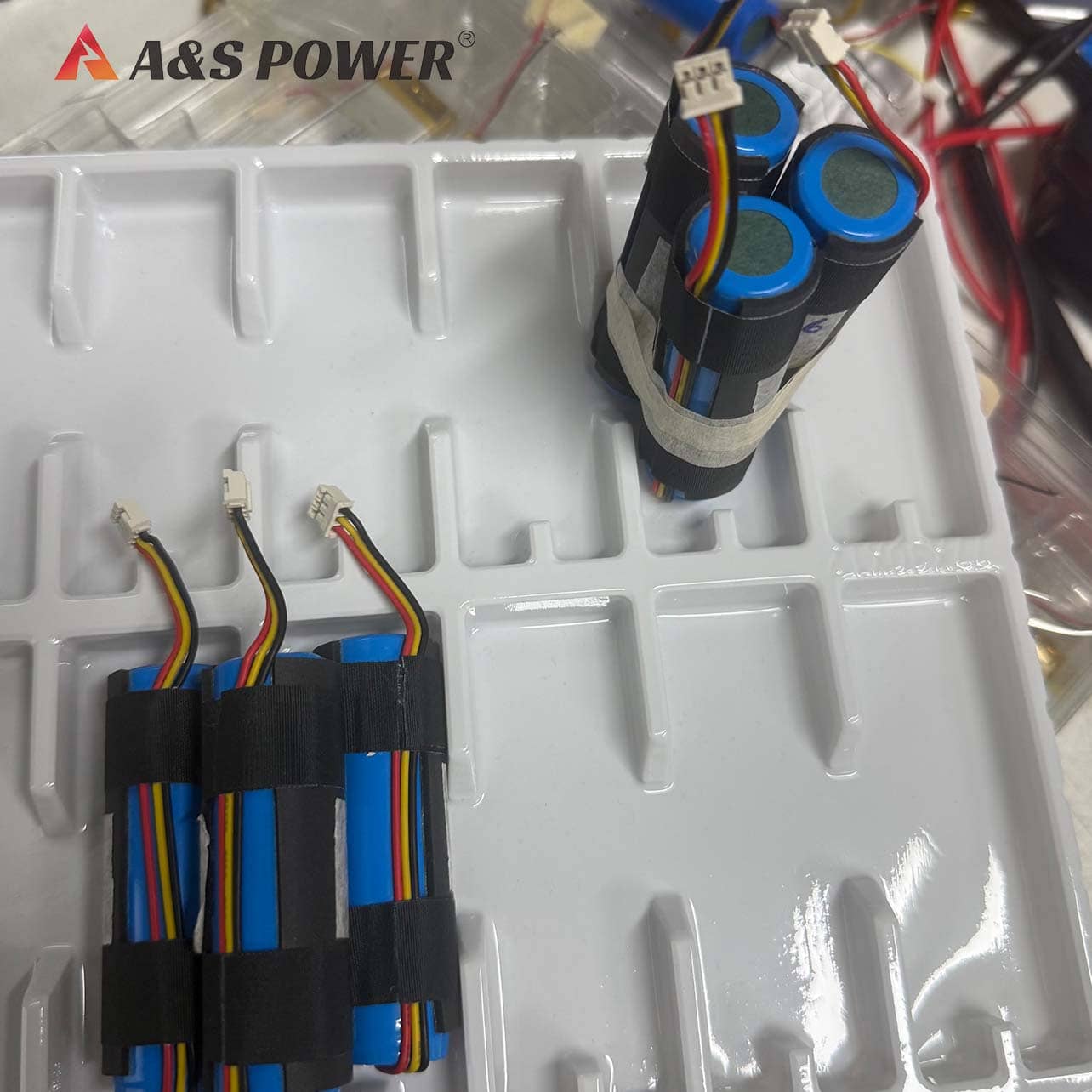
For customized battery packs, additional checks may include:
- Series and parallel configuration.
- Pack voltage and capacity.
- BMS protection functions.
- Connector type and polarity.
- Wire specifications.
- Charging and discharging performance.
- Operating temperature requirements.
For higher-risk applications, consider independent testing and a pilot production order before full-scale approval.
Document the approved sample's model, revision, specifications, and acceptance criteria. Any subsequent changes to cell sourcing, materials, or construction should be subject to change control.
9. Evaluate After-Sales Support, Warranty, and Long-Term Supply Stability
Supplier verification should not end when the first shipment passes inspection.
Battery performance problems may only become apparent after repeated charging and discharging, extended storage, or operation under real application conditions.
Before approving a manufacturer, establish clear written agreements covering:
- Warranty period and coverage.
- Product defect definitions.
- Quality complaint response time.
- Investigation and root-cause analysis.
- Replacement or compensation procedures.
- Corrective and preventive actions.
- Advance notification of product or material changes.
- Long-term availability and alternative sourcing arrangements.
For OEM projects, also clarify who is responsible for engineering changes, certification updates, and technical support.
A dependable manufacturer should be willing to discuss potential risks and provide technical explanations rather than simply promising that every product is perfect.
Long-term supply stability depends on more than production capacity. It also requires consistent sourcing, controlled manufacturing processes, documented quality standards, and effective communication.
18650 Battery Supplier Verification Checklist
The following checklist can be used by procurement and engineering teams during supplier evaluation.
| No. | Verification Item | Required Evidence |
|---|---|---|
| 1 | Manufacturing identity | Business details, factory information, supply-chain role |
| 2 | Cell authenticity | Original manufacturer, model, sourcing evidence |
| 3 | Technical specifications | Approved datasheet and specification revision |
| 4 | Electrical performance | Capacity and internal resistance test reports |
| 5 | Safety certification | Applicable certificates and test reports |
| 6 | Batch traceability | Lot numbers, date codes, inspection records |
| 7 | Manufacturing quality | Quality procedures, production records, audit results |
| 8 | Sample validation | Production-representative samples and test results |
| 9 | After-sales responsibility | Warranty, complaint handling, corrective-action procedures |
We recommend approving a supplier only after the critical requirements have been verified and documented.
Conclusion: Choose an 18650 Supplier Based on Verifiable Quality
Selecting an 18650 battery supplier is a technical and commercial decision that can affect product safety, manufacturing efficiency, and long-term business performance.
The nine checks discussed in this guide provide a practical framework for evaluating manufacturers before committing to mass production.
Rather than focusing exclusively on price, rated capacity, or certificates, buyers should verify cell authenticity, technical specifications, test results, batch traceability, manufacturing controls, and after-sales responsibilities.
At A&S Power, we understand that different applications require different battery configurations and quality requirements. As a lithium-ion battery OEM/ODM manufacturer, we support customized battery pack development, including voltage, capacity, dimensions, cell configuration, connectors, wiring, and protection circuit requirements.
Our approach is to evaluate battery requirements against actual application conditions and establish clear technical specifications before production.
If you are comparing 18650 battery manufacturers or developing a customized lithium-ion battery pack, explore A&S Power's lithium-ion battery solutions or contact our team to discuss your project and technical requirements.
Looking for a Reliable 18650 Battery Manufacturer?
A&S Power provides OEM/ODM lithium-ion battery pack solutions for different industrial and commercial applications. Discuss your required voltage, capacity, dimensions, connectors, BMS, and production requirements with our technical team.
Get a Custom Battery QuoteFrequently Asked Questions
1. How can I tell whether an 18650 battery supplier is a real manufacturer?
Check the company's registered business information, factory address, production equipment, quality control procedures, and manufacturing responsibilities. Ask whether it manufactures the cells itself or purchases cells from other manufacturers for battery pack assembly. A factory audit or production-line inspection can provide additional evidence.
2. What documents should an 18650 battery supplier provide?
A qualified supplier should be able to provide a technical datasheet, applicable safety certificates, UN 38.3 test summary, capacity and internal resistance test records, and relevant batch identification information. Depending on the application, additional documents such as SDS and a Certificate of Conformance may also be required.
3. How do I verify the actual capacity of an 18650 lithium-ion cell?
Use a calibrated battery tester to charge and discharge the cell under the manufacturer's specified conditions. Record the charging method, discharge current, cut-off voltage, ambient temperature, and measured capacity. Compare the result with the rated minimum capacity rather than relying exclusively on the typical capacity printed on the datasheet.
4. Is UN 38.3 certification enough to approve an 18650 battery supplier?
No. UN 38.3 addresses lithium battery transportation testing requirements. It does not independently establish every aspect of product performance, manufacturing consistency, or suitability for a specific application. Buyers should also review technical specifications, applicable product safety certifications, quality control procedures, and actual test results.
5. How often should buyers inspect 18650 battery batches?
The inspection frequency should depend on order volume, application risk, supplier performance, and the agreed quality plan. Incoming inspections should be performed according to documented acceptance criteria. Additional testing or factory audits may be appropriate when changing suppliers, cell models, production processes, or sourcing channels.
6. What is the difference between an 18650 cell manufacturer and an 18650 battery pack manufacturer?
An 18650 cell manufacturer produces cylindrical lithium-ion cells, while a battery pack manufacturer assembles cells into battery systems with defined voltage, capacity, wiring, connectors, and protection circuits. Some companies perform both activities, while others specialize in pack customization using externally sourced cells.
7. Should I approve a battery supplier based on sample testing alone?
No. Sample testing is necessary but should be combined with manufacturing and quality system verification. Buyers should confirm that production samples represent the actual mass-production process and establish batch inspection, traceability, and change-control requirements before approving regular orders.
8. What are the biggest warning signs when choosing an 18650 battery supplier?
Warning signs include unusually low prices without a clear explanation, unrealistic capacity claims, missing or inconsistent datasheets, unverifiable certificates, unclear cell sourcing, absent batch traceability, and refusal to provide meaningful test records. A supplier that cannot explain its quality control procedures also deserves additional scrutiny.
Author: A&S Power Technical Team | Battery Engineering & OEM Specialists