




LiFePO4 vs. Ternary NMC Battery Packs: Cost, Safety, and Lifespan
Quick Answer:
If I am choosing between a LiFePO4 (LFP) and ternary NMC battery pack, I do not consider one chemistry universally better.
For applications where cost, thermal stability, frequent cycling, and long service life matter most, LiFePO4 is usually the stronger choice. NMC, however, has a clear advantage when high energy density, lower weight, and compact pack size are critical.
The International Energy Agency reports that LFP battery packs were more than 40% cheaper per kWh than NMC alternatives in 2025, while LFP energy density remains lower than NMC.
In practical terms, I would normally consider LiFePO4 for energy storage, backup power, solar systems, and applications requiring frequent cycling, while NMC can be more suitable for weight-sensitive equipment, electric mobility, and compact high-energy applications.
Introduction
Choosing between LiFePO4 and ternary NMC battery packs is not simply a matter of comparing battery prices. In my experience with custom lithium battery projects, the right chemistry depends on how the battery will be used, how often it will cycle, how much space and weight are available, and what level of safety and service life the application requires.
LiFePO4, also known as LFP, is widely recognized for its thermal stability, long cycle-life potential, and relatively low material cost. Ternary NMC batteries, which use nickel, manganese, and cobalt in the cathode, offer higher energy density and can provide more stored energy within a limited weight or enclosure size. These differences make each chemistry better suited to particular applications.
The cost gap has also become an important factor in battery selection. According to the International Energy Agency (IEA), LFP battery packs were more than 40% cheaper per kWh than NMC packs on average in 2025. At the same time, NMC maintained an energy-density advantage, which remains valuable for electric vehicles and other weight- or space-constrained products.
In this guide, I will compare LiFePO4 and NMC battery packs from four practical perspectives: cost, safety, lifespan, and energy density. I will also explain how I approach chemistry selection when developing a custom battery pack, so you can determine which option is more appropriate for your specific application rather than choosing based on price alone.
LiFePO4 vs. Ternary NMC Battery Packs: What Is the Difference?
LiFePO4 and NMC are both lithium-ion battery chemistries, but their cathode materials are different.
LiFePO4, also called LFP or lithium iron phosphate, uses lithium iron phosphate as its cathode material. NMC, sometimes called NCM, uses a combination of nickel, manganese, and cobalt.
This chemistry difference affects much more than the battery's name. It influences energy density, thermal behavior, material cost, cycle life, weight, and the way I would design the battery management system (BMS).
The IEA notes that LFP does not contain nickel or cobalt and generally offers lower cost, lower flammability, and longer lifetime, while nickel-rich chemistries such as NMC provide higher energy density.
LiFePO4 vs NMC Battery Pack Comparison
| Parameter | LiFePO4 (LFP) | Ternary NMC |
|---|---|---|
| Cathode material | Lithium iron phosphate | Nickel-manganese-cobalt oxide |
| Energy density | Lower | Higher |
| Thermal stability | Excellent | Good, but more thermally sensitive |
| Typical cycle-life potential | High | Moderate to high, depending on cell design |
| Material cost | Generally lower | Generally higher |
| Weight for the same energy | Higher | Lower |
| Long-term frequent cycling | Excellent | Good |
| Compact applications | Moderate | Excellent |
| Stationary energy storage | Very suitable | Suitable |
| Electric mobility | Suitable | Very suitable |
| Cold-temperature performance | Generally weaker | Generally stronger |
| Key advantage | Safety, cost and longevity | Energy density and weight |
These figures should be treated as chemistry-level comparisons rather than guaranteed specifications. Actual performance depends on cell quality, electrode design, charging conditions, temperature, depth of discharge, C-rate, BMS settings, and pack construction.
1. LiFePO4 vs NMC: Which Battery Costs Less?
For most current battery projects, LiFePO4 has the cost advantage, although the exact quotation depends on cell format, capacity, production volume, BMS requirements, certifications, enclosure design, and regional supply chains.
The cost difference is largely related to the materials used in the cathode. LFP relies on iron and phosphate rather than the nickel and cobalt used in NMC.
According to the IEA's Global EV Outlook 2026, LFP battery packs were more than 40% cheaper per kWh than NMC alternatives on average in 2025. The IEA also cautions that this comparison spans EV and battery-storage applications, so it should not be interpreted as a universal quotation for every custom battery pack.
This is important when I evaluate a custom battery project. I would not compare only the initial battery price.
I would compare:
- Cell cost
- Pack assembly cost
- BMS cost
- Certification requirements
- Expected cycle life
- Replacement frequency
- Usable energy over the product lifetime
- Weight and mechanical integration costs
For a system that cycles every day, a slightly higher initial investment can be justified if the battery delivers substantially more usable energy over its service life.
2. Which Is Safer: LiFePO4 or NMC?
LiFePO4 generally provides greater thermal stability than NMC.
This does not mean an LFP battery is impossible to abuse or that an NMC battery is inherently unsafe. Both are rechargeable lithium-ion technologies and require appropriate cell selection, protection circuitry, charging control, thermal management, and manufacturing quality.
The key difference is the stability of the cathode chemistry.
LFP has a stable phosphate-based structure that is less prone to releasing oxygen under thermal stress. This contributes to its stronger thermal stability and lower risk of aggressive thermal behavior compared with many NMC chemistries. The IEA specifically identifies LFP's lower flammability as one of its advantages.
For this reason, I would give LFP a strong preference when the battery is intended for:
- Stationary energy storage
- Solar energy systems
- Backup power
- Telecom equipment
- Industrial equipment
- Applications requiring frequent cycling
- Products where thermal safety is a major design consideration
However, chemistry alone does not determine battery safety.
A properly engineered NMC battery with high-quality cells, a correctly specified BMS, appropriate thermal management, and validated protection mechanisms can also be engineered for safe operation.
3. Which Battery Has a Longer Lifespan?
LiFePO4 generally has a longer cycle-life potential than NMC, particularly in applications involving frequent charge and discharge.
However, I recommend avoiding statements such as “LFP always lasts exactly 5,000 cycles” because battery lifespan is not a fixed number.
Cycle life depends on:
- Depth of discharge (DoD)
- Charge and discharge current
- Operating temperature
- Upper and lower voltage limits
- Cell chemistry and construction
- BMS strategy
- Storage conditions
- Required end-of-life capacity
For example, an LFP pack operated under moderate temperature and controlled charging conditions can achieve substantially more cycles than the same chemistry subjected to high temperatures and aggressive C-rates.
The IEA identifies LFP's longer lifetime as one of its advantages, while current industry comparisons commonly place LFP ahead of NMC in cycle-life potential.
Why Cycle Life Matters to Total Cost
Suppose two battery packs have similar usable energy, but one can deliver considerably more charge-discharge cycles before reaching its specified end-of-life capacity.
The longer-lasting pack may provide a lower cost per delivered kWh even if its purchase price is not dramatically lower.
That is why I recommend evaluating battery cost together with expected lifetime rather than looking only at the initial quotation.
4. NMC's Biggest Advantage: Energy Density
This is where NMC remains highly competitive.
The IEA reports that LFP battery packs have approximately 20% lower gravimetric energy density and about one-third lower volumetric energy density than NMC packs.
For a battery designer, that difference can be significant.
If I have a fixed enclosure and need maximum runtime, an NMC battery may allow me to achieve the required energy with less weight or volume.
This makes NMC attractive for:
- Electric vehicles
- E-bikes and mobility equipment
- Portable power equipment
- Power tools
- Compact industrial equipment
- Weight-sensitive products
- Applications where maximum runtime per unit volume matters
This is also why I would not automatically replace an existing NMC design with LFP simply because LFP is cheaper.
If the product has a strict weight or dimensional limit, the additional LFP volume or mass could create a bigger engineering problem than the battery-price saving solves.
5. Temperature Performance Also Matters
Temperature is sometimes overlooked during battery chemistry selection.
NMC generally maintains an advantage in applications where low-temperature performance and high energy density are important. LFP can be more sensitive to low-temperature charging, meaning the battery system may require appropriate temperature monitoring and charging controls.
At the other extreme, elevated temperatures accelerate battery degradation for both chemistries.
Therefore, when I specify a custom battery pack, I look beyond the nominal capacity and ask:
Where will the battery operate, and how will it be charged?
A battery intended for an indoor medical device has very different thermal requirements from one installed outdoors in a solar-storage system.
6. Which Chemistry Should I Choose?
My selection process is relatively straightforward.
Choose LiFePO4 when:
- Long cycle life is a priority
- Battery safety and thermal stability are critical
- The pack will cycle frequently
- Weight and volume are less restrictive
- Low lifetime cost matters
- The application is stationary or semi-stationary
Choose NMC when:
- Energy density is the primary requirement
- Weight must be minimized
- Available installation space is extremely limited
- The product requires high energy in a compact enclosure
- The application benefits from strong energy-to-weight performance
There is therefore no universal winner.
LFP is generally optimized for cost, safety and longevity, while NMC is optimized for energy density and weight.
7. How I Evaluate a Custom Battery Pack
For an OEM project, I would not select chemistry based on a single specification.
I normally start with the application's electrical and mechanical requirements.
The basic design questions include:
- What voltage does the device require?
- What capacity is needed?
- What are the continuous and peak discharge currents?
- How much space is available?
- What is the maximum acceptable battery weight?
- How many cycles are expected each year?
- What temperatures will the pack experience?
- What BMS functions are required?
- Which safety and transportation standards apply?
- What is the target production volume?
This approach is particularly important for custom battery packs because the cell chemistry is only one part of the finished product.
A&S Power provides OEM/ODM battery customization covering electrical specifications, series/parallel configuration, BMS design, mechanical integration, connectors, and related battery-pack engineering.
For companies evaluating a new battery project, our Custom Lithium Battery Pack Solutions can be used as a starting point for discussing cell chemistry, capacity, voltage, dimensions, BMS, and production requirements.
8. LiFePO4 vs NMC: The Best Choice Depends on the Application
From my perspective as a battery manufacturer, the most useful way to compare LFP and NMC is not to ask “Which chemistry is better?”
Instead, I ask:
“Which chemistry solves the application's most important constraints?”
If the priority is long service life, thermal stability, frequent cycling and lower cost per kWh, LiFePO4 is usually the more attractive option.
If the priority is maximum energy density, minimum weight and compact packaging, NMC remains a strong choice.
This distinction is also reflected in the broader market. The IEA reports that LFP accounted for more than 55% of EV batteries deployed globally in 2025, showing how rapidly the chemistry has expanded beyond stationary storage.
At the same time, NMC remains important in applications where energy density provides a meaningful engineering advantage.
LiFePO4 vs NMC: Final Decision Table
| Priority | Recommended Chemistry |
| Lowest battery cost | LiFePO4 |
| Long cycle life | LiFePO4 |
| Thermal stability | LiFePO4 |
| Frequent daily cycling | LiFePO4 |
| Energy storage | LiFePO4 |
| Maximum energy density | NMC |
| Minimum battery weight | NMC |
| Compact high-energy design | NMC |
| Long-range mobility | NMC |
| Weight-sensitive equipment | NMC |
The final choice should still be validated against the exact cell datasheet, BMS design, operating temperature, charging profile, and applicable safety requirements.
Conclusion
LiFePO4 and ternary NMC battery packs are not competing solutions where one chemistry simply replaces the other.
LiFePO4 is usually the better choice when I prioritize safety, long cycle life, frequent cycling and cost. NMC is usually the better choice when I need maximum energy density and minimum weight.
For OEM and industrial applications, I recommend making the decision from the complete system rather than from cell chemistry alone. Capacity, voltage, operating temperature, discharge current, enclosure space, BMS architecture, certification requirements and expected lifetime all need to be considered together.
For companies developing a new battery-powered product, A&S Power supports customized lithium battery pack development from cell selection and electrical design through BMS integration, mechanical customization, testing and production. Our custom lithium-ion battery manufacturing service provides a useful starting point for OEM and ODM battery projects.
FAQs: About LiFePO4 vs. Ternary NMC Battery Packs
Is LiFePO4 better than NMC?
Not in every application. LiFePO4 generally has advantages in cost, thermal stability and cycle life, while NMC offers higher energy density and lower weight for the same stored energy.
Which battery lasts longer, LiFePO4 or NMC?
LiFePO4 generally offers a longer cycle-life potential than NMC. Actual lifespan depends heavily on temperature, depth of discharge, charging conditions, C-rate, cell quality and BMS control.
Is LiFePO4 safer than NMC?
LiFePO4 generally has better thermal stability and lower flammability than NMC. However, both chemistries require proper cell protection, BMS design, charging control and manufacturing quality.
Is NMC more expensive than LiFePO4?
Generally, yes. The IEA reported that LFP packs were more than 40% cheaper per kWh than NMC alternatives on average in 2025, although actual custom-pack pricing varies by application and region.
Why is NMC still used if LiFePO4 is cheaper?
NMC provides higher energy density. When weight and available space are limited, the additional energy density can outweigh the cost advantage of LFP.
Can I replace an NMC battery pack with LiFePO4?
Not as a simple drop-in replacement. LFP and NMC have different voltage characteristics, charging requirements and cell configurations. The BMS, charger, pack voltage, mechanical structure and system controls should be reviewed before changing chemistry.
Which battery chemistry is better for energy storage?
LiFePO4 is generally preferred for many stationary energy-storage applications because of its cost, thermal stability and cycle-life advantages. The IEA notes that energy density is less critical for stationary storage than for many vehicle applications, helping explain LFP's strong adoption in this market.
-

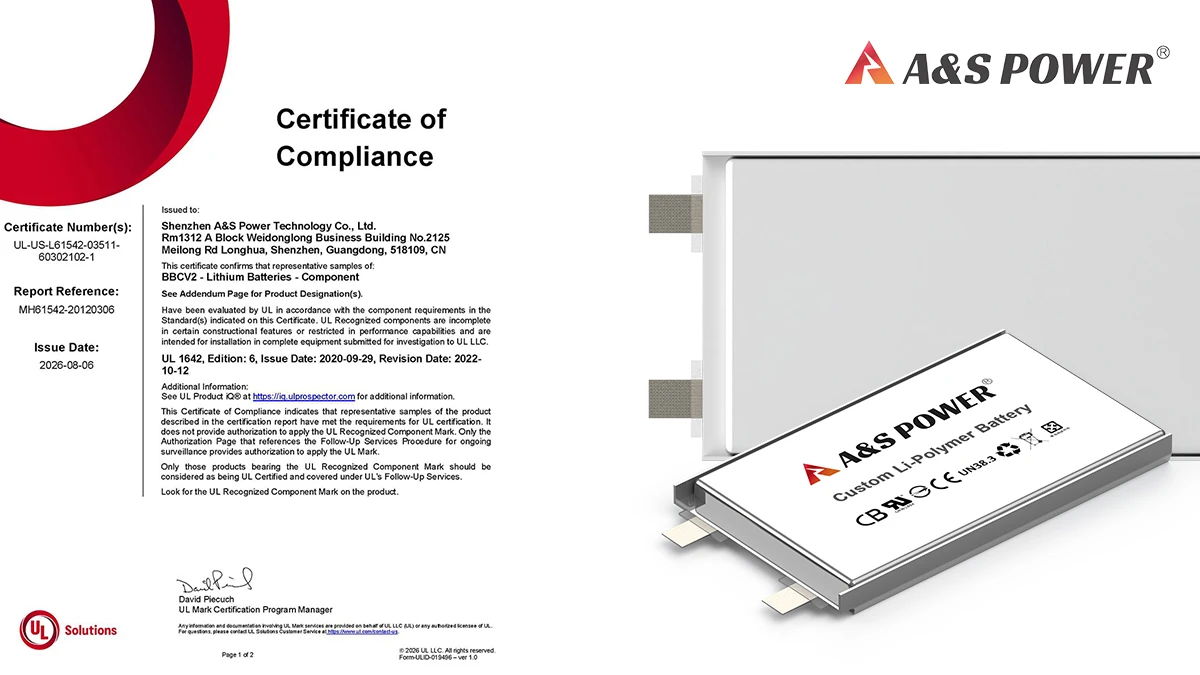 May.2026.08.27A&S Power Expands UL 1642 Certified LiPo Battery Cell PortfolioLearn More
 -
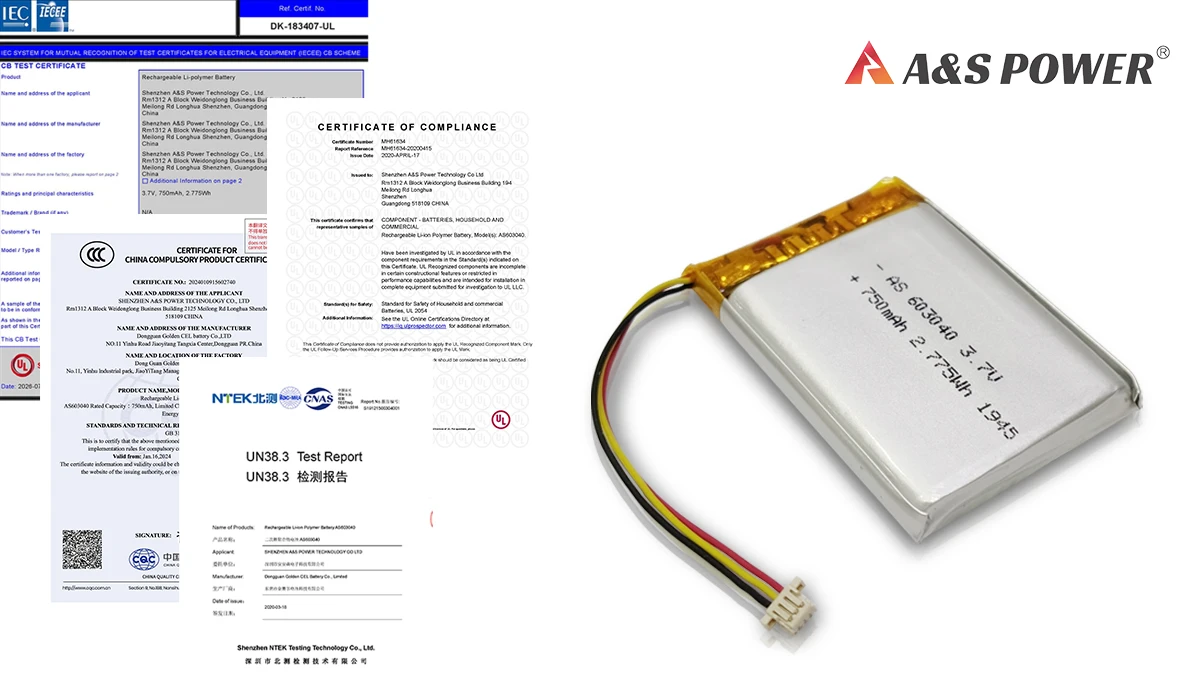 May.2026.08.273.7V 750mAh LiPo Battery - AS603040 : UL, CB, CCC & UN38.3 ComplianceLearn More
 -
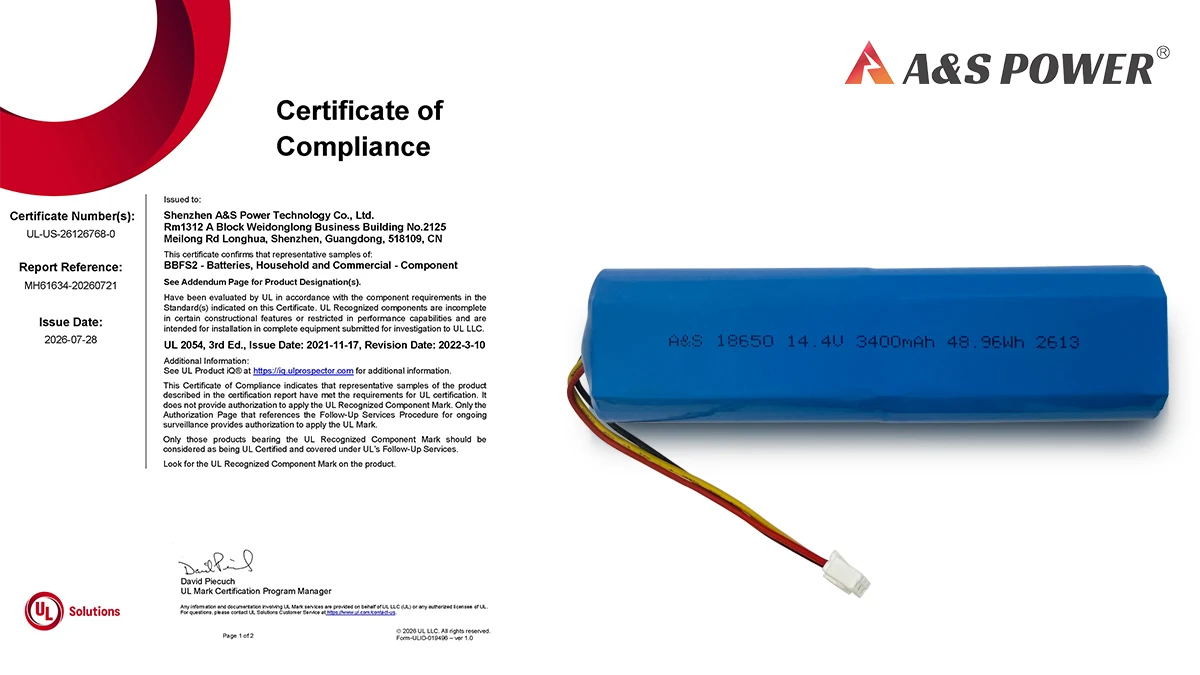 May.2026.08.26UL 2054 Compliance for 18650 3400mAh Rechargeable Li-ion BatteryLearn More
 -
 May.2026.08.2614500 Battery 3.7V Li-ion Rechargeable: What You Need to KnowLearn More
 -
 May.2026.08.25LiFePO4 vs. Ternary NMC Battery Packs: Cost, Safety, and LifespanLearn More