



Quick Answer
Is increasing PCM balance current from 52mA to 140mA always better?
No. A higher balance current can potentially reduce the time required to remove excess charge from a cell, but the appropriate current depends on the battery chemistry, cell capacity, balancing circuit, thermal conditions, and protection design.
At A&S Power, our engineer did not recommend changing the balance current to 140mA in this case. The design approach is to use an appropriate balance current and maintain cell consistency rather than treating a severely imbalanced battery as a normal operating condition.
Introduction
When developing a rechargeable lithium battery pack with a PCM (Protection Circuit Module) and cell balancing function, engineers may need to determine whether the specified balance current is sufficient for the application. A higher balance current can shorten the estimated balancing time, but increasing the current is not automatically the right solution for every battery design.
Recently, a customer asked A&S Power whether a balance current of 52mA could be increased to more than 140mA. The customer was concerned that a severely imbalanced battery could require more than 24 hours to balance and suggested modifying the circuit configuration to reduce the balancing time to approximately 9 hours.
After reviewing the technical question, our engineer did not recommend increasing the balance current to 140mA. The recommendation was based on the intended balancing behavior, battery reliability, and the importance of preventing severe cell imbalance in a properly designed battery pack.
This article explains the customer's concern, how balance current affects the balancing process, and why the appropriate balance current should be determined through battery-specific engineering rather than simply maximizing the current.
Key Takeaways
- A higher balance current may shorten balancing time, but it does not automatically improve battery safety or cell consistency.
- The 52mA and 140mA values must be evaluated against the actual PCM balancing circuit and battery design.
- A battery pack with a balancing function should be designed to maintain appropriate cell voltage consistency during operation.
- Severe and recurring cell imbalance requires investigation rather than relying only on a higher balancing current.
- A&S Power evaluates battery protection and balancing requirements according to the customer's application and battery specifications.
1. What Was the Customer's Concern About 52mA Balance Current?
The customer noted that the specified maximum balance current was only 52mA. Based on the customer's calculation, a severely imbalanced battery could take more than 24 hours to complete the balancing process.
The customer then proposed a possible circuit configuration that could increase the balance current to more than 140mA. According to the customer's estimate, this could reduce the balancing time to approximately 9 hours.
The concern is understandable from a battery development perspective. When multiple cells in a series-connected battery pack have different voltage levels, the balancing circuit may need to reduce the voltage difference before the battery pack can operate within the intended voltage range.
However, balancing time is only one part of the engineering evaluation. The design must also consider how the balancing circuit operates, how much heat it generates, and whether the selected current is appropriate for the cells and battery pack.
Why Does Balancing Time Matter?
In a series-connected lithium battery pack, individual cells may not have exactly the same state of charge. Differences can develop because of cell capacity variation, self-discharge, operating conditions, or charging behavior.
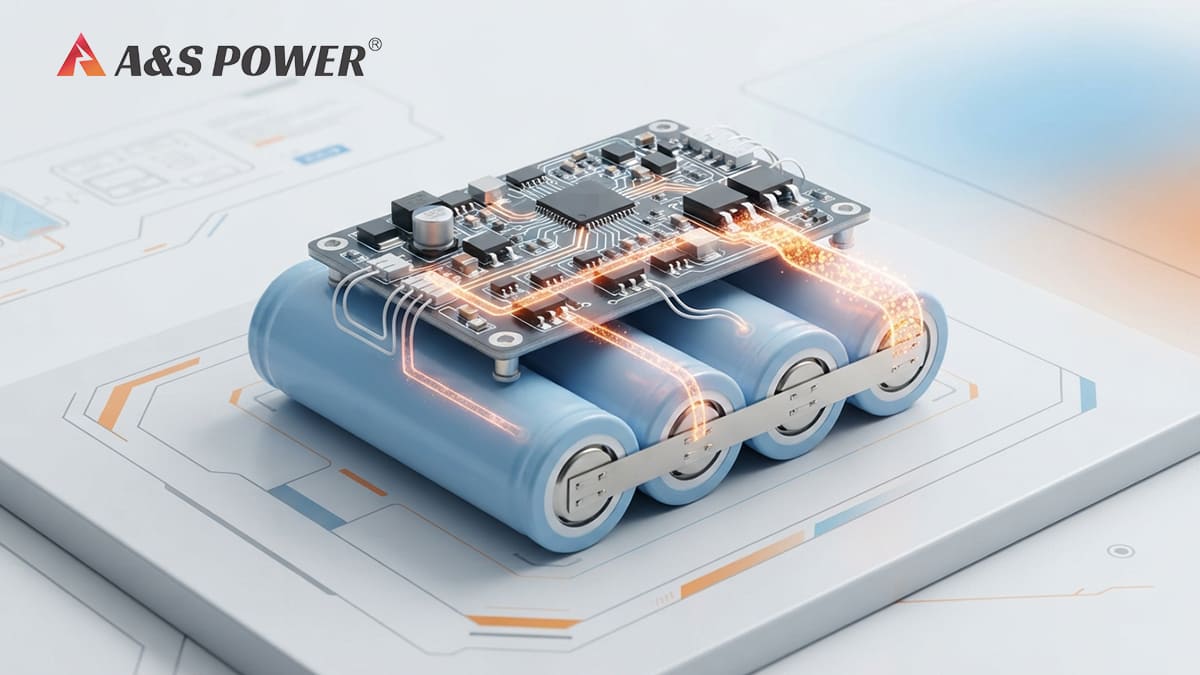
A balancing circuit helps manage differences between cells. Depending on the circuit design, the balancing process may remove excess charge from a higher-voltage cell or redistribute energy between cells.
When the balance current is higher, the circuit may be able to remove a given amount of excess charge more quickly. However, the actual balancing time depends on the voltage difference, available balancing current, balancing method, circuit behavior, and the amount of charge that needs to be balanced.
Therefore, a simple comparison between 52mA and 140mA does not establish the actual balancing time for every battery pack.
2. Why A&S Power Did Not Recommend Increasing the Balance Current to 140mA
After reviewing the customer's suggestion, A&S Power's engineer did not recommend increasing the balance current to 140mA.
The engineer's response was based on the following design considerations:
"Our engineer does not suggest changing the balance current to 140mA, the balance is the smaller the current, the more balanced."
The practical engineering interpretation is that the balance current should not be increased solely to achieve a faster balancing process. The current must be selected according to the complete battery design and the intended balancing behavior.
A balancing circuit is not simply a component where the highest available current is always the preferred option. Increasing the current may affect circuit losses, thermal performance, component ratings, and the overall balancing strategy.
For this reason, a proposed change from 52mA to 140mA should be assessed through the actual PCM circuit configuration and battery specifications before any modification is approved.
Does a Lower Balance Current Always Provide Better Balancing?
Not necessarily.
The balance current, by itself, does not determine the final degree of cell consistency. A lower current may offer a more gradual balancing process and can reduce instantaneous balancing power under comparable conditions. However, it also generally takes longer to remove the same amount of excess charge.
The actual performance depends on the balancing topology, control algorithm, cell characteristics, operating temperature, and voltage thresholds.
For example, passive balancing dissipates excess energy as heat, while active balancing transfers energy between cells. These approaches have different efficiency, thermal, and circuit design considerations.
Therefore, the engineering goal should be to select a suitable balance current for the intended battery system—not to assume that either the lowest or highest current is universally optimal.
3. Why Severe Cell Imbalance Should Not Be Treated as a Normal Condition
The second important part of A&S Power's response concerns severe cell imbalance.
Our engineer explained:
"And it will not occur severely imbalanced conditions when the battery comes with the balance function. otherwise it means the battery got problems."
This reflects an important design principle: a battery pack should be developed with appropriate cell matching, charging control, protection, and balancing functions to support consistent operation.
A balancing function is intended to manage cell voltage differences within the design's operating conditions. It should not automatically be regarded as a solution for any degree of severe or persistent imbalance.
If a battery pack repeatedly develops substantial voltage differences between cells, the engineering team should investigate the underlying cause.
Possible Causes of Cell Imbalance
Depending on the battery chemistry and application, potential contributing factors may include:
- Variations in cell capacity or internal resistance.
- Differences in cell state of charge before assembly.
- Uneven charging or operating conditions.
- Self-discharge differences between cells.
- A fault in the balancing circuit or related components.
- Battery aging or abnormal cell behavior.
These possibilities cannot be confirmed without testing. A higher balance current does not by itself identify or resolve the underlying cause.
For a custom battery pack, the cell selection, matching process, charging system, PCM configuration, and validation procedures should be considered together.
Severe cell imbalance may be related to differences in cell capacity, internal resistance, aging, or manufacturing consistency. For this reason, cell selection and matching are important parts of reliable battery design. Learn more about cell consistency and battery performance and how these factors influence battery pack reliability.
4. Understanding the Difference Between 52mA and 140mA
The customer's suggested increase from 52mA to more than 140mA represents a substantial change in the balancing current.
In an idealized constant-current model, the approximate time required to remove a given quantity of charge can be expressed as:
Where:
- t = approximate balancing time.
- Q = charge that needs to be removed or transferred.
- I = effective balancing current.
This simplified relationship assumes that the effective current remains constant and does not account for circuit cutoffs, voltage thresholds, temperature, or changes in the balancing behavior.
The ratio between 140mA and 52mA is approximately 2.69. Under idealized conditions, the time could therefore be reduced to around 37% of the original time for the same charge quantity.
However, this is only a theoretical comparison. It does not validate the customer's estimate of 24 hours versus 9 hours, because the actual charge imbalance and circuit operation have not been provided.
Why Theoretical Balancing Time Is Not Enough
Real battery balancing systems may not operate at a constant current throughout the entire process.
The current can vary depending on the circuit topology, cell voltage, balancing thresholds, temperature, and control behavior. In addition, balancing may stop or change its operating mode when certain conditions are reached.
As a result, the actual balancing time must be determined using the specific PCM circuit and battery configuration.
A&S Power therefore does not recommend increasing the balance current based only on a theoretical reduction in balancing time.
5. What Should Engineers Evaluate Before Changing PCM Balance Current?
Before modifying a PCM balancing circuit, engineers should evaluate several technical parameters.
5.1 Battery Chemistry and Cell Configuration
The battery chemistry and series configuration affect the required voltage range, charging characteristics, and protection strategy.
For example, a multi-cell lithium-ion or lithium polymer battery pack may require different balancing and protection parameters from a LiFePO4 battery pack.
The number of cells in series, nominal voltage, full-charge voltage, and cell specifications should be confirmed before selecting a balancing approach.
5.2 Cell Capacity and Imbalance Level
Balance current should be evaluated relative to the cell capacity and the expected voltage difference between cells.
A balancing current that is suitable for one battery capacity may not be appropriate for another application. The required balancing performance also depends on how much excess charge must be removed or transferred.
Engineers should distinguish between normal small voltage differences and substantial or persistent cell imbalance that requires further investigation.
5.3 PCM Circuit Configuration
The customer specifically noted that the actual PCM circuit configuration was not known.
This is an important limitation. Without the schematic, component specifications, and balancing topology, it is not possible to confirm whether a proposed current increase is electrically and thermally suitable.
The circuit should be evaluated for factors such as:
- Balancing resistor or active balancing component ratings.
- Current regulation and tolerance.
- Power dissipation and thermal conditions.
- Control thresholds and balancing duration.
- PCB layout and component operating limits.
- Interaction with charging and protection functions.
A circuit modification should be validated against the complete design rather than based on the balance current value alone.
The balancing current should not be evaluated separately from the rest of the battery protection system. Cell chemistry, capacity, charging conditions, thermal performance, and circuit design must be considered together. A&S Power supports custom PCM circuit board design based on the electrical and application requirements of the battery pack.
5.4 Safety and Reliability
Battery balancing is part of the overall battery management and protection design.
Increasing the balancing current can change the heat generated by the circuit and may require a review of component ratings and thermal performance. It may also affect the intended operating behavior of the balancing circuit.
For custom battery development, the balancing current should be selected with the battery's safety and reliability requirements in mind.
6. How A&S Power Approaches Custom Battery Balancing Requirements
At A&S Power, we understand that different applications may have different requirements for battery capacity, voltage, size, protection, and operating performance.
When a customer asks about PCM balancing current, our engineering team needs to consider the battery configuration and intended application before recommending a change.
Rather than increasing the balancing current simply to shorten the theoretical balancing time, we focus on selecting a configuration that is appropriate for the battery pack's design requirements.
The specific balance current should be determined through engineering evaluation and, where necessary, testing of the actual battery pack and PCM configuration.
Information That Helps With Engineering Evaluation
For customers developing a custom battery pack, the following information can help our engineering team assess balancing requirements:
- Battery chemistry, such as lithium-ion, lithium polymer, or LiFePO4.
- Series and parallel cell configuration.
- Nominal voltage and full-charge voltage.
- Cell capacity and model.
- PCM or BMS balancing requirements.
- Expected charging and operating conditions.
- Application requirements and any known cell voltage imbalance.
Providing this information allows the battery manufacturer to assess whether the proposed balancing parameters are appropriate for the application.
For a custom battery project, balancing requirements should be defined during the electrical design and validation stages. This includes reviewing the battery configuration, cell characteristics, protection parameters, and expected operating conditions. Our custom battery development process covers requirement analysis, cell selection, electrical design, prototype production, and testing.
7. Should You Increase Battery PCM Balance Current to Shorten Balancing Time?
The answer depends on the actual battery design.
If the battery pack has a balancing current of 52mA, it should not automatically be changed to 140mA simply because a higher current could theoretically shorten the balancing time.
The engineering team must first understand the circuit configuration, battery specifications, operating conditions, and intended balancing performance.
A higher current may be appropriate for some designs when supported by the circuit and system requirements. In other designs, retaining the existing current may be more suitable.
At the same time, severe or recurring cell imbalance should be investigated rather than treated as a normal condition that can always be corrected through a larger balancing current.
The right approach is to evaluate the battery pack as a complete system and select the balance current based on the design requirements.
The theoretical balancing time should not be treated as a confirmed real-world result. Actual performance depends on the balancing circuit, cell voltage difference, charging conditions, and battery operating temperature. Therefore, battery pack testing and validation are important before approving a revised balancing-current design. A&S Power explains more about battery pack testing and validation .
Conclusion
A higher PCM balance current may reduce the theoretical time required to balance a battery pack, but increasing the current is not always the best engineering solution.
In the customer discussion, A&S Power's engineer did not recommend increasing the balance current from 52mA to more than 140mA. The recommendation emphasized an appropriate balancing approach and the expectation that a properly designed battery pack should not experience severe cell imbalance as a normal operating condition.
For custom lithium battery development, balance current should be evaluated together with the battery chemistry, cell capacity, PCM circuit configuration, thermal performance, and overall protection requirements.
If your project requires a specific balancing current, protection threshold, or multi-cell battery configuration, A&S Power can evaluate the requirements and develop a custom lithium battery solution based on your application, electrical specifications, and safety requirements.
Frequently Asked Questions
1. Is 140mA balance current better than 52mA?
Not necessarily. A higher current may shorten the balancing time under comparable conditions, but the appropriate value depends on the battery design, circuit configuration, thermal performance, and balancing requirements.
2. How long does it take to balance a battery at 52mA?
The actual time depends on the amount of charge imbalance and the operation of the balancing circuit. The theoretical time cannot be determined accurately from the current rating alone.
3. Can the PCM balance current be increased from 52mA to 140mA?
A change may be technically possible in some designs, but it requires an engineering assessment of the actual PCM circuit, components, battery specifications, and thermal conditions. A&S Power did not recommend this change for the configuration discussed with the customer.
4. Does a lower balance current always provide better cell balancing?
No. A lower current may provide a more gradual balancing process, but it also generally requires more time for the same charge quantity. Balancing performance depends on the complete circuit and battery design.
5. What causes severe cell imbalance in a lithium battery pack?
Possible contributing factors include cell capacity variation, differences in self-discharge, operating conditions, charging issues, circuit faults, and cell aging. The actual cause requires appropriate testing and evaluation.
6. What information is needed to select a PCM balance current?
Engineers typically need the battery chemistry, cell configuration, capacity, voltage requirements, PCM circuit details, and application operating conditions to assess a suitable balancing current.
7. Can A&S Power customize a battery pack with a PCM and cell balancing function?
Yes. A&S Power provides custom rechargeable battery development, including battery pack configuration and protection requirements. Customers can contact our engineering team to discuss their application and technical specifications.
Need a Custom Lithium Battery Pack?
A&S Power provides OEM and ODM rechargeable battery solutions, including custom lithium-ion, lithium polymer, and LiFePO4 battery packs. Discuss your cell configuration, PCM protection, balancing requirements, and application specifications with our engineering team.
Get Custom Quote