



Quick Answer
Battery self-discharge is the gradual loss of stored electrical energy while a battery is not connected to an external load. It occurs because electrochemical reactions and small internal leakage currents can continue even when the battery is sitting idle.
For rechargeable lithium batteries, self-discharge is generally low compared with older battery chemistries, but it is not zero. Temperature, state of charge (SOC), battery chemistry, cell condition, impurities, internal leakage, and aging can all influence the rate.
An important engineering point is that self-discharge and battery aging are related but not identical. A battery can lose measurable charge during storage without all of that lost capacity representing permanent degradation. However, parasitic reactions during storage can also consume active lithium and contribute to irreversible capacity loss over time.
Key Takeaways
- Battery self-discharge means the battery loses stored charge while it is not powering an external load.
- Self-discharge can result from internal electrochemical reactions, leakage currents, electrode/electrolyte reactions, and other parasitic processes.
- Temperature is one of the most important factors affecting lithium-ion battery storage degradation.
- Higher SOC and elevated temperature can accelerate parasitic reactions and calendar aging.
- A voltage drop does not always mean that the battery has permanently lost the same percentage of capacity.
- Self-discharge specifications should be evaluated under defined temperature, SOC, storage time, and test conditions.
- For OEM battery packs, cell selection, PCM/BMS design, protection-current consumption, storage conditions, and production quality all matter.
Introduction
When an electronic device is turned off and its battery is left unused for several weeks or months, users may notice that the battery is no longer at the same state of charge.
This often leads to a simple question: Why does a battery lose power even when nothing is connected to it?
The answer is battery self-discharge.
From an OEM battery engineering perspective, self-discharge is more important than it may first appear. It affects products that spend long periods in warehouses, medical equipment waiting for deployment, emergency lighting systems, GPS devices, backup systems, industrial IoT equipment, and other battery-powered products that may remain idle between operating cycles.
In this article, I will explain what battery self-discharge actually means, what causes it, how temperature and SOC influence it, and why battery self-discharge should be considered together with calendar aging when designing a rechargeable battery system.
What Is Battery Self-Discharge?
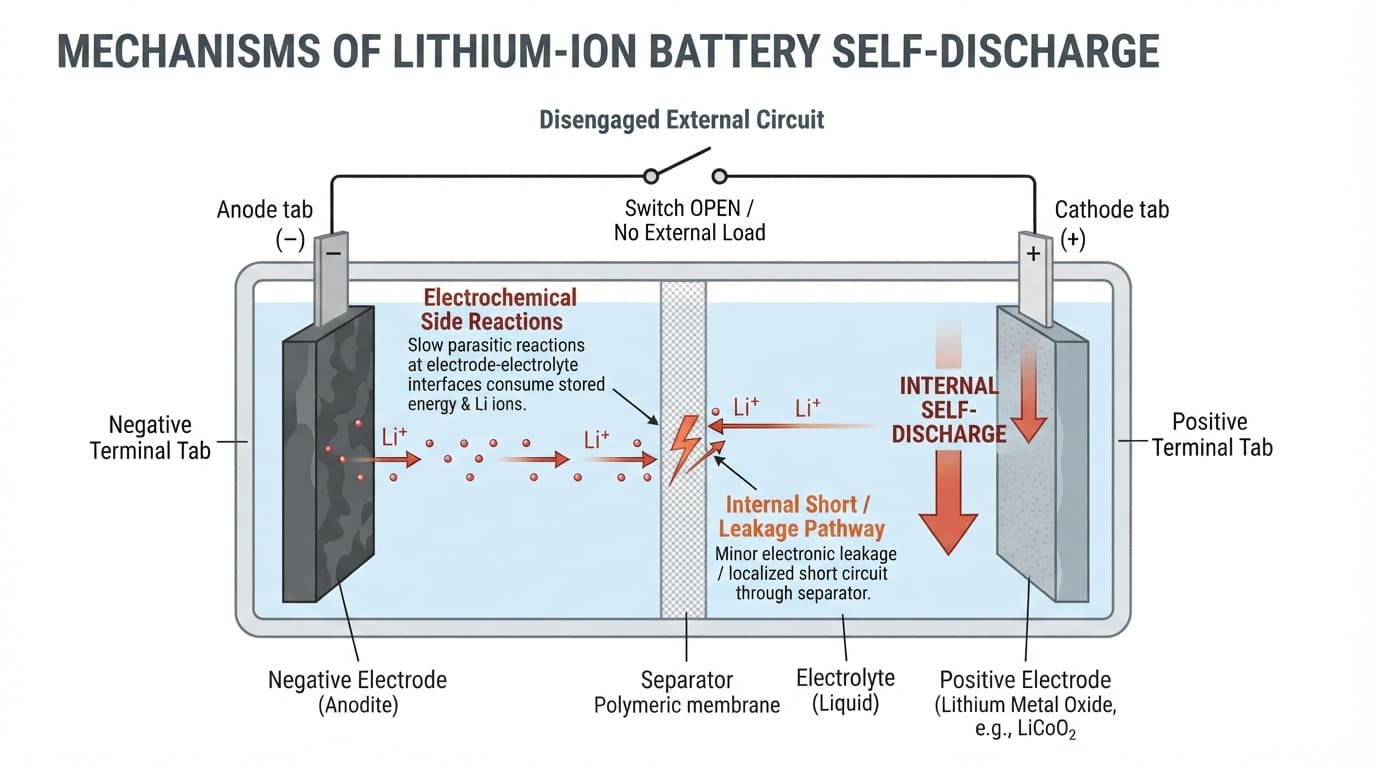
Battery self-discharge is the gradual reduction of a battery's stored charge when the battery is not connected to an external electrical load.
In a simplified example, imagine a rechargeable battery is charged and then disconnected from the equipment. Ideally, it would retain all of its stored energy indefinitely. In a real electrochemical cell, however, internal processes continue to occur.
Some of these processes consume stored electrochemical energy.
The result is a gradual decrease in available state of charge.
Self-discharge can therefore be thought of as an internal loss of stored charge during an idle condition.
For an engineering specification, the self-discharge rate should always be associated with test conditions. Temperature, storage duration, initial SOC, battery chemistry, measurement method, and cell design can all affect the result.
This is why statements such as "all lithium batteries self-discharge at X% per month" are misleading.
Why Does Battery Self-Discharge Occur?
1. Internal Electrochemical Reactions
The main reason batteries self-discharge is that electrochemical reactions do not completely stop when the external circuit is open.
Electrode materials and electrolyte can participate in slow side reactions. These reactions may consume some of the chemically stored energy even though no useful current is being delivered to the device.
Research on lithium-ion battery degradation identifies electrode/electrolyte reactions, internal or external electron leakage, passivation effects, electrolyte-related processes, and active-material changes among mechanisms associated with self-discharge and capacity loss.
The exact mechanism depends strongly on battery chemistry and construction.
2. Electrode and Electrolyte Side Reactions
Lithium-ion batteries contain complex interfaces between the electrodes and electrolyte.
During normal operation, protective interfacial layers such as the solid electrolyte interphase (SEI) form on the anode. Related interfacial processes can continue during storage.
These reactions do not necessarily produce useful external power. Instead, they can consume active lithium or electrolyte components.
Over time, this can contribute not only to apparent charge loss but also to permanent capacity degradation.
This distinction becomes particularly important when evaluating batteries that are expected to remain in storage for months or years.
3. Internal Leakage and Electronic Leakage
Another possible contributor is internal leakage.
Ideally, the battery's internal insulation and electrochemical structure prevent significant unwanted current flow. In a real cell or battery pack, however, small leakage paths can exist.
For a battery pack, the situation becomes more complicated because the pack may contain additional electronic components.
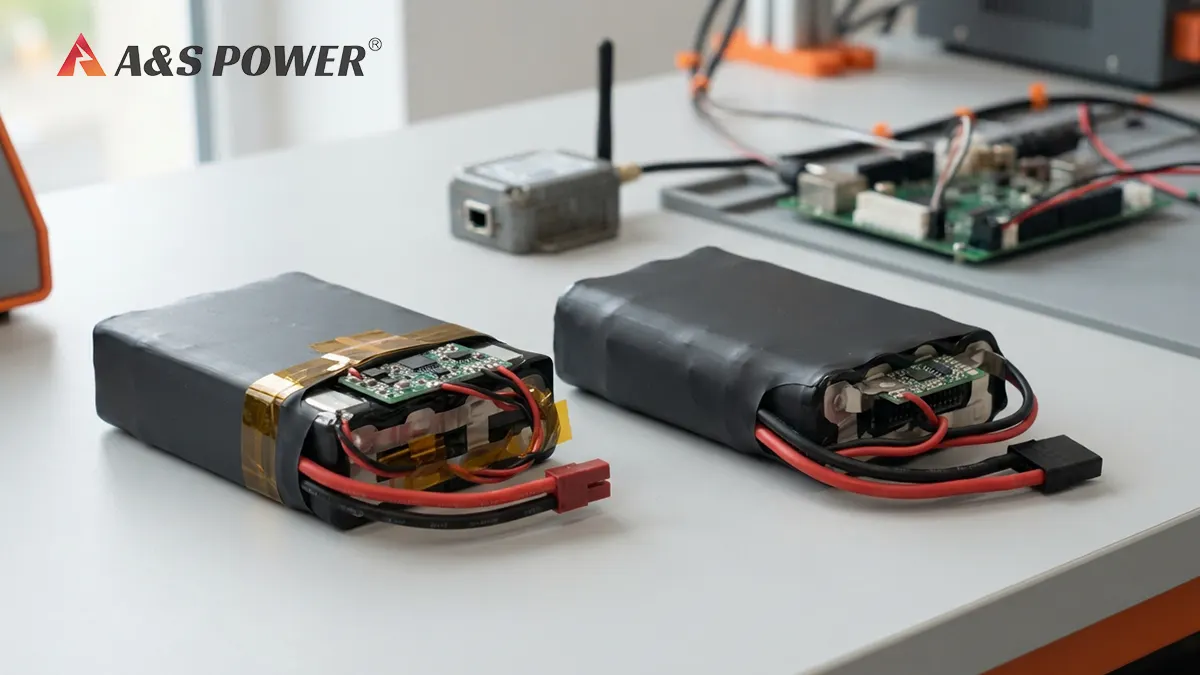
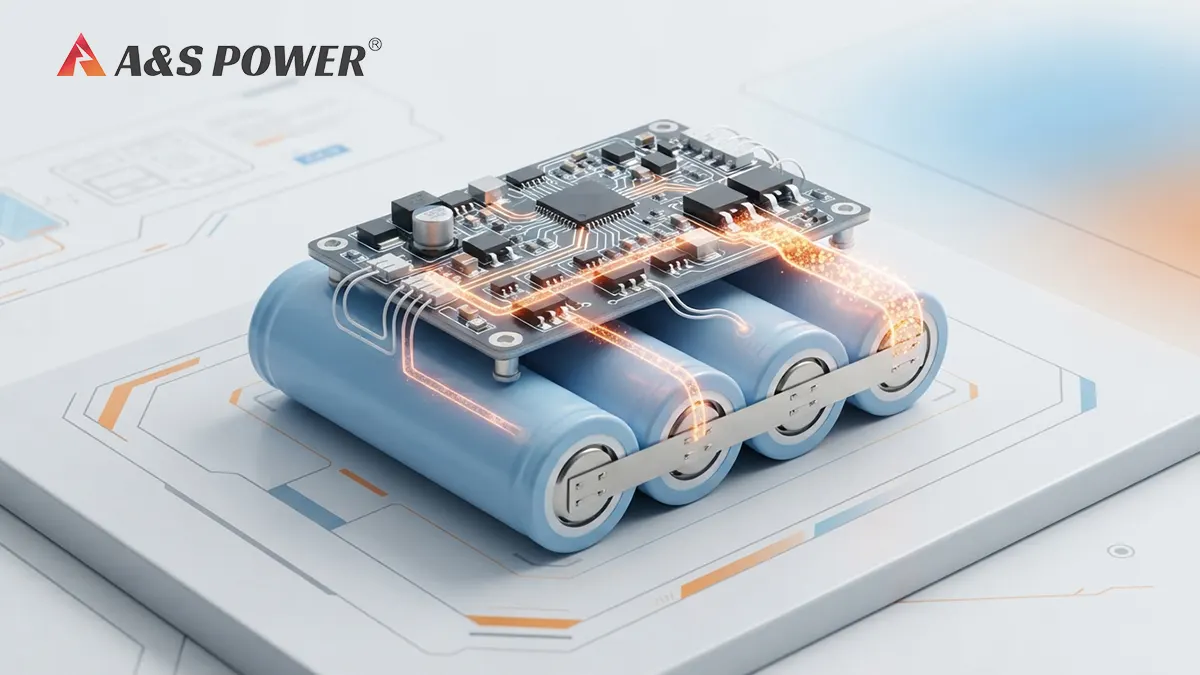
A PCM, BMS, fuel-gauge IC, communication circuit, protection circuit, or monitoring system can consume a small amount of current even when the main equipment is switched off.
Therefore, when an engineer observes that a complete battery pack loses charge faster than the individual cell specification suggests, the pack electronics should also be investigated.
What Factors Increase Battery Self-Discharge?
Temperature
Temperature is one of the most important variables.
Higher temperature generally accelerates chemical reaction rates. For lithium-ion batteries, elevated temperature can therefore accelerate parasitic reactions and calendar aging.
Recent research on LiFePO4/graphite lithium-ion batteries found that temperature and SOC interact strongly during long-term storage. In one modeled and experimentally validated study, storage at 55°C and 90% SOC produced substantially greater degradation than lower-stress conditions.
Another recent study examining LiFePO4/graphite pouch cells found that high-temperature storage at high SOC increased capacity fade, lithium inventory loss, and interfacial degradation.
This is why I do not recommend evaluating self-discharge without specifying the storage temperature.
State of Charge (SOC)
Initial SOC also matters.
A battery stored at a very high SOC can experience different electrochemical stresses from one stored at a lower SOC.
Recent research has shown that higher SOC can intensify calendar-aging reactions in lithium-ion batteries, particularly when combined with elevated temperature.
However, this does not mean that every lithium battery should simply be stored at an arbitrary low SOC.
The appropriate storage SOC depends on the chemistry, cell manufacturer's specifications, battery construction, expected storage period, and application.
For OEM projects, I recommend using the actual cell supplier's storage specification rather than applying a universal percentage. If you are also evaluating LiPo operating windows, our practical guide to the 80% rule for LiPo batteries provides additional context on SOC, depth of discharge, and battery operating limits.
Battery Chemistry
Different rechargeable battery chemistries have different electrochemical characteristics.
For example, lithium-ion, lithium polymer, and LiFePO4 batteries can all have relatively low self-discharge compared with some older rechargeable battery technologies, but their actual performance is determined by cell construction and operating conditions.
Even within the same chemistry, two cells from different manufacturers can have different self-discharge characteristics.
For example, A&S Power lists a self-discharge specification of ≤3.5% per month at 25°C for certain LiFePO4 battery products. This is a product-specific specification and should not be interpreted as a universal LiFePO4 value. You can see the actual storage and self-discharge specification on the 12.8V 250Ah LiFePO4 rechargeable battery pack product page.
Battery Self-Discharge vs. Battery Aging
These two terms are often confused.
Self-discharge
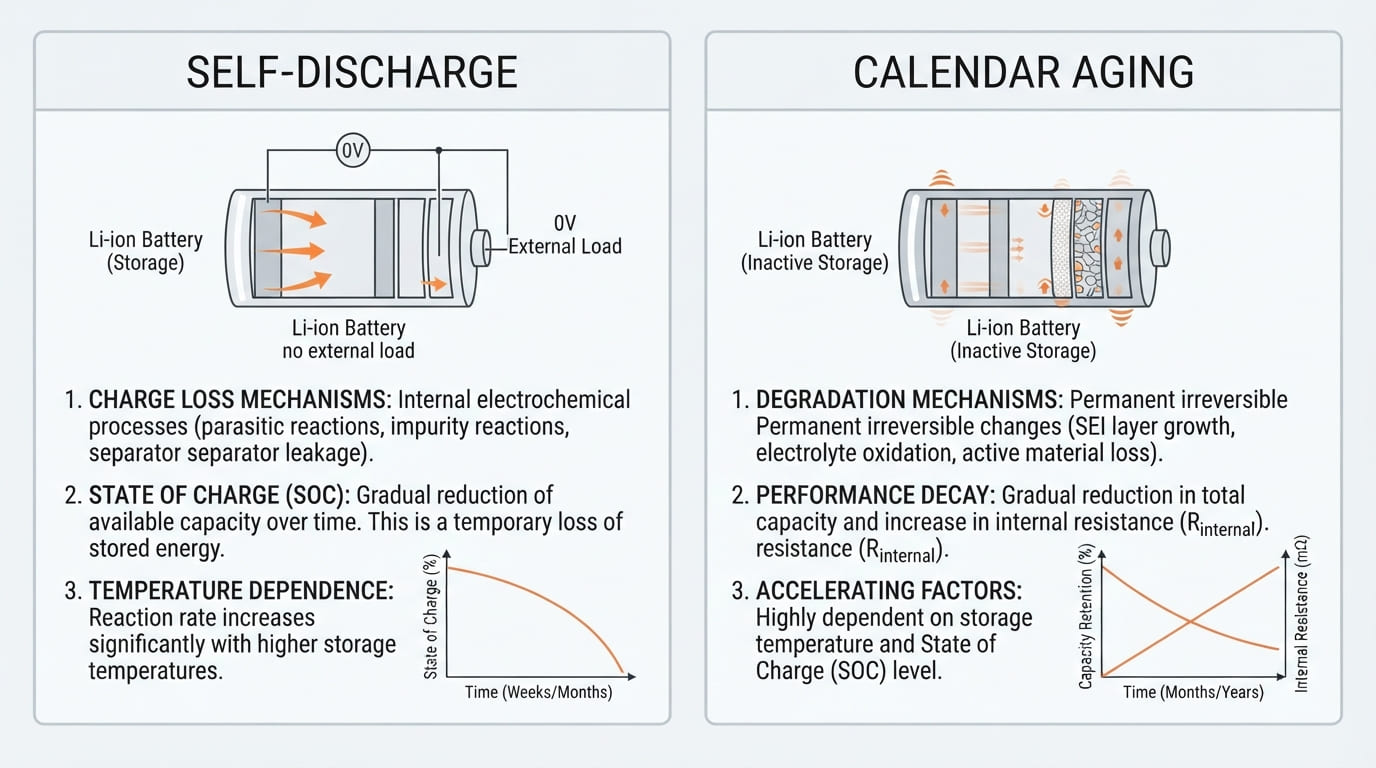
Self-discharge refers primarily to the loss of stored charge while the battery is not connected to an external load.
Calendar aging
Calendar aging describes the gradual degradation of battery performance as time passes, even when the battery is not being actively cycled.
The two processes can overlap.
For example, parasitic reactions may reduce the immediately available charge and simultaneously consume active lithium or increase internal resistance. In that case, part of the apparent loss may be recoverable after charging, while another part represents irreversible degradation.
Recent lithium-ion battery research describes calendar aging as being strongly influenced by storage temperature and SOC, with side reactions such as SEI growth contributing to capacity degradation.
For this reason, I prefer to evaluate self-discharge, capacity retention, and calendar aging as related but separate engineering parameters. A&S Power also discusses time-dependent battery degradation and capacity loss in its technical article on lithium battery aging tests.
How Is Battery Self-Discharge Measured?
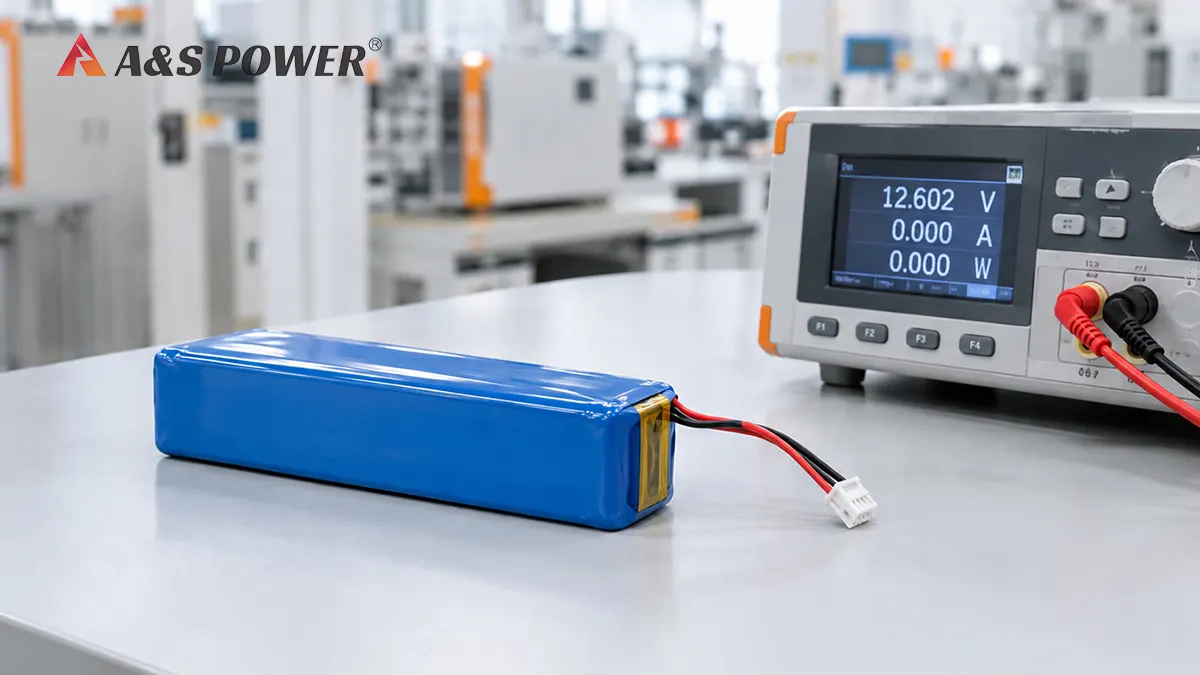
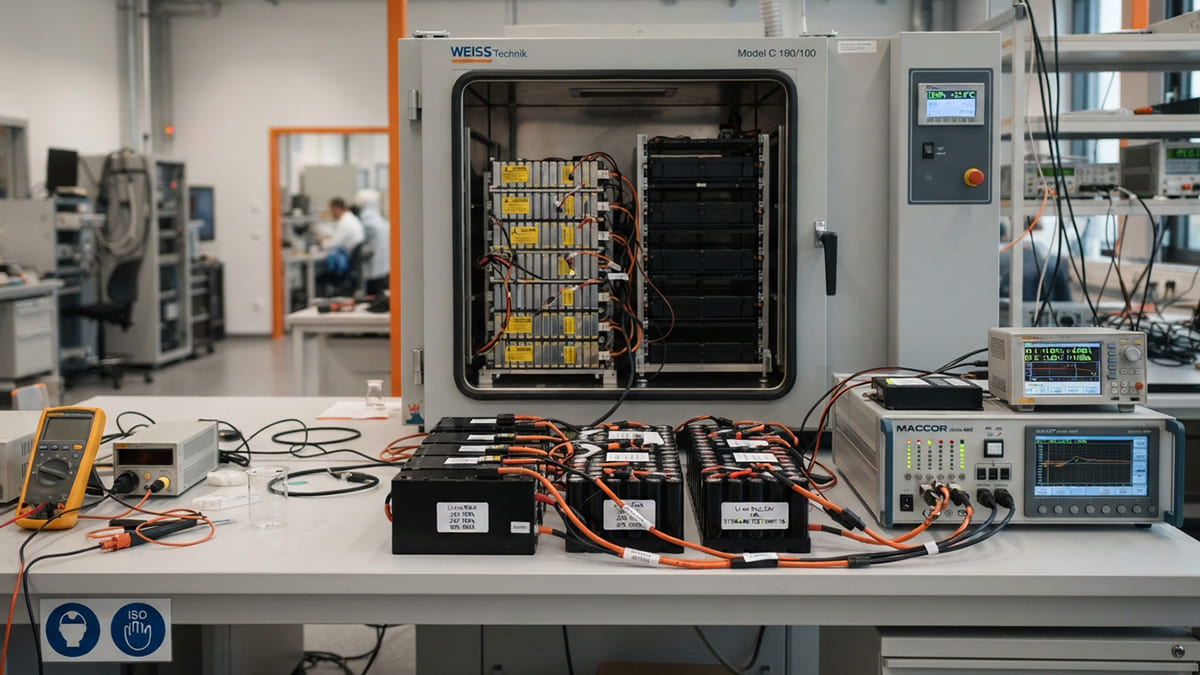
A basic self-discharge test normally requires a controlled storage condition and measurements before and after a defined storage period.
A simplified approach is:
- Fully charge or condition the battery according to the specified test procedure.
- Record initial voltage and/or capacity-related measurements.
- Store the battery under a defined temperature and SOC condition.
- Leave the battery disconnected from the external load.
- Measure the battery after a specified period.
- Compare the results with the initial condition.
However, voltage alone is not a complete measurement of remaining capacity.
A battery's open-circuit voltage depends on chemistry, SOC, temperature, relaxation behavior, and measurement conditions. Therefore, for engineering qualification, capacity testing under a defined discharge procedure can provide more meaningful information than simply comparing voltage readings.
International standards such as IEC 61960 establish performance-test requirements for secondary lithium cells and batteries and include capacity-after-storage considerations.
Typical Factors Affecting Battery Self-Discharge
| Factor | Typical Effect on Self-Discharge / Storage Loss | Engineering Consideration |
|---|---|---|
| Temperature | Higher temperature generally accelerates chemical reactions | Control storage temperature |
| SOC | High SOC can accelerate some calendar-aging reactions | Follow cell-specific storage guidance |
| Battery chemistry | Different chemistries have different electrochemical behavior | Compare actual cell data |
| Cell quality | Impurities and defects can increase unwanted reactions | Supplier quality control matters |
| Battery age | Aging can change internal resistance and leakage behavior | Consider production date and storage history |
| PCM/BMS | Electronics consume quiescent current | Check pack-level current consumption |
| Storage time | Longer storage allows more cumulative loss | Define shelf-life requirements |
| Mechanical/electrochemical condition | Internal degradation can affect leakage and capacity | Monitor production consistency |
The important point is that these factors do not operate independently. Temperature and SOC, for example, can interact and accelerate calendar-aging mechanisms together.
How Can Battery Self-Discharge Be Reduced?
For OEM battery projects, reducing self-discharge starts with controlling the complete battery system rather than focusing only on the cell.
1. Select an Appropriate Cell
Cell chemistry, cell design, electrolyte formulation, electrode materials, manufacturing quality, and aging history can all influence storage performance.
A qualified battery supplier should be able to provide relevant electrical specifications and recommended storage conditions.
For OEM projects, this is closely related to choosing the appropriate custom rechargeable battery solution based on the actual application rather than selecting a battery only by nominal capacity.
2. Control Storage Temperature
Avoid unnecessary exposure to high temperatures during manufacturing, transportation, and warehouse storage.
Temperature control is particularly important for products expected to remain unused for long periods.
3. Evaluate PCM/BMS Quiescent Current
For a battery pack with protection electronics, measure the actual current consumed by the PCM or BMS during standby.
This can be especially important for small-capacity batteries, because even a relatively small electronic current can represent a meaningful percentage of the available capacity over a long storage period.
4. Define the Required Shelf Life
If your product needs to remain in inventory for six months, twelve months, or longer, communicate this requirement during battery development.
The battery supplier can then evaluate cell selection, storage SOC, protection-circuit consumption, packaging, and qualification testing around the actual requirement.
Why Self-Discharge Matters for OEM Battery Design
Self-discharge becomes especially important when a battery-powered product has a long supply chain.
Consider a medical device, GPS tracker, emergency light, industrial IoT sensor, or backup power product.
The battery may spend time:
- in production,
- in quality inspection,
- in shipping,
- in a distributor's warehouse,
- in a customer's inventory,
- and finally inside the finished product before first use.
The battery therefore needs to perform reliably not only during active operation but also during storage.
At A&S Power, we consider battery requirements such as capacity, voltage, dimensions, operating temperature, storage conditions, protection electronics, and application requirements together when developing custom rechargeable battery packs.
Our product range includes Li-ion, LiPo, and LiFePO4 battery solutions, with customized battery configurations for different OEM applications.
A&S Power has been developing and producing customized battery solutions since 2011, and its current company profile states that it has designed and produced more than 1,000 battery specifications.
A Practical Example
Suppose an OEM customer requires a rechargeable battery to retain adequate energy after six months of warehouse storage.
It would not be sufficient to ask only:
"What is the battery's self-discharge rate?"
I would first clarify:
- Which chemistry is being used?
- What is the nominal capacity?
- What SOC will the battery have during storage?
- What temperature will the warehouse maintain?
- Is the PCM/BMS connected during storage?
- What is the acceptable remaining capacity after six months?
- How will capacity retention be tested?
- What is the expected production-to-use time?
These questions turn a general battery specification into a measurable engineering requirement.
That is particularly important for custom OEM battery packs, because the final pack may behave differently from the bare cell once protection electronics, wiring, connectors, and other components are added.
Conclusion
Battery self-discharge is the gradual loss of stored charge while a battery is not supplying power to an external load. It occurs because electrochemical and electronic processes can continue inside the battery even when the external circuit is open.
For lithium-ion batteries, self-discharge should not be treated as a single fixed percentage that applies to every product. Temperature, SOC, chemistry, cell quality, aging, storage time, and battery-pack electronics can all affect the result.
More importantly, self-discharge should be distinguished from calendar aging. Some charge loss during storage can be measured as self-discharge, while ongoing parasitic reactions can also cause irreversible capacity loss and increasing internal resistance over time.
For OEM battery applications, the most reliable approach is to define storage conditions and shelf-life requirements early, then validate the complete battery pack under realistic conditions.
If your product requires a customized Li-ion, LiPo, or LiFePO4 battery with defined storage and shelf-life requirements, the battery should be evaluated as part of the complete product system rather than by cell capacity alone.
Need a Custom Rechargeable Battery With Defined Storage Requirements?
If your product will spend weeks or months in storage before deployment, battery self-discharge should be considered during the battery design stage—not after mass production.
A&S Power provides customized Li-ion, LiPo, and LiFePO4 battery solutions for OEM applications. We can evaluate capacity, voltage, dimensions, operating conditions, protection electronics, storage requirements, and application-specific battery performance together.
Contact A&S Power for a Custom Battery SolutionFAQ: Battery Self-Discharge
What is battery self-discharge?
Battery self-discharge is the gradual loss of stored charge while a battery is not connected to an external load. It results from internal electrochemical reactions, leakage mechanisms, and other parasitic processes.
Do lithium-ion batteries self-discharge?
Yes. Lithium-ion batteries have relatively low self-discharge compared with many older rechargeable battery technologies, but self-discharge is not zero. The actual rate depends on cell design, chemistry, temperature, SOC, age, and other conditions.
Does temperature affect battery self-discharge?
Yes. Higher temperatures generally accelerate chemical reactions and can increase storage-related degradation. Temperature is an important variable when evaluating lithium-ion battery storage performance.
Is self-discharge the same as battery aging?
No. Self-discharge describes the loss of stored charge during storage, while battery aging describes broader changes in battery performance over time. They can be connected because some reactions responsible for charge loss can also cause irreversible capacity degradation.
Does a higher SOC increase self-discharge?
A higher SOC can accelerate some storage-related side reactions, particularly under elevated temperatures. The appropriate storage SOC depends on the specific battery chemistry and manufacturer's requirements.
How do I calculate battery self-discharge?
A basic calculation can compare measured battery capacity before and after a defined storage period. For meaningful engineering results, temperature, SOC, storage duration, test current, and measurement procedure should be controlled.
How can OEM manufacturers reduce battery self-discharge?
OEM manufacturers can address self-discharge through appropriate cell selection, controlled storage temperature, suitable storage SOC, low-quiescent-current PCM or BMS electronics, and qualification testing under realistic storage conditions.
Can a custom battery pack have higher storage loss than its cell?
Yes. A complete battery pack can include a PCM, BMS, fuel gauge, communication electronics, or other components that consume standby current. Pack-level storage performance should therefore be validated separately from the cell specification.