




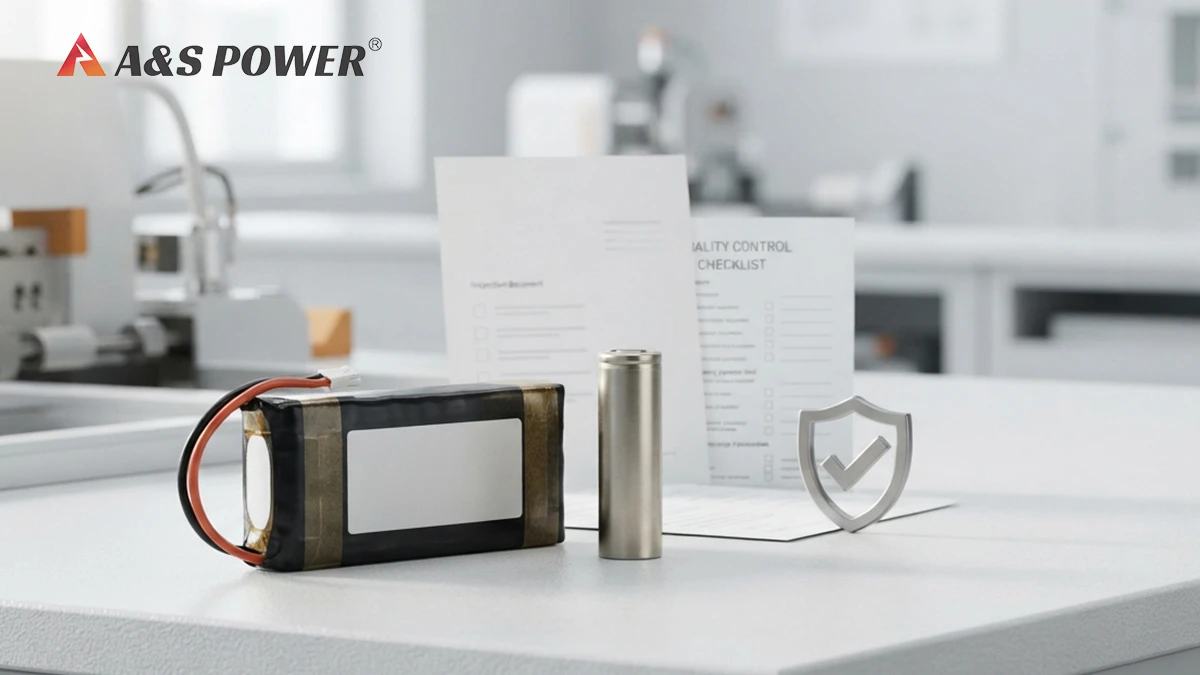
Who Pays UL Battery Certification Maintenance Fees?
Yes, UL-certified battery products can involve ongoing certification-related activities such as annual audits and documentation management. However, the important question for an OEM battery buyer is who is responsible for these costs.
At A&S Power, we understand that customers need predictable long-term battery costs, not unexpected certification expenses after production begins. Although certification maintenance may involve annual audit and documentation management fees, A&S Power covers these costs for our customers under our cooperation arrangement.
This means customers do not need to budget separately for these certification maintenance expenses when working with us.
- UL certification can involve ongoing audit and documentation management activities.
- Certification maintenance costs should be clarified before placing an OEM battery order.
- A battery quotation should not be evaluated only on the initial unit price.
- A&S Power covers the relevant annual audit and documentation management costs for our customers.
- Customers can work with us without worrying about these certification maintenance expenses becoming an unexpected additional cost.
- Clear responsibility for certification costs helps make long-term battery supply more predictable.
Introduction: Why Do Customers Ask About UL Certification Costs?
When purchasing a custom lithium battery for a commercial product, the initial quotation is only one part of the total procurement cost.
For products that require safety certifications, customers may also want to understand what happens after the initial certification is completed.
One question we regularly encounter from customers is:
This is a reasonable question.
For an OEM battery project, certification is not simply a one-time document that is obtained and then forgotten. Depending on the certification program and product arrangement, manufacturers may need to maintain certification through ongoing audits, documentation, production controls, or other compliance activities.
For customers purchasing batteries in large quantities or planning long-term cooperation, understanding who is responsible for these costs is important.
At A&S Power, our approach is straightforward: we take responsibility for the relevant certification maintenance expenses so our customers do not have to pay them separately.
Do UL-Certified Batteries Have Ongoing Certification Costs?
A common misunderstanding is that once a battery receives UL certification, there will never be any further certification-related work.
In practice, certification programs can require ongoing maintenance.
For example, depending on the applicable UL certification program, manufacturing site, product scope, and certification arrangement, there may be activities associated with:
- Annual or periodic factory audits
- Certification maintenance
- Documentation management
- Follow-up compliance activities
- Production-related certification records
- Changes to certified products or manufacturing processes
These activities help maintain the validity and consistency of a certified product and manufacturing system.
Therefore, when an OEM customer asks whether there could be future certification expenses, the technically responsible answer is not simply “there are no future costs.”
A better question is:
This distinction is especially important when comparing battery suppliers.
What Are UL Annual Audit and Documentation Management Fees?
Annual Audit Fees
Certification organizations may conduct periodic or annual activities to verify that certified products continue to be manufactured according to the applicable requirements.
For a battery manufacturer, this can involve reviewing aspects of the manufacturing process, quality control, production records, materials, and other certification-related information.
The exact requirements and costs depend on the specific certification program and product.
Therefore, customers should not assume that every UL-certified battery project has exactly the same maintenance cost.
Certification Documentation Management
Certification also involves technical and administrative documentation.
Battery manufacturers may need to maintain records related to:
- Certified battery models
- Cell specifications
- Battery construction
- Critical components
- Manufacturing processes
- Quality-control procedures
- Certification reports
- Product changes
- Factory information
Managing these documents is part of maintaining an organized certification system.
For an OEM customer, this work may happen behind the scenes, but it remains an important part of responsible battery certification management.
Why Should Customers Ask About Certification Costs Before Ordering?
For a custom battery project, the quoted battery price may not tell the entire story.
Imagine two battery suppliers provide similar quotations.
Supplier A offers a lower initial battery price but requires the customer to pay future certification-related expenses separately.
Supplier B provides a slightly different quotation structure but takes responsibility for ongoing certification maintenance costs.
The initial unit price alone would not provide a complete comparison.
This is why we recommend that OEM customers ask suppliers:
- Is the battery already certified?
- Which certification applies to the battery?
- Is the certification maintained by the manufacturer?
- Are annual audits required?
- Are there certification maintenance fees?
- Who pays those fees?
- Could future certification costs be charged to the customer?
- What happens if the battery design changes?
- Who manages certification documentation?
- Are additional testing costs possible when the product is modified?
These questions can help buyers understand the total cost of ownership, rather than focusing only on the initial quotation.
How Does A&S Power Handle UL Certification Maintenance Costs?
This is where our answer to the customer's question is particularly important.
The customer asked:
Our answer was clear:
In other words, although certification maintenance is a real responsibility, we do not pass these particular costs on to the customer under our cooperation arrangement.
This gives customers a more predictable purchasing structure.
Instead of receiving an initial quotation and then worrying about unexpected annual certification charges later, customers can plan their battery procurement with greater confidence.
Why Certification Cost Responsibility Matters for OEM Battery Projects
Certification cost responsibility becomes particularly important for products that are expected to remain in production for several years.
A custom battery is often designed specifically around a customer's product.
The battery may have a customized:
- Voltage
- Capacity
- Dimensions
- Connector
- PCM or BMS
- Cell configuration
- Wire length
- Protection parameters
- Mechanical structure
Once the battery enters mass production, changing suppliers can be difficult.
For this reason, customers generally want a supplier that can support not only the initial battery development but also the long-term production and certification requirements.
A&S Power's approach is to treat certification support as part of the long-term OEM relationship rather than simply as a one-time sales activity.
Certification Cost vs. Battery Unit Price
When evaluating custom battery suppliers, buyers often focus heavily on price per battery.
Unit price is certainly important, but it should not be the only consideration.
For a certified battery project, the total commercial picture can include:
| Cost or Responsibility | What Customers Should Check |
|---|---|
| Battery unit price | Is the quotation based on the required specification? |
| Initial certification | Is certification already available or required for the project? |
| Testing | Who pays for required testing? |
| Annual audits | Who handles ongoing audit costs? |
| Documentation | Who maintains certification documentation? |
| Certification maintenance | Are recurring fees passed to the customer? |
| Design changes | Could a change trigger additional testing? |
| Long-term supply | Can the supplier maintain the certified configuration? |
A supplier with a transparent certification policy can reduce uncertainty for the customer.
What Happens If a Certified Battery Design Changes?
This is another important issue for OEM customers.
A certified battery is normally evaluated according to a specific construction, component configuration, manufacturing arrangement, and applicable requirements.
Therefore, a significant change to the battery may require additional evaluation.
For example, changes involving critical components, battery construction, cells, protection components, or manufacturing conditions may need to be reviewed before being implemented.
This does not mean every small change automatically creates a new certification cost.
Instead, the appropriate approach is to evaluate the proposed change and determine whether it affects the certified construction or applicable requirements.
At A&S Power, we recommend that customers communicate design changes with us before mass production. This allows our engineering and certification teams to evaluate the potential impact and determine whether additional testing or documentation is necessary.
Why a Reliable Battery Manufacturer Should Manage Certification Proactively
For OEM customers, certification is closely connected to engineering, manufacturing, and quality control.
A battery supplier should therefore understand that certification is not simply about obtaining a certificate.
The supplier also needs to maintain consistency between:
If these areas are not properly managed, certification-related issues can become a problem for long-term production.
A&S Power works with customers on customized lithium-ion, lithium polymer, and LiFePO4 battery projects and supports certification requirements according to the application and target market.
Our goal is to make the certification process easier for customers by handling the relevant technical and administrative responsibilities on the manufacturing side.
What Should You Ask Your Battery Supplier About Certification?
Before placing an OEM battery order, we recommend asking for clear answers to the following questions.
1. Is the battery already certified?
Ask whether the exact battery model or an applicable battery configuration has existing certification.
2. Which certification applies?
Depending on the product and target market, customers may encounter requirements such as UL, CB, CE, UN38.3, RoHS, KC, CCC, PSE, or other market-specific requirements.
3. Are there recurring certification costs?
Do not assume that the initial certification fee represents every future certification-related expense.
4. Who pays annual audit fees?
This should be explicitly clarified in the commercial agreement.
5. Who manages certification documentation?
A professional battery manufacturer should be able to explain how certification documents are maintained.
6. What happens when the battery specification changes?
Ask the supplier whether engineering changes could affect certification and whether additional evaluation may be required.
7. Are these costs included in the long-term cooperation arrangement?
This is particularly important for customers purchasing batteries over multiple years.
A&S Power's Approach to Certification Cost Transparency
At A&S Power, we believe that customers should understand their potential costs before production starts.
We do not want customers to discover unexpected certification maintenance expenses after establishing a long-term battery supply relationship.
For the certification maintenance costs discussed in this customer inquiry, including the relevant annual audit and documentation management expenses, A&S Power takes responsibility for these costs.
Therefore, customers can focus on their product development, production planning, and battery procurement without separately budgeting for these specific certification maintenance expenses.
This is part of our broader approach to OEM battery manufacturing:
Clear certification responsibilities.
Clear communication.
Predictable long-term supply.
Conclusion
UL certification is an important consideration when selecting a custom battery supplier, but certification should be viewed as an ongoing responsibility rather than simply a one-time certificate.
Depending on the applicable certification program, annual audits and documentation management activities may generate ongoing costs.
The key question for an OEM customer is therefore not only “Are there certification maintenance costs?”, but also “Who is responsible for paying them?”
At A&S Power, we understand why customers ask this question before placing an order.
While certification can involve annual audit and documentation management fees, A&S Power covers these costs for our customers under our cooperation arrangement. Customers therefore do not need to pay these specific certification maintenance expenses separately.
For companies developing and sourcing custom lithium batteries, transparent certification cost responsibility can make long-term procurement easier, more predictable, and less risky.
Frequently Asked Questions
Does UL battery certification have annual maintenance costs?
Certification may involve ongoing activities such as periodic audits and documentation management. The exact requirements depend on the applicable certification program and product arrangement.
Does A&S Power charge customers for UL annual audit fees?
For the certification maintenance costs discussed in this customer inquiry, A&S Power covers the relevant annual audit and documentation management expenses, so customers do not need to pay these costs separately.
Are UL inspection fees included in the battery quotation?
Customers should always clarify this with their battery supplier. At A&S Power, we take responsibility for the relevant certification maintenance expenses described above.
Can certification costs increase after mass production starts?
Certification requirements can involve ongoing maintenance activities, and changes to a certified product may sometimes require additional evaluation. Customers should discuss significant design or component changes with their battery supplier before implementation.
Who manages certification documentation at A&S Power?
A&S Power manages the relevant certification and documentation responsibilities associated with our battery manufacturing projects.
Does every custom lithium battery need UL certification?
Not necessarily. Certification requirements depend on the battery, end product, target market, application, and customer's compliance requirements. The appropriate certification should be determined during the project development stage.
What should I ask a battery supplier about certification fees?
Ask whether the battery is already certified, what certification applies, whether recurring fees exist, who pays annual audit costs, who manages documentation, and how design changes may affect certification.
Need a Custom Battery With Certification Support?
If you are developing a product that requires a UL-certified lithium-ion, lithium polymer, or LiFePO4 battery, A&S Power can support the project from battery design and engineering through certification coordination and mass production.
Tell us your required voltage, capacity, dimensions, application, connector, quantity, and certification requirements, and our engineering team can evaluate the appropriate battery solution.
A&S Power — Custom Rechargeable Battery Manufacturer in China
Request a custom battery solution and discuss your certification requirements with our team.
Get Custom Battery Quote-

 May.2026.09.14Who Pays UL Battery Certification Maintenance Fees?Learn More
 -
 May.2026.09.11PTC vs PCM: Why Use Both in Lithium Battery Protection?Learn More
 -
 May.2026.09.10What Happens When Battery Charging and Discharging Ports Are Swapped?Learn More
 -
 May.2026.09.10Will the Production Battery Be the Same as the Approved Sample?Learn More
 -
 May.2026.09.08Why Doesn't a 2A LiPo Battery Pulse Trip PCM Over-Current Protection?Learn More