




3.7V LiPo Battery Applications: an industry guide
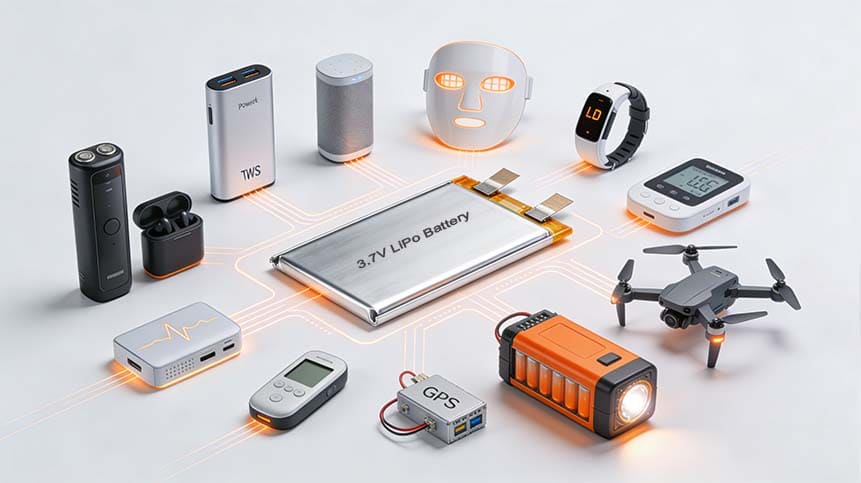
I’ve worked with hundreds of OEMs and product teams who choose Rechargeable 3.7V lithium-polymer (LiPo) pouch cells for their compact products. In this guide I explain, from a practical manufacturer/OEM perspective, where 3.7V LiPo cells shine, how to choose the right cell (capacity, C-rate, protection), safety & compliance considerations, and concrete examples across six major application groups: portable consumer electronics, beauty devices, medical and health monitoring, IoT / smart hardware, toys & models (including drones), and emergency/special equipment.
Quick technical primer: what “3.7V” means and core properties
A single LiPo cell is commonly specified by its nominal voltage (3.7V) — that’s the mid-range operating voltage. In practice a fully charged LiPo cell reads about 4.20V and the practical cut-off is commonly around ~3.0V per cell depending on design and protection. This is industry standard for many lithium chemistries and is essential when designing device power rails, BMS/PCM protection and charging circuits.
Key technical strengths of 3.7V LiPo pouch cells (why OEMs pick them):
-
High volumetric energy density for their form factor — good runtime in tight spaces.
-
Form factor flexibility: pouch construction lets us make flat, thin or oddly-shaped cells that conform to device geometry (critical for wearables and slim beauty devices).
-
Customizable capacity ranges (hundreds of mAh to several thousand mAh) and discharge capabilities (C-rate) to suit everything from sensors to backup power.
How I select a 3.7V LiPo cell (design checklist for product teams)
When I recommend a cell for a project I run through a short checklist:
-
Voltage & system design — single 3.7V cell vs. multi-cell packs; regulator choices.
-
Capacity (mAh) — runtime requirements vs. size/weight constraints.
-
C-rate / discharge current — continuous and burst needs (e.g., for motors, RF tx, drone motors). Typical consumer LiPo C-rates vary — many small devices are fine at 1C–5C; RC/drone packs often require 10C–50C depending on power draw.
-
Protection & PCM — overcharge, overdischarge, short-circuit protection required for shipping & safety.
-
Charge strategy — USB / USB-C PD / fast charge expectations; thermal constraints.
-
Mechanical integration — adhesives, thermal paths, waterproofing (IP ratings).
-
Regulatory & shipping tests — UN38.3, IEC 62133, RoHS, and for some markets UL or CE marks. (I always validate certificates before shipping.)
LiPo Battery Application section
Below I treat each group with practical detail, typical battery selections, and real-world examples.
1. Lithium LiPo Battery for Portable Consumer Electronic Devices
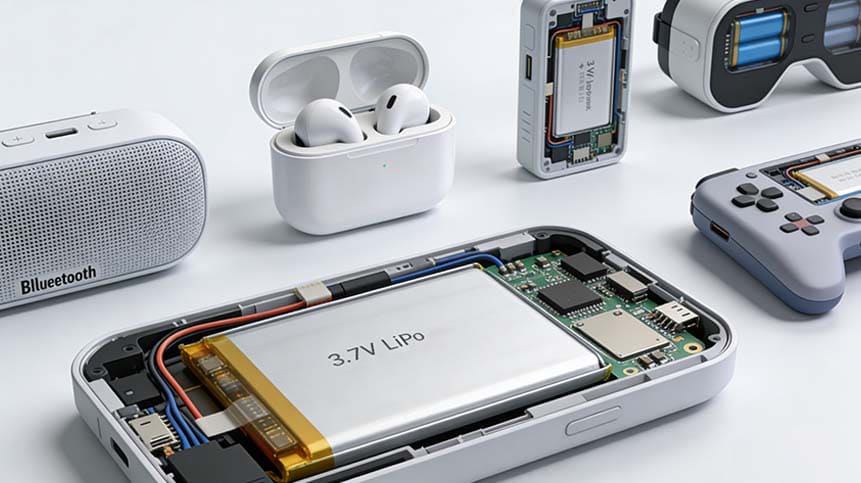
Use cases: large-capacity power banks, long-life Bluetooth accessories (TWS charging cases / earbud chargers), Bluetooth speakers, translation devices, handheld game consoles and accessories (e.g., Steam Deck style accessories), AR/VR battery packs.
Why LiPo: flat pouch cells fit into slim housings and provide higher pack energy density for a given volume vs. similarly sized cylindrical cells. For power banks, manufacturers either assemble multiple 3.7V cells in parallel / series with boost converters or use single high-capacity cells plus boost circuits.
Typical specs & selection tips
-
Capacities: 500mAh — 10,000mAh (device-dependent).
-
Voltage: single cell 3.7V (nominal); power bank packs often combine cells plus boost to 5V output.
-
Safety: power banks must pass thermal, short, and overcharge tests (and many notable recalls show the importance of validated safety systems). For example, a large recall of power banks highlighted thermal risk when safety architecture or cell quality is inadequate.
Practical example: modern TWS charging cases commonly use 300–1200mAh flat LiPo cells for several recharges of earbuds; many power bank designs use multiple 3.7V pouch cells internally.
2. Lithium LiPo Battery for Beauty Products (K-beauty & beyond)
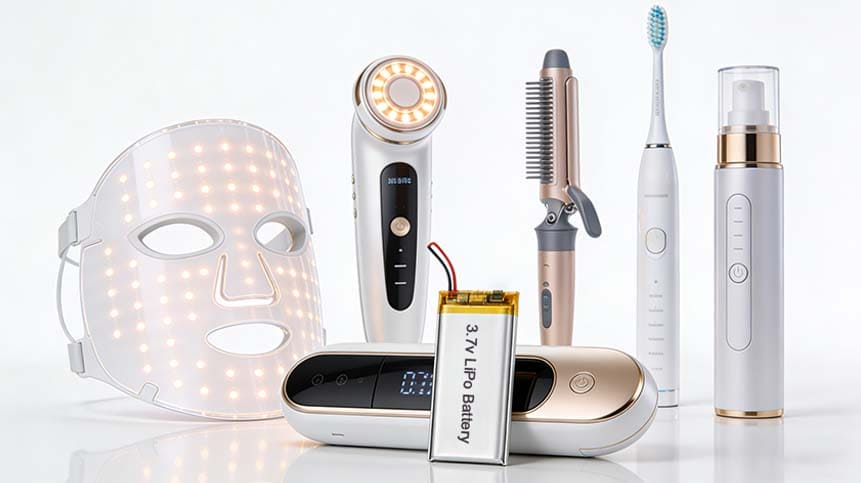
Use cases: ultrasonic facial devices, LED therapy masks, cordless styling tools (curling irons), sonic toothbrushes, handheld misting devices.
Why LiPo:
| slim profile, lightweight, and ability to be integrated into sleek consumer housings made LiPo the default for many premium beauty devices. Example: LG’s Pra.L devices use built-in Li-ion/LiPo packs at rated voltages around 3.7V and capacities that vary by model — manufacturers publish charging specs on product pages, confirming real world use of low-voltage lithium cells in premium beauty devices. | 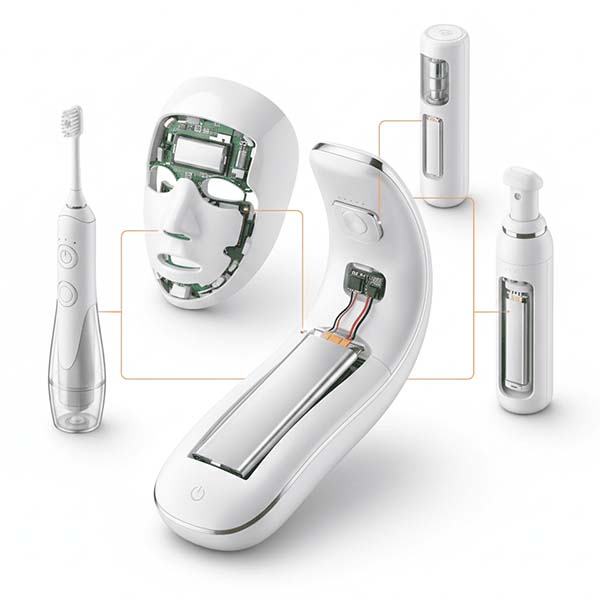 |
Typical specs & selection tips
-
Capacities: 300mAh — 3,000mAh depending on runtime and device power draw (e.g., a cordless curling iron needs higher capacity for longer run times). Supplier catalogs commonly list standard pouch sizes such as 800mAh, 1,200mAh and 3,000mAh for such devices.
-
IP and mechanical: many beauty devices require IPX7 or higher for safe washability; battery compartment sealing and charger design must match the device IP rating. (See LG device specs referencing IPX7 for washability in some models.)
3. Lithium LiPo Battery for Medical and Health Monitoring Equipment
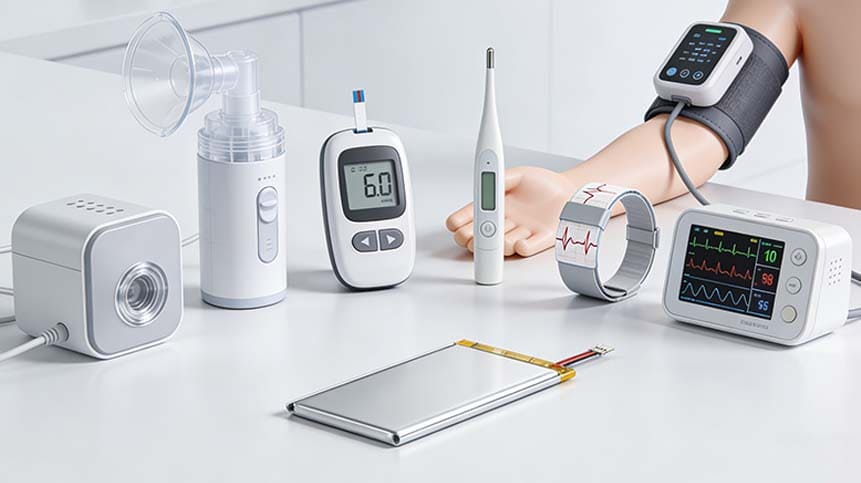
Use cases: portable nebulizers, blood glucose meters, electronic thermometers, smart blood pressure monitors, ECG patches and other wearable health devices.
Why LiPo: flexibility and low form factor make pouch cells well suited to devices that must be small and comfortable (wearables often use cells 4–6 mm thick and contoured to the housing). Medical or near-medical devices also often demand stable voltage, low self-discharge, and high reliability. Research and industry writing highlight LiPo pouch cells as a leading option for wearable medical electronics.
Typical specs & selection tips
-
Capacities: tiny sensors — 150–800mAh; more capable hand-held devices — 800–3000mAh.
-
Safety & certifications: IEC 60601 (device level), IEC 62133 (battery cell/pack), UN38.3 for transport. For any medical classification, ensure documented testing and traceability of cell batches.
-
Mechanical form: ultra-thin pouch cells (4–6 mm typical thickness for wearables) and flexible connectors for body conformal devices.
4. Lithium LiPo Battery for Internet of Things (IoT) and Smart Hardware
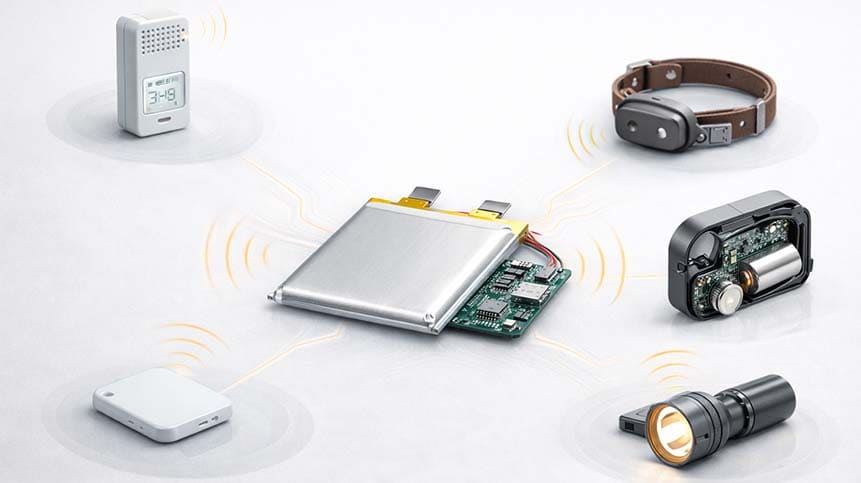
Use cases: wireless sensor nodes (temperature/humidity), smart locks, GPS trackers (pet collars, asset locators), connected gateways with sleep/wake cycles.
Why LiPo: small LiPo cells provide a good power/size trade-off for battery-powered IoT nodes. For devices with continuous GPS or cellular modem transmission, larger capacities or energy saving firmware are required because radios dominate energy use. Industry supplier guides for trackers note that rechargeable Li-ion / LiPo are common in many GPS pet trackers — while ultra-long-life trackers sometimes use primary chemistries (but rechargeable pouch cells are used where recharging is expected).
Typical specs & selection tips
-
Capacities: 300mAh — 5000mAh depending on expected on-time and duty cycle.
-
Power management: aggressive sleep modes, capacitive backup, and telemetry batching are common strategies to extend runtime.
-
Example: GPS trackers with continuous reporting will need larger cells or external battery packs; BLE, LoRaWAN, or low-power NB-IoT designs can use much smaller cells.
5. Lithium LiPo Battery for Electric Toys and Models (drones, RC)
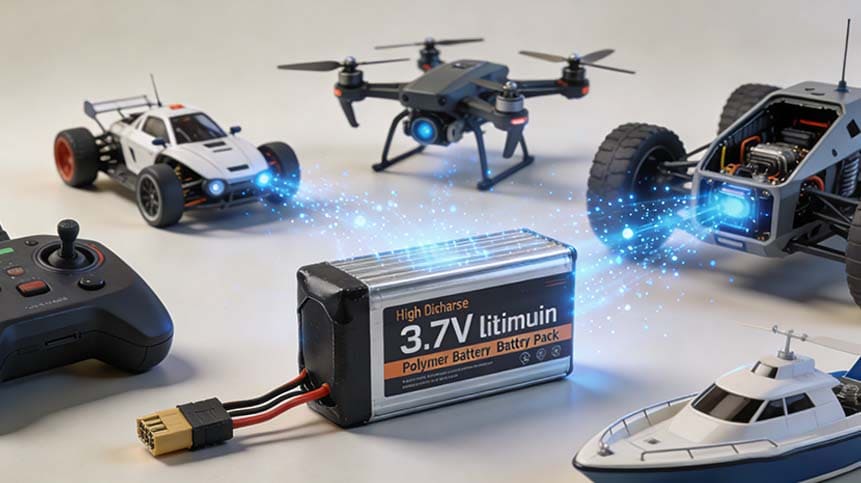
Use cases: small aerial photography drones, RC cars/boats, backup power for UAV systems.
Why LiPo: high discharge (burst) capability (C-rate) makes LiPo cells the standard in hobby and many professional small UAV systems. They deliver the high peak current motors need and better power-to-weight than legacy NiMH cells. Typical continuous discharge ratings for hobby LiPo packs range widely (5C, 10C, 20C and higher) — specify C-rate to match motor amp draw.
Typical specs & selection tips
-
C-rate: choose a pack whose continuous discharge rating comfortably exceeds the expected motor current draw; a 5–10C pack is common for small models; high-performance models often use 20–50C packs.
-
Capacity: depending on weight/flight time tradeoffs (typical micro drone packs 300–1500mAh; larger camera drones much higher).
-
Safety: mechanical fixation, vibration damping, and robust connectors (and appropriate charger hardware) are crucial.
6. Lithium LiPo Battery for Emergency and Special Equipment
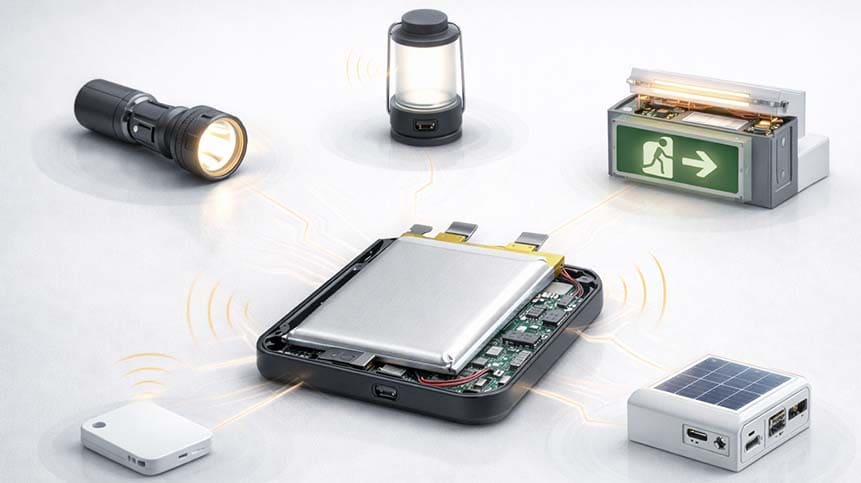
Use cases: portable lighting (high-intensity torches, camping lamps), small solar energy storage units (street lamp nodes), emergency signage, escape equipment.
Why LiPo: rapid recharge (when coupled with USB-C or higher power charging) and reasonably high energy per volume make LiPo useful in compact emergency tools. Many modern portable lights support USB-C fast charging, letting mid-capacity packs (1000–5000mAh) recharge in ~1–2 hours with appropriate PD chargers; however, actual charge time depends on cell design, internal PCM, and charger rating. See product examples and power bank designs for real-world charging times.
Typical specs & selection tips
-
Capacities: 1000mAh — 10,000mAh depending on lamp output and runtime targets.
-
Charge method: USB-C PD or multi-port fast charge is a common product differentiator for emergency gear.
-
Integration: consider thermal management and overcurrent protection for lanterns with high-output LEDs.
Data table: typical ranges & selection guidance (quick reference)
| Application group | Typical capacity (mAh) | Typical C-rate (continuous) | Typical thickness/form | Notes |
|---|---|---|---|---|
| TWS charging cases / small audio | 300 – 1200 | 1C – 3C | thin pouch | Optimized for many charge cycles |
| Power banks / portable chargers | 2000 – 10000+ | 1C – 3C | stacked pouch | Often multiple cells + boost converter |
| Beauty devices (ultrasonic / LED) | 500 – 3000 | 1C – 5C | thin, flat pouch | IP sealing often required; example LG models use 3.7V packs. |
| Medical wearables & monitors | 150 – 1200 | 0.5C – 2C | 4–6 mm thin pouch | Must pass IEC/medical device testing. |
| IoT nodes & trackers | 200 – 5000 | 0.2C – 2C | thin pouch | Energy management critical for GPS devices. |
| Drones / RC models | 300 – 5000+ | 10C – 50C+ | multi-cell pouch / pack | High burst current; choose C-rate to match motor current. |
| Emergency lights / solar nodes | 1000 – 10000 | 1C – 5C | stacked pouch | USB-C PD fast charge is common (charge time depends on charger/cell). |
Note: The values in the table represent typical industry ranges. For actual design, please confirm the sample, test data, and certification documents with the battery supplier.
Safety, compliance & reliability (what I insist on for every shipment)
Safety is non-negotiable. From my production experience, these are mandatory checks:
-
Cell level: verify IEC 62133 test reports, UN38.3 transport tests, and supplier batch traceability.
-
Pack/protection: PCM/BMS with overcharge, overdischarge, short circuit and temperature protection.
-
Design for safety: mechanical restraints, thermal dissipation, fire retardant materials where applicable.
-
Quality audits: supplier ISO9001, incoming sample testing (capacity, internal resistance, cycle life).
-
Field vigilance: track product returns and failures — recalls (e.g., a large consumer power bank recall in recent years) show the reputational and safety risks when corners are cut.
Charging strategy & thermal considerations
-
Charge profile: CC-CV profile to 4.2V per cell is common; some chemistries or designs may opt for lower final voltages to increase cycle life. Battery University and industry sources document standard Li-ion charge/discharge windows.
-
USB-C PD & fast charging: when using USB-C PD, you can shorten recharge times significantly for packs designed for higher input power — but validate cell thermal rise under fast charge test cycles. Real product tests (e.g., modern power banks) show faster full recharges using higher PD power inputs.
-
Thermal management: enclosed consumer devices must be tested for temperature rise during normal & abuse conditions.
FAQ (common buyer questions)
Q1: Why choose a 3.7V LiPo cell instead of a cylindrical cell?
A: For slim form factors and high volumetric energy density. Pouch cells let you optimize shape and packing for thin devices and wearables.
Q2: Are LiPo batteries safe for medical/wearable use?
A: Yes — when selected with appropriate chemistry, robust PCM/BMS, and tested to IEC and medical device standards. Always require supplier test reports (IEC 62133, UN38.3).
Q3: What is a safe charge/discharge window for a 3.7V LiPo cell?
A: Typical full charge ~4.20V, nominal 3.7V, and cutoff ~3.0V; use CC-CV charging profile and PCM protection.
Q4: How do I size the battery for a GPS tracker or IoT device?
A: Estimate average daily energy use (sleep+active duty), add margin for temp and aging, then pick a capacity to meet target days between charges. For continuous GPS, expect higher capacity needs or alternative power strategies.
Q5: What C-rate should I choose for a small drone?
A: Match the battery’s continuous current rating to motor peak draw with margin — many small models use 10C–30C packs; consult load test data.
Q6: Can LiPo be quickly charged with USB-C PD?
A: Yes, but battery and pack design must be validated for higher input power and thermal behavior; real charging times depend on charger and cell specs.
Q7: What certifications should I check before buying cells?
A: UN38.3 (transport), IEC 62133 (safety), supplier ISO and batch test reports. For medical products, device-level standards apply too.
Conversion & procurement tips (how I work with clients to convert concept → certified battery pack)
-
Requirement capture: run a short questionnaire (target runtime, dimensions, temperature, duty cycle, charges/day).
-
Cell selection & prototype: propose 2–3 cell candidates (with sample datasheets & test logs).
-
Pack design & PCM: integrate mechanical layout, connectors, and protection.
-
Pre-compliance testing: capacity, IR, thermal rise, short circuit proof, vibration & shock for wearables/drones.
-
Certification support: assist in compiling UN38.3, IEC 62133 dossier and custom labeling for shipping.
-
Scaling & traceability: batch coding, traceability documents, and QC sampling plans.
Closing
I hope this guide helps you understand where 3.7V LiPo pouch cells are the right choice and how to select them for real products. If you’re designing a device and want a free feasibility review (cell suggestion, estimated cost, mechanical footprint and certificate checklist), drop your product brief or the expected runtime/size targets at:
References (key sources I used)
-

 May.2026.09.17Meet A&S Power at KES 2026 in Seoul – Custom Lithium Battery SolutionsLearn More
 -
 May.2026.09.16How to Choose a Custom Lithium Battery Manufacturer in China: A Buyer's GuideLearn More
 -
 May.2026.09.15Can VHR-4N Connectors Work With 14 AWG Battery Wires?Learn More
 -
 May.2026.09.14Who Pays UL Battery Certification Maintenance Fees?Learn More
 -
 May.2026.09.11PTC vs PCM: Why Use Both in Lithium Battery Protection?Learn More